







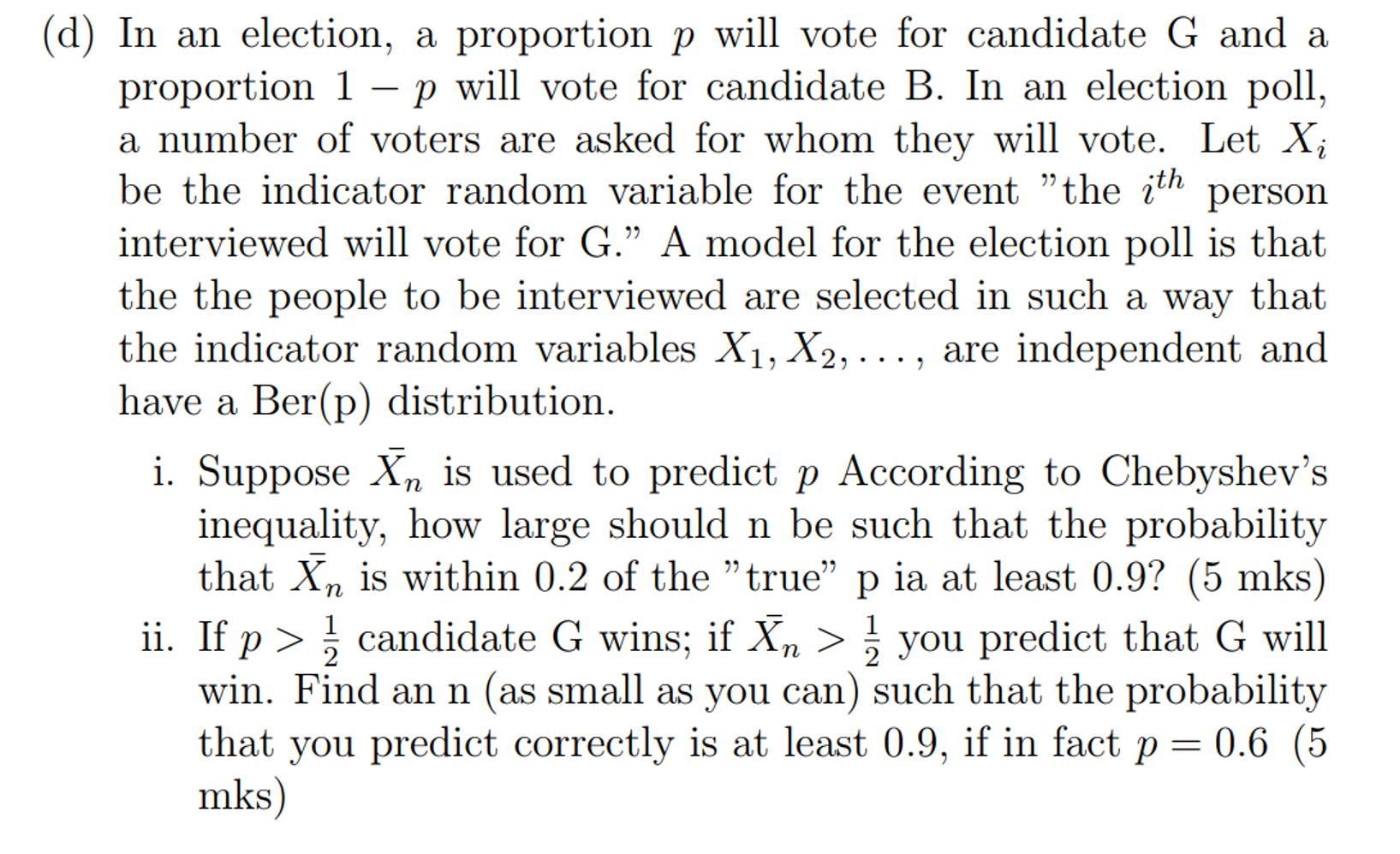
Question: ( d ) In an election, a proportion p will vote for candidate G and a proportion 1 - p will vote for candidate B
d In an election, a proportion will vote for candidate and a
proportion will vote for candidate B In an election poll,
a number of voters are asked for whom they will vote. Let
be the indicator random variable for the event "the person
interviewed will vote for G A model for the election poll is that
the the people to be interviewed are selected in such a way that
the indicator random variables dots, are independent and
have a Ber distribution.
i Suppose is used to predict According to Chebyshev's
inequality, how large should be such that the probability
that is within of the "true" p ia at least
ii If candidate wins; if you predict that will
win. Find an as small as you can such that the probability
that you predict correctly is at least if in fact
mks
Step by Step Solution
There are 3 Steps involved in it
1 Expert Approved Answer
Step: 1 Unlock

Question Has Been Solved by an Expert!
Get step-by-step solutions from verified subject matter experts
Step: 2 Unlock
Step: 3 Unlock
 Study Help