







Question: D Question 2 3 pts The double integral is built out of iterated (familiar) integrals and so we expect that many of the properties of
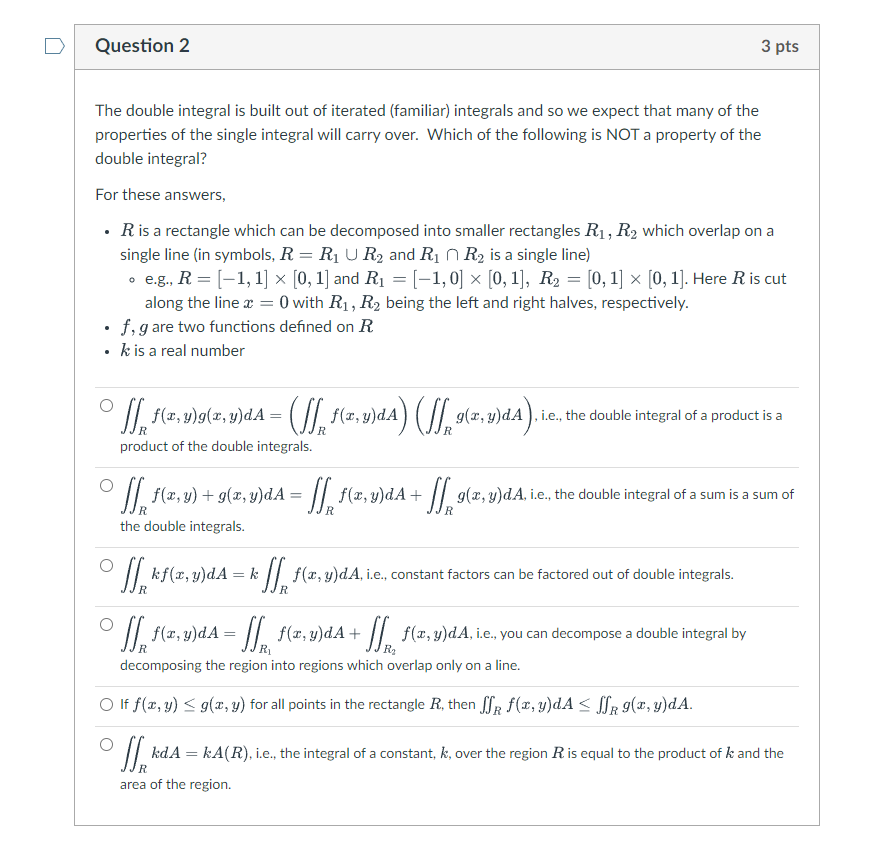
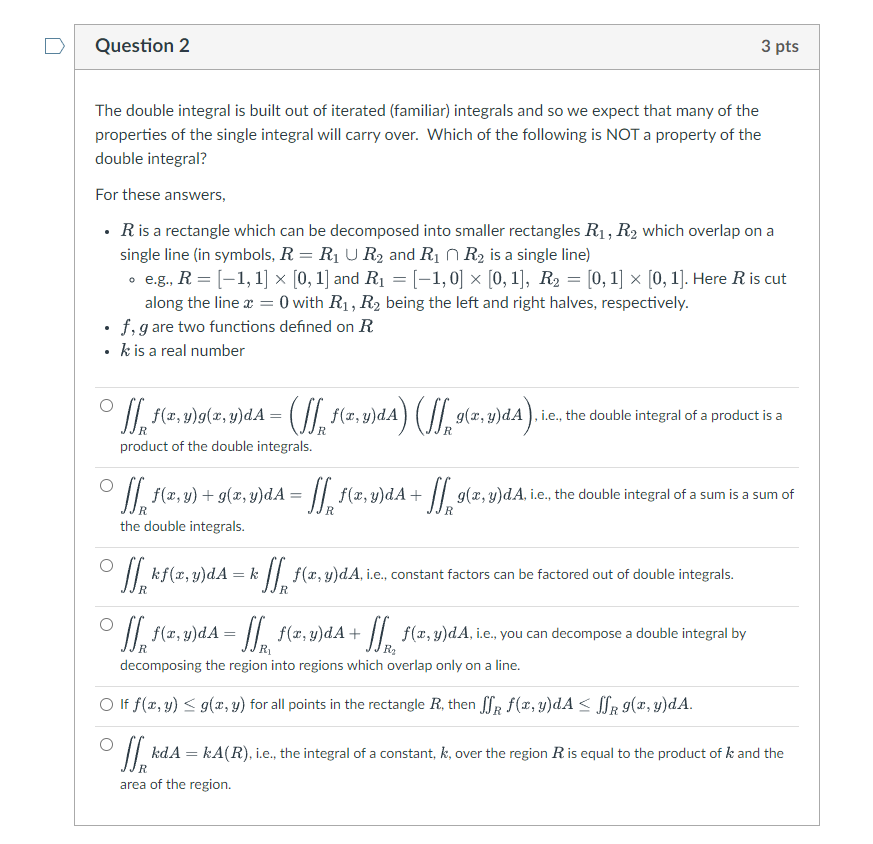
D Question 2 3 pts The double integral is built out of iterated (familiar) integrals and so we expect that many of the properties of the single integral will carry over. Which of the following is NOT a property of the double integral? For these answers, . R is a rectangle which can be decomposed into smaller rectangles R1, R2 which overlap on a single line (in symbols, R = R1 U R2 and R1 n R2 is a single line) . e.g., R = [-1, 1] x [0, 1] and R1 = [-1, 0] x [0, 1], R2 = [0, 1] x [0, 1]. Here R is cut along the line x = 0 with R1, R2 being the left and right halves, respectively. . f, g are two functions defined on R . k is a real number [, f(z,y)(z,4)dA - (J f(z,y)dA) ( (z,y)dA ),i.e., the double integral of a product is a product of the double integrals. [, f(z,y) + 9(z,4)dA = [/ f(z,y)dA + 9(z,u)dA ie., the double integral of a sum is a sum of the double integrals. [, kf(z,y)dA =k f(z,y) dA. ie, constant factors can be factored out of double integrals, [, f(z,u)da = flu.)da+ of(z,y)dA, ie, you can decompose a double integral by decomposing the region into regions which overlap only on a line. O If f(x, y)
Step by Step Solution
There are 3 Steps involved in it

Get step-by-step solutions from verified subject matter experts
 Study Help