







Question: (d) What is the probability that the third marble is red? (e) Given that there are & red marbles among the four drawn, where 0
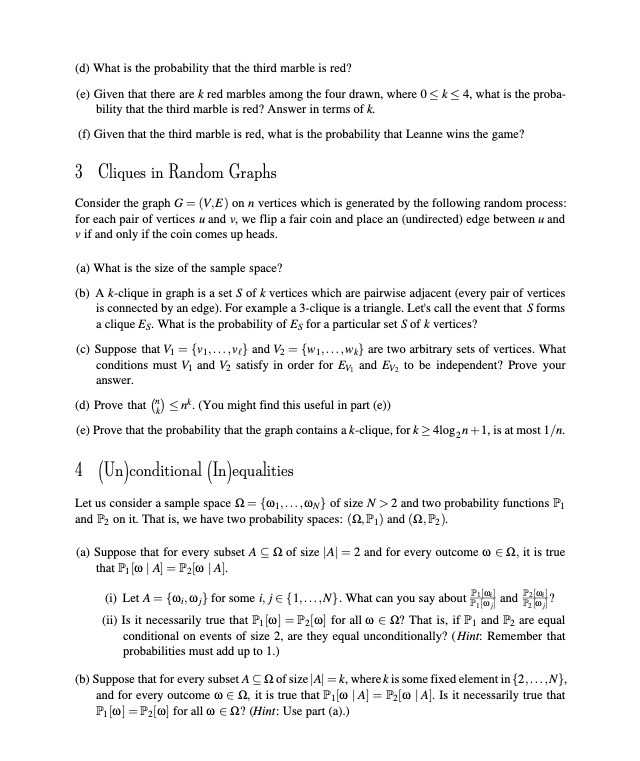
(d) What is the probability that the third marble is red? (e) Given that there are & red marbles among the four drawn, where 0 4log,# + 1, is at most 1. 4 (Un )conditional (In )equalities Let us consider a sample space $ = {@1,...,w} of size > > 2 and two probability functions Pi and P2 on it. That is, we have two probability spaces: (2. P, ) and ($2, P2). (a) Suppose that for every subset A C Q of size |A| = 2 and for every outcome @ 6 2, it is true that Pi [w | A] = P2[@ | 4]. (i) Let A = {o;, w/} for some i, je {1,. .., N). What can you say about poo, and ? (ii) Is it necessarily true that P, [w] = Pz[w] for all w c $2? That is, if P, and Py are equal conditional on events of size 2, are they equal unconditionally? (Hint: Remember that probabilities must add up to 1.) (b) Suppose that for every subset A C $2 of size |A| = k, where k is some fixed element in {2,..., N), and for every outcome @ 6 2, it is true that Pi [@ | A] = P2[w | A]. Is it necessarily true that Pi [w] = Pz[w] for all w E S? (Hint: Use part (a).)
Step by Step Solution
There are 3 Steps involved in it

Get step-by-step solutions from verified subject matter experts
 Study Help