



Question: D Your J-number J:= (klk E 1..8) Hence J1= 12 = 13 = J4 = 15 = J6 = J7 = J8 = D mnm
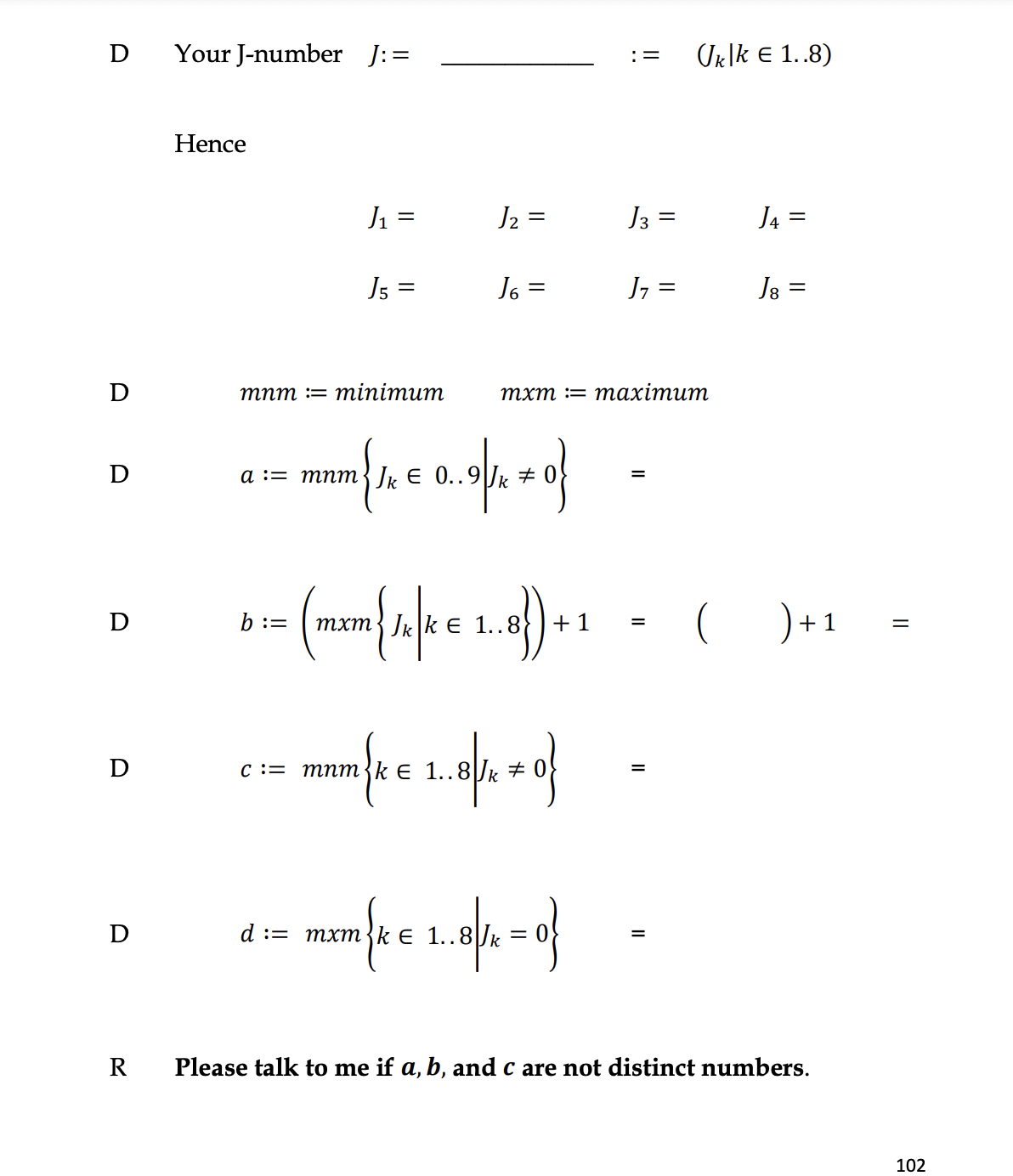
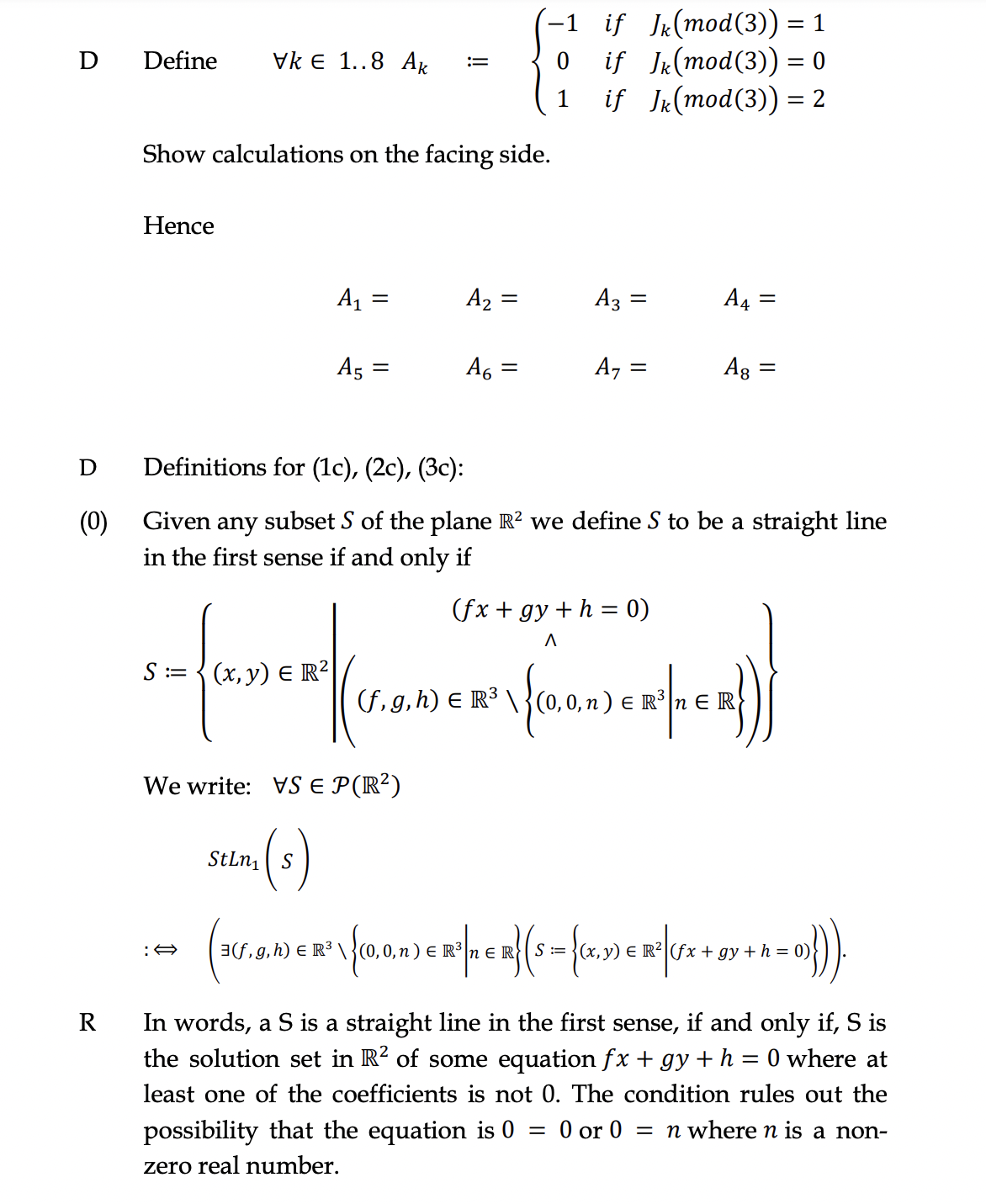
D Your J-number J:= (klk E 1..8) Hence J1= 12 = 13 = J4 = 15 = J6 = J7 = J8 = D mnm := minimum mxm := maximum D a := mnm Jk E 0.. 9 JK * 0 = D b := mxm JK ke 1. 8 +1 - ( ) +1 = D c := mnm ke 1.. 8 Jk * 0 D d := mxm ke 1.. 8 Jk = of R Please talk to me if a, b, and c are not distinct numbers. 102-1 if Jk(mod(3)) = 1 D Define 0 if Jk(mod(3)) = 0 if JK(mod(3)) = 2 Show calculations on the facing side. Hence A1 = A2 = A2 = A = As = A6 = A7 = Ag = Definitions for (1c), (2c), (3c): (0) Given any subset S of the plane R2 we define S to be a straight line in the first sense if and only if (fx + gy + h= 0) (f,g , h) ER3 \\ (0, 0, n ) ER n ER (za) d = SA :ILIMOM StLn s R In words, a S is a straight line in the first sense, if and only if, S is the solution set in R2 of some equation fx + gy + h = 0 where at least one of the coefficients is not 0. The condition rules out the possibility that the equation is 0 = 0 or 0 = n where n is a non- zero real number
Step by Step Solution
There are 3 Steps involved in it

Get step-by-step solutions from verified subject matter experts