







Question: D1 = X1,1 - X2,1 , . . . ; Dn = Xin - X2,n and correspondingly the realized differences d1 = 1,1 - 12,1
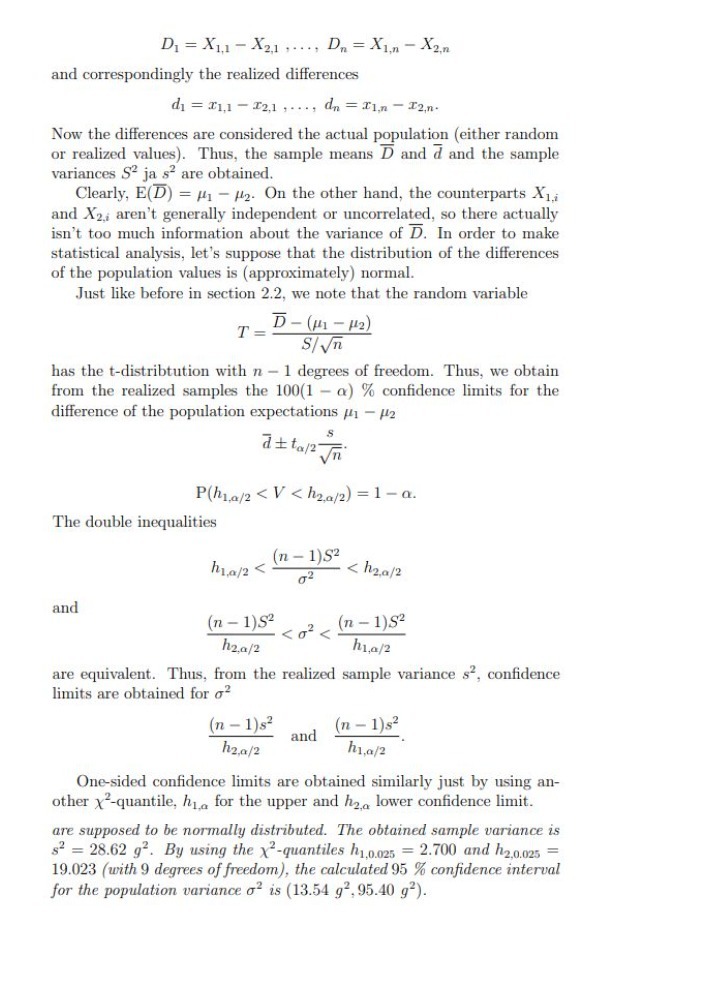
D1 = X1,1 - X2,1 , . . . ; Dn = Xin - X2,n and correspondingly the realized differences d1 = 1,1 - 12,1 , ..., dn = Il,n - 12,n- Now the differences are considered the actual population (either random or realized values). Thus, the sample means D and d and the sample variances $2 ja s are obtained. Clearly, E(D) = /1 - #2. On the other hand, the counterparts X1, and X2, aren't generally independent or uncorrelated, so there actually isn't too much information about the variance of D. In order to make statistical analysis, let's suppose that the distribution of the differences of the population values is (approximately) normal. Just like before in section 2.2, we note that the random variable T = D - (/1 - #2) S/ Vn has the t-distribution with n - 1 degrees of freedom. Thus, we obtain from the realized samples the 100(1 - a) % confidence limits for the difference of the population expectations #1 - #2 atta/2 n P(h1,a/2
Step by Step Solution
There are 3 Steps involved in it

Get step-by-step solutions from verified subject matter experts
 Study Help