







Question: d2x K dt m - 1 (d+ x) - 1 (d- x) (a) Classify this ODE and explain why there is little hope of
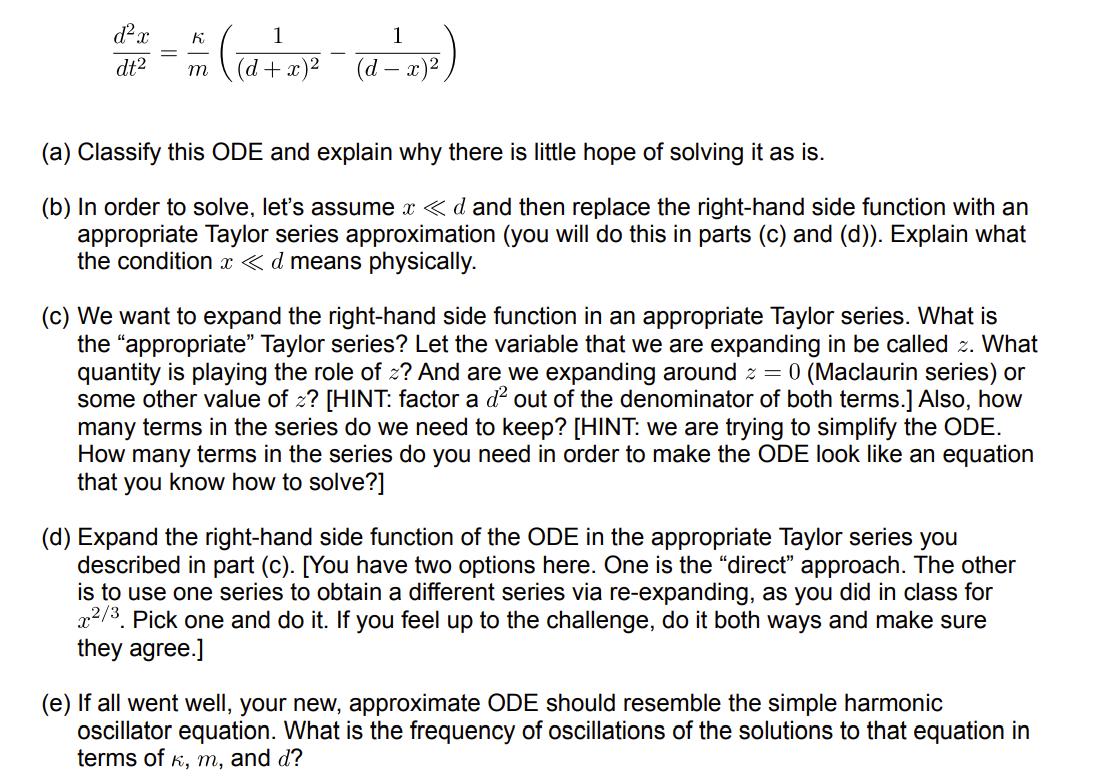
d2x K dt m - 1 (d+ x) - 1 (d- x) (a) Classify this ODE and explain why there is little hope of solving it as is. (b) In order to solve, let's assume x < d and then replace the right-hand side function with an appropriate Taylor series approximation (you will do this in parts (c) and (d)). Explain what the condition x < d means physically. (c) We want to expand the right-hand side function in an appropriate Taylor series. What is the "appropriate" Taylor series? Let the variable that we are expanding in be called z. What quantity is playing the role of z? And are we expanding around z = 0 (Maclaurin series) or some other value of z? [HINT: factor a out of the denominator of both terms.] Also, how many terms in the series do we need to keep? [HINT: we are trying to simplify the ODE. How many terms in the series do you need in order to make the ODE look like an equation that you know how to solve?] (d) Expand the right-hand side function of the ODE in the appropriate Taylor series you described in part (c). [You have two options here. One is the "direct" approach. The other is to use one series to obtain a different series via re-expanding, as you did in class for x/3. Pick one and do it. If you feel up to the challenge, do it both ways and make sure they agree.] (e) If all went well, your new, approximate ODE should resemble the simple harmonic oscillator equation. What is the frequency of oscillations of the solutions to that equation in terms of k, m, and d?
Step by Step Solution
3.47 Rating (157 Votes )
There are 3 Steps involved in it
The given ordinary differential equation ODE is dxdt 777dx2 1dx2 This ODE is a firstorder nonlinear ... View full answer

Get step-by-step solutions from verified subject matter experts
 Study Help