Question: ? Damage Expense Topic: Violations of Internal Control Characters: Chris, New Distribution Supervisor at a large candy manufacturer Bob, Inventory Control Manager, Chris's immediate boss
 ?
?
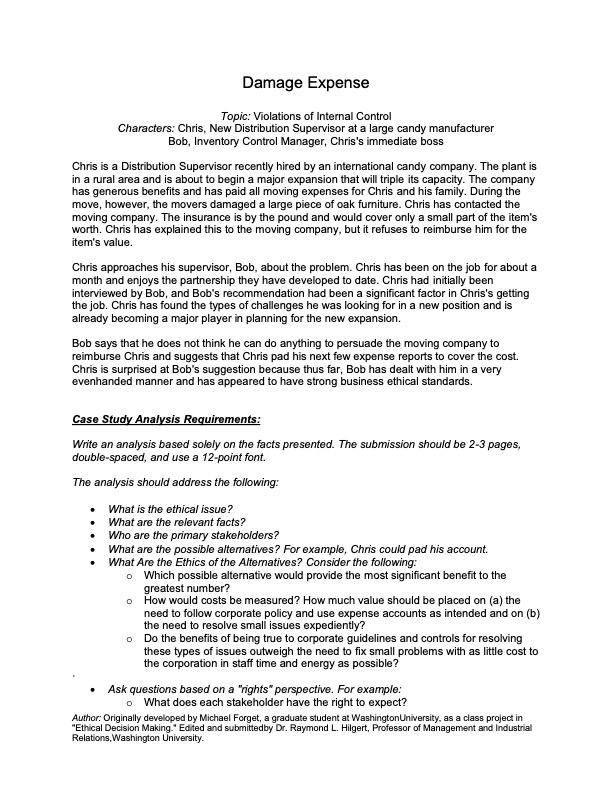
Damage Expense Topic: Violations of Internal Control Characters: Chris, New Distribution Supervisor at a large candy manufacturer Bob, Inventory Control Manager, Chris's immediate boss Chris is a Distribution Supervisor recently hired by an international candy company. The plant is in a rural area and is about to begin a major expansion that will triple its capacity. The company has generous benefits and has paid all moving expenses for Chris and his family. During the move, however, the movers damaged a large piece of oak furniture. Chris has contacted the moving company. The insurance is by the pound and would cover only a small part of the item's worth. Chris has explained this to the moving company, but it refuses to reimburse him for the item's value. Chris approaches his supervisor, Bob, about the problem. Chris has been on the job for about a month and enjoys the partnership they have developed to date. Chris had initially been interviewed by Bob, and Bob's recommendation had been a significant factor in Chris's getting the job. Chris has found the types of challenges he was looking for in a new position and is already becoming a major player in planning for the new expansion. Bob says that he does not think he can do anything to persuade the moving company to reimburse Chris and suggests that Chris pad his next few expense reports to cover the cost. Chris is surprised at Bob's suggestion because thus far, Bob has dealt with him in a very evenhanded manner and has appeared to have strong business ethical standards. Case Study Analysis Requirements: Write an analysis based solely on the facts presented. The submission should be 2-3 pages, double-spaced, and use a 12-point font. The analysis should address the following: What is the ethical issue? What are the relevant facts? Who are the primary stakeholders? What are the possible altematives? For example, Chris could pad his account. What Are the Ethics of the Alternatives? Consider the following: o Which possible alternative would provide the most significant benefit to the greatest number? o How would costs be measured? How much value should be placed on (a) the need to follow corporate policy and use expense accounts as intended and on (b) the need to resolve small issues expediently? o Do the benefits of being true to corporate guidelines and controls for resolving these types of issues outweigh the need to fix small problems with as little cost to the corporation in staff time and energy as possible? Ask questions based on a "rights" perspective. For example: o What does each stakeholder have the right to expect? Author: Originally developed by Michael Forget, a graduate student at Washington University, as a class project in "Ethical Decision Making." Edited and submitted by Dr. Raymond L. Hilgert, Professor of Management and Industrial Relations, Washington University









 Study Help