







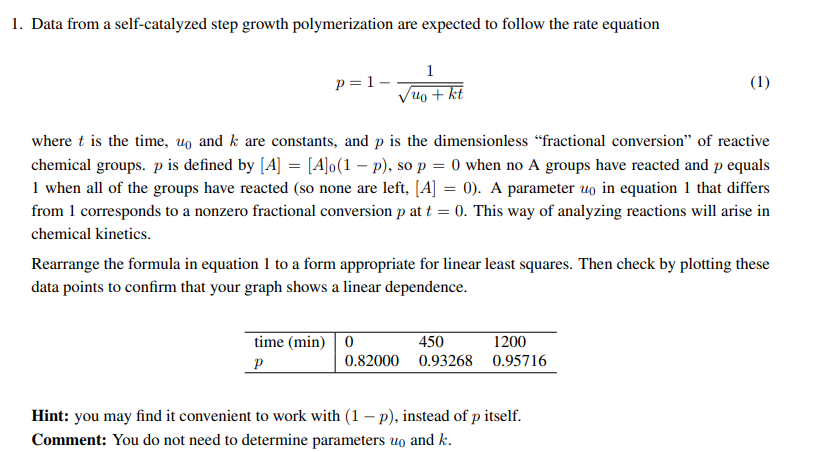
Question: Data from a self - catalyzed step growth polymerization are expected to follow the rate equation p = 1 - 1 u 0 + k
Data from a selfcatalyzed step growth polymerization are expected to follow the rate equation
where is the time, and are constants, and is the dimensionless "fractional conversion" of reactive
chemical groups. is defined by so when no A groups have reacted and equals
when all of the groups have reacted so none are left, A parameter in equation that differs
from corresponds to a nonzero fractional conversion at This way of analyzing reactions will arise in
chemical kinetics.
Rearrange the formula in equation to a form appropriate for linear least squares. Then check by plotting these
data points to confirm that your graph shows a linear dependence.
Hint: you may find it convenient to work with instead of itself.
Comment: You do not need to determine parameters and
Step by Step Solution
There are 3 Steps involved in it
1 Expert Approved Answer
Step: 1 Unlock

Question Has Been Solved by an Expert!
Get step-by-step solutions from verified subject matter experts
Step: 2 Unlock
Step: 3 Unlock
 Study Help