







Question: data link - https://drive.google.com/file/d/1pjhLAp-7d1_Kd7A2_AHCm74XrdodZGio/view?usp=sharing aim - In any outbreak of diseases, we need to study the trend based on gender who mostly delay taking or
data link - https://drive.google.com/file/d/1pjhLAp-7d1_Kd7A2_AHCm74XrdodZGio/view?usp=sharing
aim - In any outbreak of diseases, we need to study the trend based on gender who mostly delay taking or hesitancy to vaccines. The vaccine promoters need to understand how gender roles, relationships, norms, and gender inequality impact the access to and, demand for 3 vaccines. In many situations, women face limited mobility to reach vaccination sites. Besides, women and gender-based groups are often at risk of sexual harassment and other related forms of gender-based violence when seeking vaccines and other health services (Domek et al., 2018). Vaccine hesitancy could be due to failure to listening to women about the interrelated vulnerability or barriers. It was therefore hypothesized that a gender lens would help to respond to all the needs and understand the vaccine hesitancy reasons. It would also assist to identify target groups to provide mass education to eradicate vaccine hesitancy.
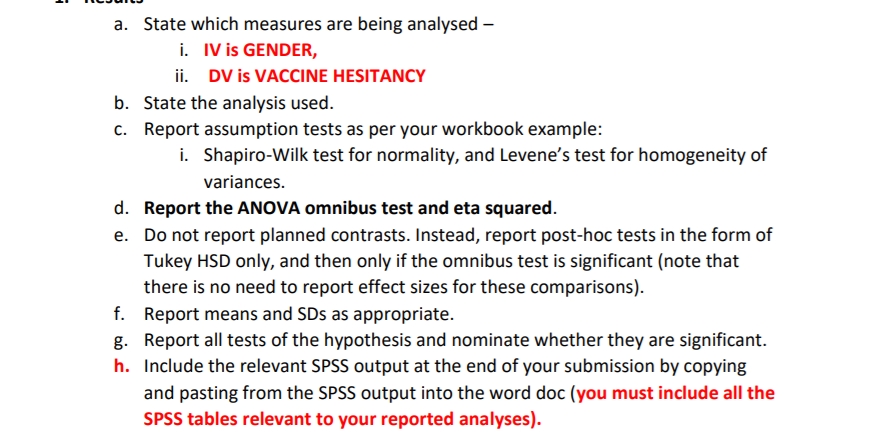
a. State which measures are being analysed - i. IV is GENDER, ii. DV is VACCINE HESITANCY
b. State the analysis used.
c. Report assumption tests as per your workbook example: i. Shapiro-Wilk test for normality, and Levene's test for homogeneity of variances.
d. Report the ANOVA omnibus test and eta squared.
e. report post-hoc tests in the form of Tukey HSD only, and then only if the omnibus test is significant (note that there is no need to report effect sizes for these comparisons).
f. Report means and SDs as appropriate. g. Report all tests of the hypothesis and nominate whether they are significant. h. Include the relevant SPSS output at the end of your submission by copying and pasting from the SPSS output into the word doc (you must include all the SPSS tables relevant to your reported analyses).
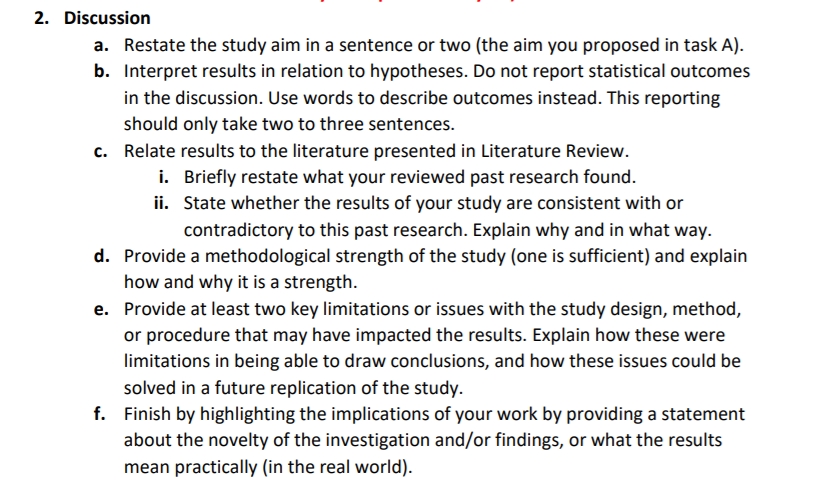
2. Discussion a. Restate the study aim in a sentence or two (the aim you proposed in task A).
b. Interpret results in relation to hypotheses. Do not report statistical outcomes in the discussion. Use words to describe outcomes instead. This reporting should only take two to three sentences.
c. Relate results to the literature presented in Literature Review. i. Briefly restate what your reviewed past research found. ii. State whether the results of your study are consistent with or contradictory to this past research. Explain why and in what way.
d. Provide a methodological strength of the study (one is sufficient) and explain how and why it is a strength.
e. Provide at least two key limitations or issues with the study design, method, or procedure that may have impacted the results. Explain how these were limitations in being able to draw conclusions, and how these issues could be solved in a future replication of the study.
f. Finish by highlighting the implications of your work by providing a statement about the novelty of the investigation and/or findings, or what the results mean practically (in the real world).
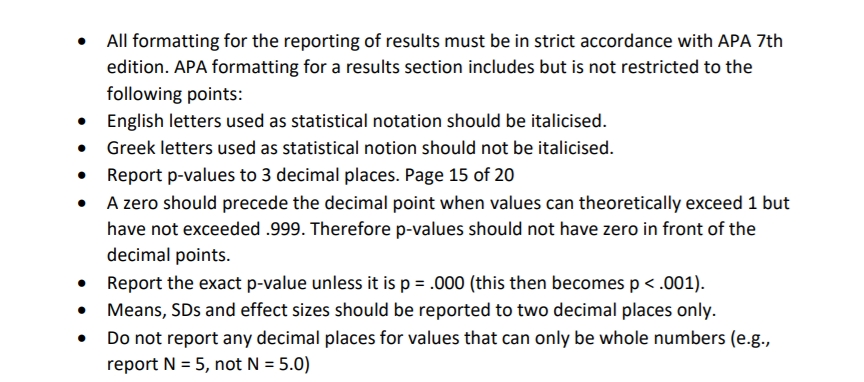
a. State which measures are being analysed - i. IV is GENDER, ii. DV is VACCINE HESITANCY b. State the analysis used. c. Report assumption tests as per your workbook example: i. Shapiro-Wilk test for normality, and Levene's test for homogeneity of variances. d. Report the ANOVA omnibus test and eta squared. e. Do not report planned contrasts. Instead, report post-hoc tests in the form of Tukey HSD only, and then only if the omnibus test is significant (note that there is no need to report effect sizes for these comparisons). f. Report means and SDs as appropriate. g. Report all tests of the hypothesis and nominate whether they are significant. h. Include the relevant SPSS output at the end of your submission by copying and pasting from the SPSS output into the word doc (you must include all the SPSS tables relevant to your reported analyses).2. Discussion a. Restate the study aim in a sentence or two {the aim you proposed in task A). b. Interpret results in relation to hypotheses. Do not report statistical outcomes in the discussion. Use words to describe outcomes instead. This reporting should only take two to three sentences. c. Relate results to the literature presented in Literature Review. i. Briey restate what your reviewed past research found. ll. State whether the results of your study are consistent with or contradictory to this past research. Explain why and in what way. d. Provide a methodological strength of the study (one is sufcient) and explain how and why it is a strength. e. Provide at least two key limitations or issues with the study design, method, or procedure that may have impacted the results. Explain how these were limitations in being able to draw conclusions, and how these issues could be solved in a future replication of the study. f. Finish by highlighting the implications ofyour work by providing a statement about the novelty of the investigation andfor ndings, or what the results mean practically [in the real world). All formatting for the reporting of results must be in strict accordance with APA ?th edition. APA formatting for a results section includes but is not restricted to the following points: English letters used as statistical notation should be italicised. Greek letters used as statistical notion should not be italicised. Report p-values to 3 decimal places. Page 15 of 20 A zero should precede the decimal point when values can theoretically exceed 1 but have not exceeded .999. Therefore p-values should not have zero in front of the decimal points. Report the exact p-value unless it is p = .000 (this then becomes p
Step by Step Solution
There are 3 Steps involved in it

Get step-by-step solutions from verified subject matter experts
 Study Help