







Question: Data represent a-c The accompanying data represent the pulse rates (beats per minute) of nine students enrolled in a statistics course Treat the nine students
Data represent a-c
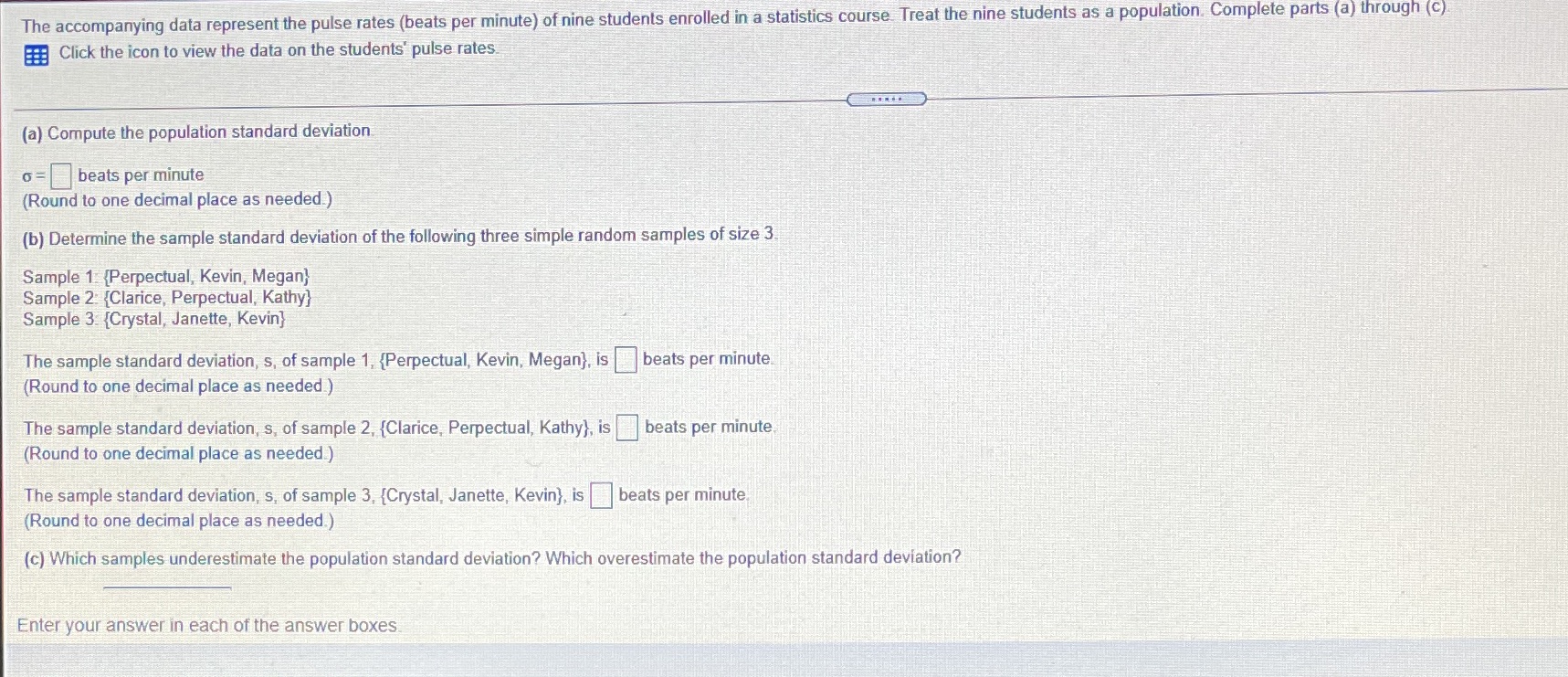
The accompanying data represent the pulse rates (beats per minute) of nine students enrolled in a statistics course Treat the nine students as a population. Complete parts (a) through (c) Click the icon to view the data on the students' pulse rates. (a) Compute the population standard deviation o = beats per minute (Round to one decimal place as needed.) (b) Determine the sample standard deviation of the following three simple random samples of size 3. Sample 1 {Perpectual, Kevin, Megan} Sample 2: {Clarice, Perpectual, Kathy} Sample 3. {Crystal, Janette, Kevin} The sample standard deviation, s, of sample 1, {Perpectual, Kevin, Megan}, is beats per minute (Round to one decimal place as needed ) The sample standard deviation, s, of sample 2, {Clarice, Perpectual, Kathy), is beats per minute (Round to one decimal place as needed.) The sample standard deviation, s, of sample 3, {Crystal, Janette, Kevin}, is beats per minute (Round to one decimal place as needed.) (c) Which samples underestimate the population standard deviation? Which overestimate the population standard deviation? Enter your answer in each of the answer boxes
Step by Step Solution
There are 3 Steps involved in it

Get step-by-step solutions from verified subject matter experts
 Study Help