







Question: Data set X Y Instance 1 1 1 Instance 2 0 1 Instance 3 1 0 Instance 4 11 12 Instance 5 11 13 Instance
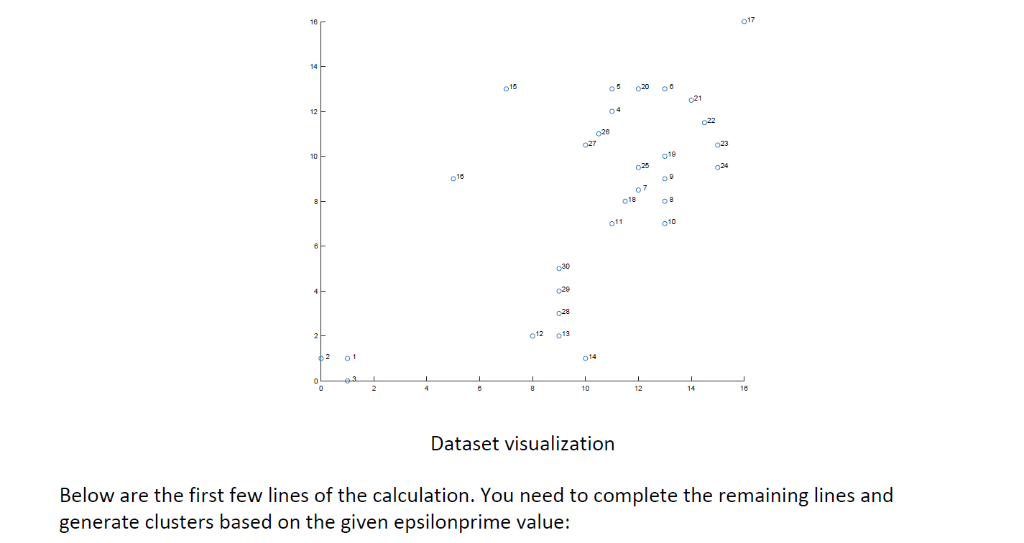
Data set
X Y Instance 1 1 1 Instance 2 0 1 Instance 3 1 0 Instance 4 11 12 Instance 5 11 13 Instance 6 13 13 Instance 7 12 8.5 Instance 8 13 8 Instance 9 13 9 Instance 10 13 7 Instance 11 11 7 Instance 12 8 2 Instance 13 9 2 Instance 14 10 1 Instance 15 7 13 Instance 16 5 9 Instance 17 16 16 Instance 18 11.5 8 Instance 19 13 10 Instance 20 12 13 Instance 21 14 12.5 Instance 22 14.5 11.5 Instance 23 15 10.5 Instance 24 15 9.5 Instance 25 12 9.5 Instance 26 10.5 11 Instance 27 10 10.5 Instance 28 9 3 Instance 29 9 4 Instance 30 9 5
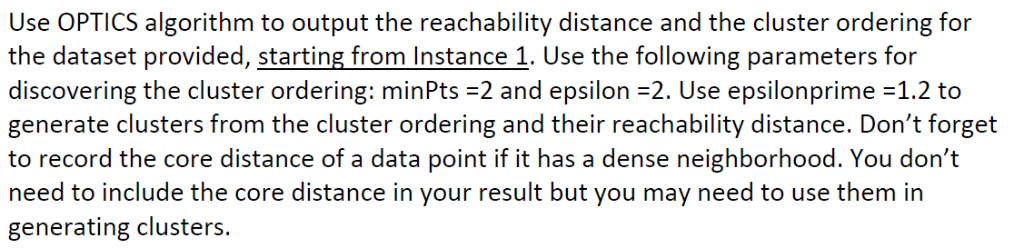
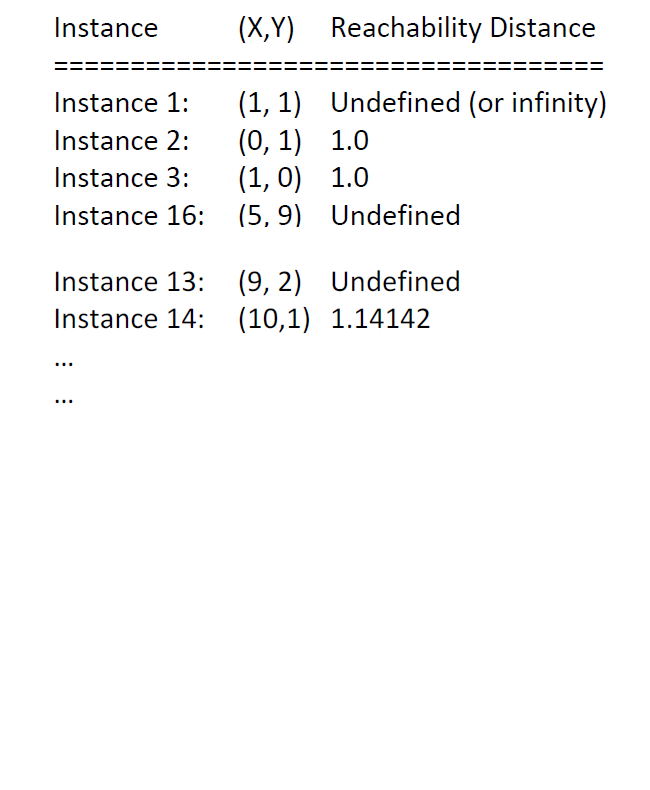
Use OPTICS algorithm to output the reachability distance and the cluster ordering for the dataset provided, starting from instance 1. Use the following parameters for discovering the cluster ordering: minPts 2 and epsilon 2. Use epsilonprime -1.2 to generate clusters from the cluster ordering and their reachability distance. Don't forget to record the core distance of a data point if it has a dense neighborhood. You don't need to include the core distance in your result but you may need to use them in generating clusters. Instance (X,Y) Reachability Distance Instance 1: (1,1) Undefined (or infinity) Instance 2: (0,1) 1.0 Instance 3: (1, 0) 1.0 Instance 16: (5, 9) Undefined Instance 13: (9, 2) Undefined Instance 14: (10,1) 1.14142 Use OPTICS algorithm to output the reachability distance and the cluster ordering for the dataset provided, starting from instance 1. Use the following parameters for discovering the cluster ordering: minPts 2 and epsilon 2. Use epsilonprime -1.2 to generate clusters from the cluster ordering and their reachability distance. Don't forget to record the core distance of a data point if it has a dense neighborhood. You don't need to include the core distance in your result but you may need to use them in generating clusters. Instance (X,Y) Reachability Distance Instance 1: (1,1) Undefined (or infinity) Instance 2: (0,1) 1.0 Instance 3: (1, 0) 1.0 Instance 16: (5, 9) Undefined Instance 13: (9, 2) Undefined Instance 14: (10,1) 1.14142
Step by Step Solution
There are 3 Steps involved in it

Get step-by-step solutions from verified subject matter experts
 Study Help