







Question: data structure and algorithms chapter - arrays and recursion 4. (a) State what the following pseudocode does. Then, modify the code to perform insertion at
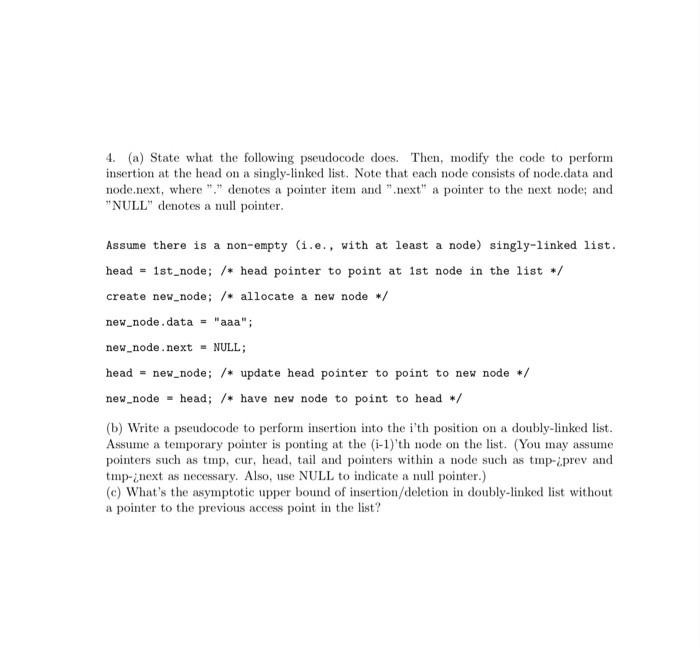
4. (a) State what the following pseudocode does. Then, modify the code to perform insertion at the head on a singly-linked list. Note that each node consists of node.data and node.next, where "." denotes a pointer item and ".next" a pointer to the next node; and "NULL" denotes a null pointer. Assume there is a non-empty (i.e., with at least a node) singly-linked list. head - 1st_node; /* head pointer to point at 1st node in the list */ create new_node; /* allocate a new node */ new_node.data = "aaa"; new_node.next = NULL; head - new_node; /* update head pointer to point to new node */ new_node = head; /* have new node to point to head */ (b) Write a pseudocode to perform insertion into the i'th position on a doubly-linked list. Assume a temporary pointer is ponting at the (i-1)'th node on the list. (You may assume pointers such as tmp, cur, head, tail and pointers within a node such as tmp-prev and tmp-inext as necessary. Also, use NULL to indicate a null pointer.) (c) What's the asymptotic upper bound of insertion/deletion in doubly-linked list without a pointer to the previous access point in the list
Step by Step Solution
There are 3 Steps involved in it

Get step-by-step solutions from verified subject matter experts
 Study Help