





Question: Data Structure in C++ Implement a multithreaded version of Quicksort, where the recursive calls will be replaced by other threads. Parallelization This code creates an
Data Structure in C++

Implement a multithreaded version of Quicksort, where the recursive calls will be replaced by other threads.

Parallelization

Data Structure in C++ Implement a multithreaded version of Quicksort, where the

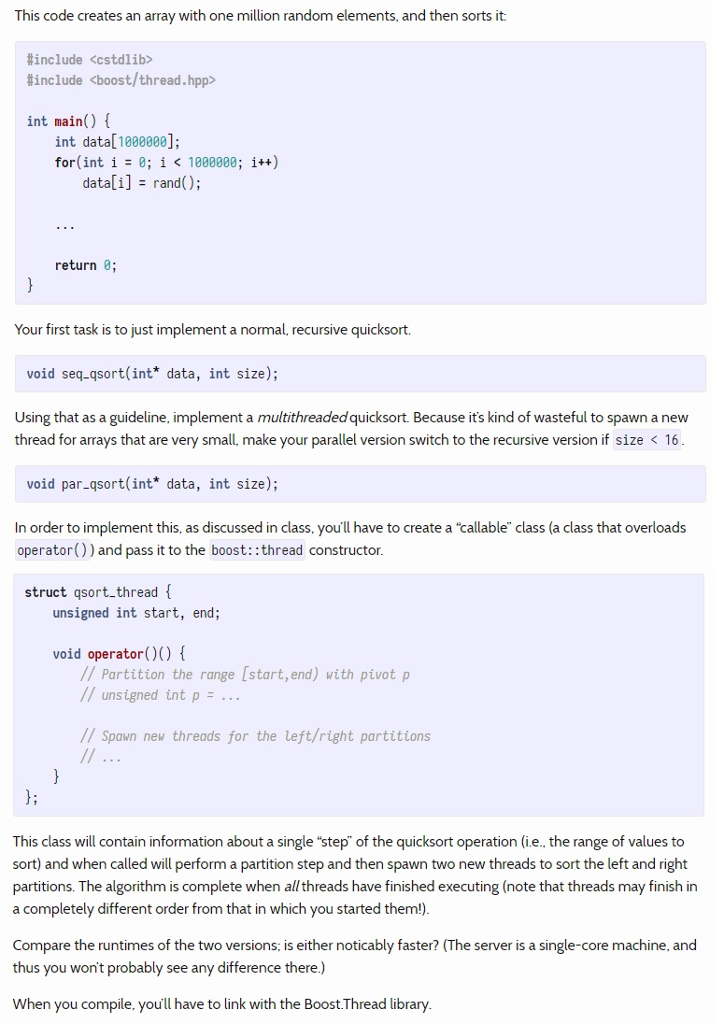
This code creates an array with one million random elements, and then sorts it #include int main() int data 1000000]; for (int i 0; i K 1000000; i++) data[i] rand() return 0 Your first task is to just implement a normal. recursive quicksort. void seq-qsort(int* data, int size Using that as a guideline, implement a multithreaded quicksort. Because its kind of wasteful to spawn a new thread for arrays that are very small. make your parallel version switch to the recursive version if size 16 void par-qsort(int* data, int size In order to implement this, as discussed in class, you'll have to create a "callable class (a class that overloads operator and pass it to the boost::thread constructor struct qsort-thread unsigned int start, end; void operator Partition the range lstart,end) with pivot p unsigned int p Spawn new threads for the left/right partitions This class will contain information about a single "step of the quicksort operation e.. the range of values to sort) and when called will perform a partition step and then spawn two new threads to sort the left and right partitions. The algorithm is complete when allthreads have finished executing (note that threads may finish in a completely different order from that in which you started them!) Compare the runtimes of the two versions: is either noticably faster? The server is a single-core machine, and thus you won't probably see any difference there.) When you compile. youll have to link with the Boost.Thread library

Step by Step Solution

There are 3 Steps involved in it

1 Expert Approved Answer
Step: 1 Unlock blur-text-image
Question Has Been Solved by an Expert!

Get step-by-step solutions from verified subject matter experts

Step: 2 Unlock
Step: 3 Unlock

Students Have Also Explored These Related Databases Questions!