







Question: Data Structure In many computer applications, it is often necessary to store a collection of key-value pairs. For example, consider a digital movie catalog. In
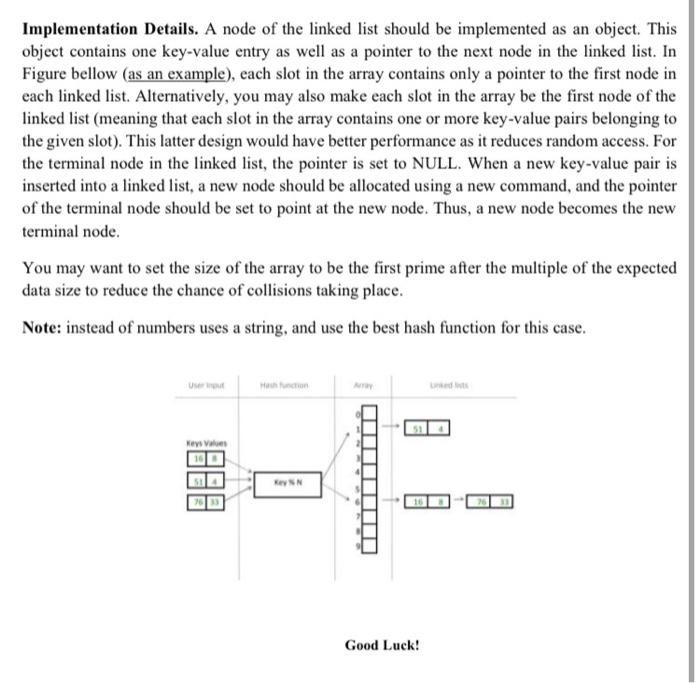
Implementation Details. A node of the linked list should be implemented as an object. This object contains one key-value entry as well as a pointer to the next node in the linked list. In Figure bellow (as an example), each slot in the array contains only a pointer to the first node in each linked list. Alternatively, you may also make each slot in the array be the first node of the linked list (meaning that each slot in the array contains one or more key-value pairs belonging to the given slot). This latter design would have better performance as it reduces random access. For the terminal node in the linked list, the pointer is set to NULL. When a new key-value pair is inserted into a linked list, a new node should be allocated using a new command, and the pointer of the terminal node should be set to point at the new node. Thus, a new node becomes the new terminal node. You may want to set the size of the array to be the first prime after the multiple of the expected data size to reduce the chance of collisions taking place. Note: instead of numbers uses a string, and use the best hash function for this case. News Ves KNN Good Luck
Step by Step Solution
There are 3 Steps involved in it

Get step-by-step solutions from verified subject matter experts
 Study Help