







Question: data structures and algorithm analysis For this machine problem you will write a program to add very large hexadecimal (unsigned) integers. For the allowable digits
data structures and algorithm analysis
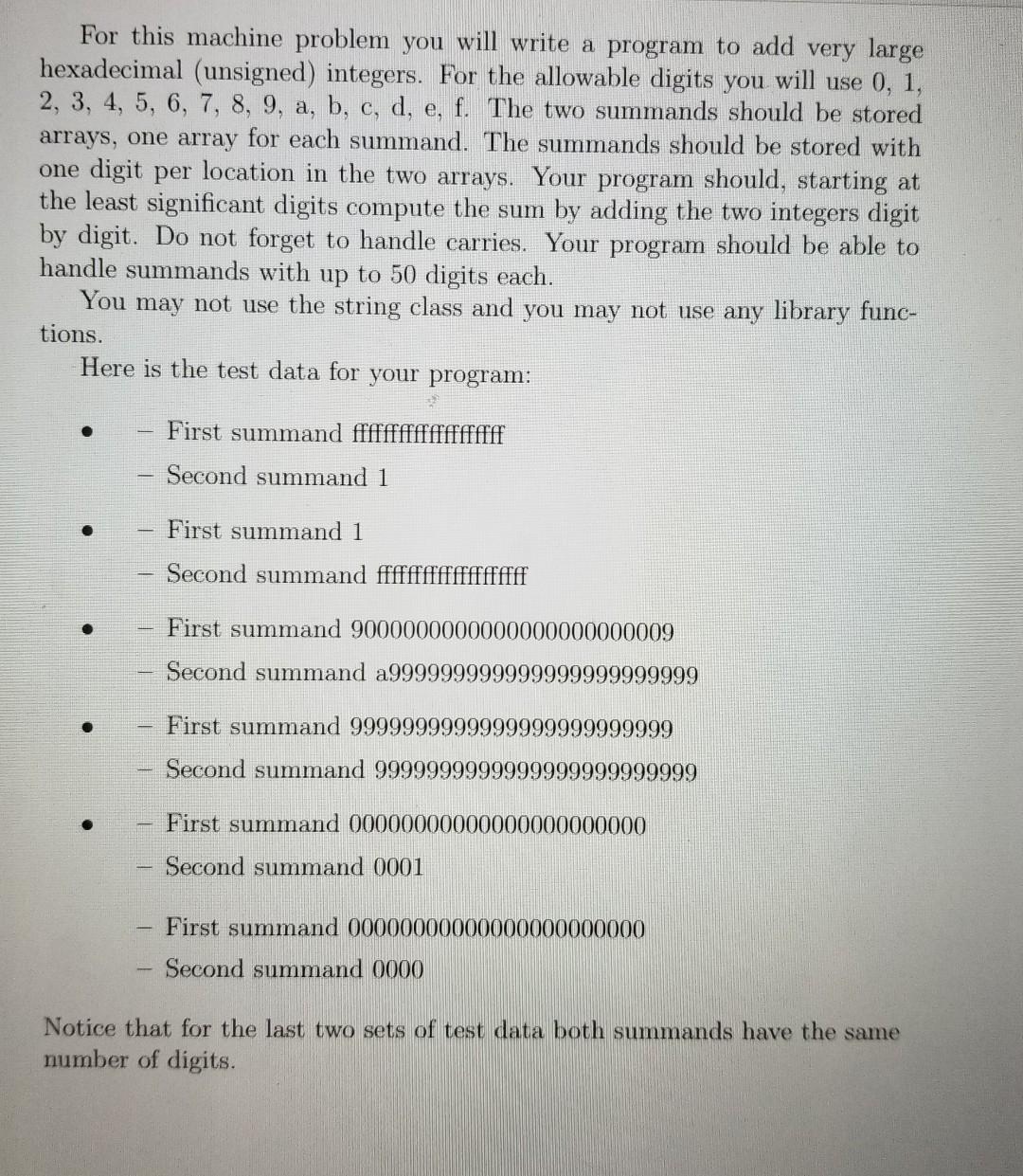
For this machine problem you will write a program to add very large hexadecimal (unsigned) integers. For the allowable digits you will use 0, 1, 2, 3, 4, 5, 6, 7, 8, 9, a, b, c, d, e, f. The two summands should be stored arrays, one array for each summand. The summands should be stored with one digit per location in the two arrays. Your program should, starting at the least significant digits compute the sum by adding the two integers digit by digit. Do not forget to handle carries. Your program should be able to handle summands with up to 50 digits each. You may not use the string class and you may not use any library func- tions. Here is the test data for your program: First summand ffffffffffffffffffff Second summand 1 First summand 1 Second summand ffffffffffffffffffff First summand 9000000000000000000000009 Second summand a999999999999999999999999 First summand 9999999999999999999999999 Second summand 9999999999999999999999999 First summand 00000000000000000000000 Second summand 0001 - First summand 00000000000000000000000 Second summand 0000 Notice that for the last two sets of test data both summands have the same number of digits
Step by Step Solution
There are 3 Steps involved in it

Get step-by-step solutions from verified subject matter experts
 Study Help