







Question: Data Structures and Algorithms 1 . In manufacturing, most factories operate as a queue using the FIFO approach. Orders are processed as they are received
Data Structures and Algorithms
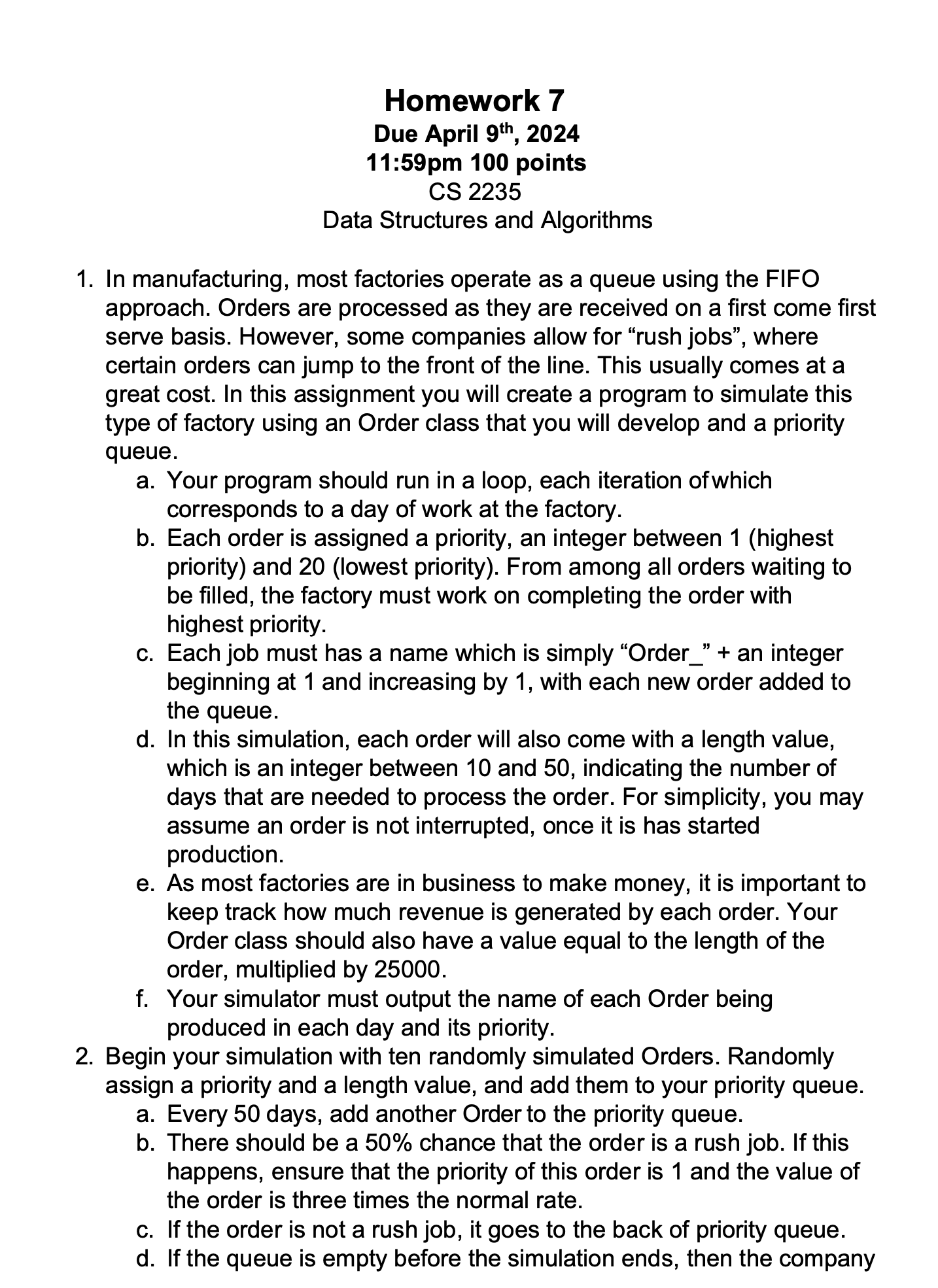
In manufacturing, most factories operate as a queue using the FIFO
approach. Orders are processed as they are received on a first come first
serve basis. However, some companies allow for "rush jobs", where
certain orders can jump to the front of the line. This usually comes at a
great cost. In this assignment you will create a program to simulate this
type of factory using an Order class that you will develop and a priority
queue.
a Your program should run in a loop, each iteration of which
corresponds to a day of work at the factory.
b Each order is assigned a priority, an integer between highest
priority and lowest priority From among all orders waiting to
be filled, the factory must work on completing the order with
highest priority.
c Each job must has a name which is simply "Order an integer
beginning at and increasing by with each new order added to
the queue.
d In this simulation, each order will also come with a length value,
which is an integer between and indicating the number of
days that are needed to process the order. For simplicity, you may
assume an order is not interrupted, once it is has started
production.
e As most factories are in business to make money, it is important to
keep track how much revenue is generated by each order. Your
Order class should also have a value equal to the length of the
order, multiplied by
f Your simulator must output the name of each Order being
produced in each day and its priority.
Begin your simulation with ten randomly simulated Orders. Randomly
assign a priority and a length value, and add them to your priority queue.
a Every days, add another Order to the priority queue.
b There should be a chance that the order is a rush job. If this
happens, ensure that the priority of this order is and the value of
the order is three times the normal rate.
c If the order is not a rush job, it goes to the back of priority queue.
d If the queue is empty before the simulation ends, then the company must heavily discount a project to keep the factory running. Add a
job of random length and priority with a value of per day.
The simulation ends after years days Print the total number of
Orders processed, number of rush jobs, number of discounted jobs and
amount of revenue earned during the simulation.
Demonstrate that your program works. Submit your source code and output
screenshots. Utilize good objectoriented programming and efficient
algorithms.
I suggest creating a class "Order" which has instance variables,
such as "name", "priority", "value" and "length", and any other necessary
methods. Then, instantiate a using the java.util.PriorityQueue class and
populate it with these Orders. Also, it is important to note that the
PriorityQueue package does not allow objects that are not comparable to be
put in a priority queue. When you create your Order class, make sure to
implement the Comparable interface from java.util and include the required
method to compare objects.
Scoring:
Use of object oriented programming.
Each order has name, priority, value and length associated with it
Orders are properly processed until completed, based on priority.
Program coded, so that new orders are added as orders are
processed.
Order number and priority printed for each time step.
Meaningful comments and proper header
Step by Step Solution
There are 3 Steps involved in it
1 Expert Approved Answer
Step: 1 Unlock

Question Has Been Solved by an Expert!
Get step-by-step solutions from verified subject matter experts
Step: 2 Unlock
Step: 3 Unlock
 Study Help