







Question: Data Structures in Python, modify the code so that the pivot is always chosen at a random location from the list (or sublist) to be
Data Structures in Python, modify the code so that the pivot is always chosen at a random location from the list (or sublist) to be sorted.
Description (please read all of it)
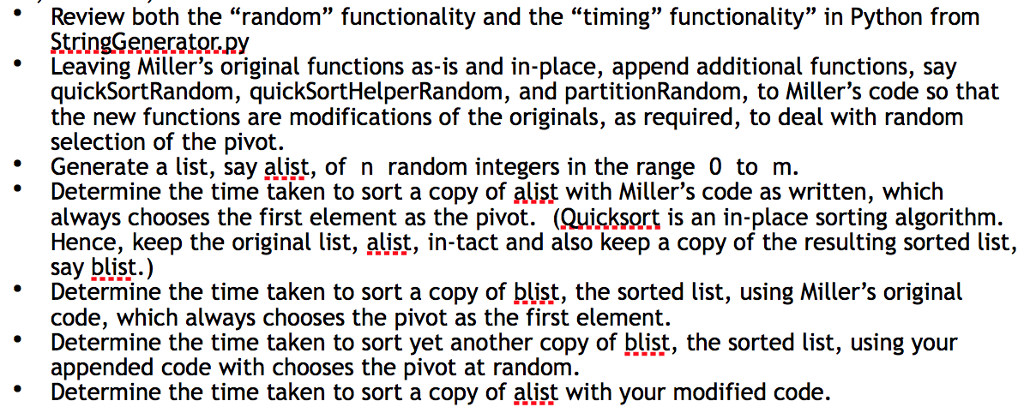
TASKS TO BE COMPLETED:
STRINGGENERATOR.PY
import random #stringGenerator.py
import string
import time
from itertools import permutations
def anagramSolution1(s1,s2):
alist = list(s2)
pos1 = 0
stillOK = True
while pos1
pos2 = 0
found = False
while pos2
if s1[pos1] == alist[pos2]:
found = True
else:
pos2 = pos2 + 1
if found:
alist[pos2] = None
else:
stillOK = False
pos1 = pos1 + 1
return stillOK
def anagramSolution2(s1,s2):
alist1 = list(s1)
alist2 = list(s2)
alist1.sort()
alist2.sort()
pos = 0
matches = True
while pos
if alist1[pos]==alist2[pos]:
pos = pos + 1
else:
matches = False
return matches
#anagramSolutions3 is not implemented in Miller notes
def anagramSolution3(s1,s2):
perms = [''.join(p) for p in permutations(s2)]
found=False
for s in perms:
if s1 == s:
found = True
break
return found
def anagramSolution4(s1,s2):
c1 = [0]*26
c2 = [0]*26
for i in range(len(s1)):
pos = ord(s1[i])-ord('a')
c1[pos] = c1[pos] + 1
for i in range(len(s2)):
pos = ord(s2[i])-ord('a')
c2[pos] = c2[pos] + 1
j = 0
stillOK = True
while j
if c1[j]==c2[j]:
j = j + 1
else:
stillOK = False
return stillOK
def buildMyString(n):
s=""
for i in range(n):
aletter=random.choice(string.letters)
s=s+aletter
return(s)
#-- the root (main) program starts here
string.letters = 'abcdefghijklmopqrstuvwxyz'
n=11
s1=buildMyString(n)
if random.uniform(0.0,1.0)<.5:>
r=random.randrange(0,n-1)
aletter = random.choice(string.letters)
s2=s1[0:r]+aletter+s1[r+1:n]
else:
s2=s1
print("s1 is: ",s1)
print("s2 is: ",s2)
print(" ...timing anagramSolution1 with n = ",n)
start=time.time()
print(anagramSolution1(s1,s2))
print(time.time()-start)
print(" ...timing anagramSolution2 with n = ",n)
start=time.time()
print(anagramSolution2(s1,s2))
print(time.time()-start)
print(" ...timing anagramSolution3 with n = ",n)
start=time.time()
print(anagramSolution3(s1,s2))
print(time.time()-start)
print(" ...timing anagramSolution4 with n = ",n)
start=time.time()
print(anagramSolution4(s1,s2))
print(time.time()-start)
!!!!!THE CODE THAT NEEDS TO BE MODIFIED!!!!!!
def quickSort(alist):
quickSortHelper(alist,0,len(alist)-1)
def quickSortHelper(alist,first,last):
if first
splitpoint = partition(alist,first,last)
quickSortHelper(alist,first,splitpoint-1)
quickSortHelper(alist,splitpoint+1,last)
def partition(alist,first,last):
pivotvalue = alist[first]
leftmark = first+1
rightmark = last
done = False
while not done:
while leftmark
alist[leftmark]
leftmark = leftmark + 1
while alist[rightmark] >= pivotvalue and \
rightmark >= leftmark:
rightmark = rightmark -1
if rightmark
done = True
else:
temp = alist[leftmark]
alist[leftmark] = alist[rightmark]
alist[rightmark] = temp
temp = alist[first]
alist[first] = alist[rightmark]
alist[rightmark] = temp
return rightmark
alist = [54,26,93,17,77,31,44,55,20]
quickSort(alist)
print(alist)
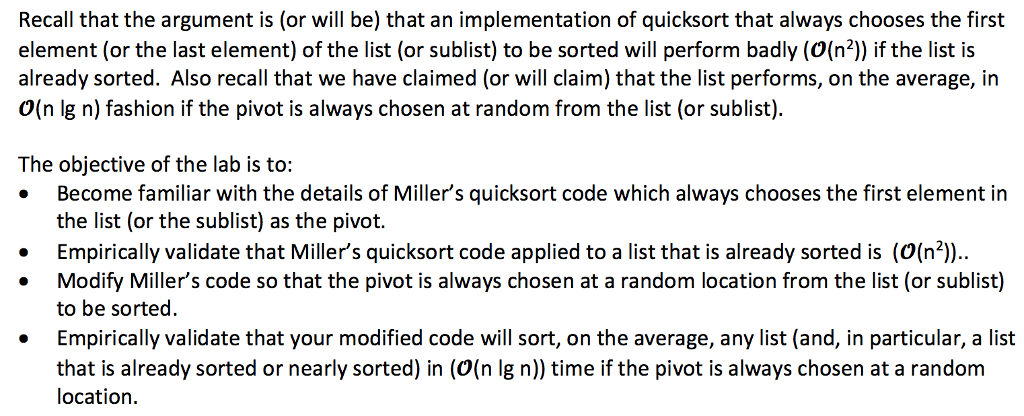
Recall that the argument is (or will be) that an implementation of quicksort that always chooses the first element (or the last element) of the list (or sublist) to be sorted will perform badly (O(n2)) if the list is already sorted. Also recall that we have claimed (or will claim) that the list performs, on the average, in O (n lg n) fashion if the pivot is always chosen at random from the list (or sublist). The objective of the lab is to: Become familiar with the details of Miller's quicksort code which always chooses the first element in the list (or the sublist) as the pivot. Empirically validate that Miller's quicksort code applied to a list that is already sorted is (O(n2).. Modify Miller's code so that the pivot is always chosen at a random location from the list (or sublist) to be sorted. Empirically validate that your modified code will sort, on the average, any list (and, in particular, a list that is already sorted or nearly sorted) in (O(n lg n)) time if the pivot is always chosen at a random locationStep by Step Solution
There are 3 Steps involved in it

Get step-by-step solutions from verified subject matter experts
 Study Help