







Question: data table 04 data table 05 D. Measuring Mass and Volume of Water with Beaker Materials 50-mL beaker (n=1) Procedure (The data has been provided
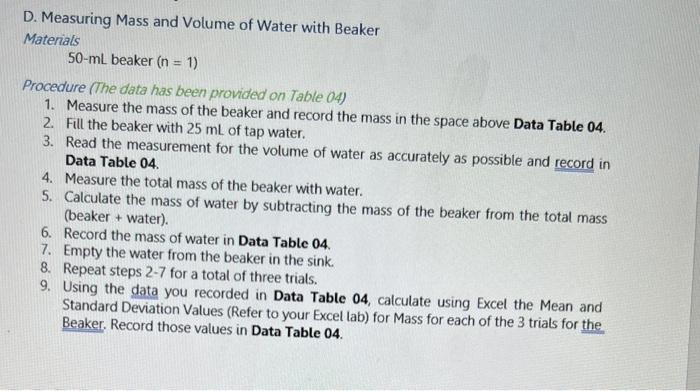
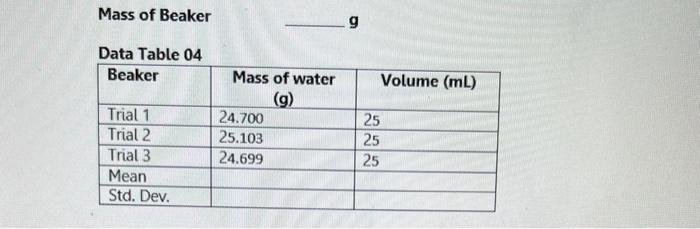
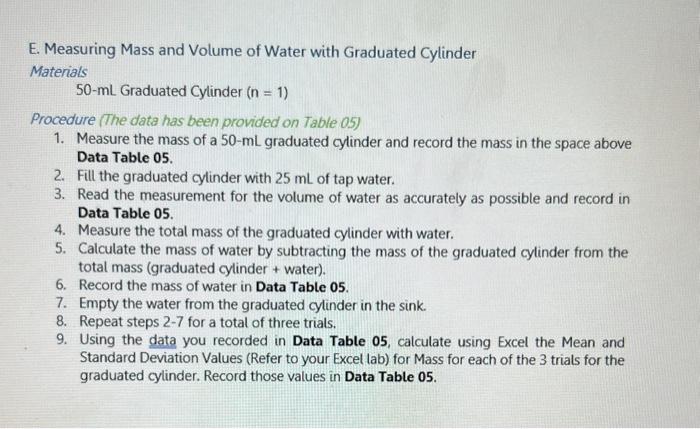
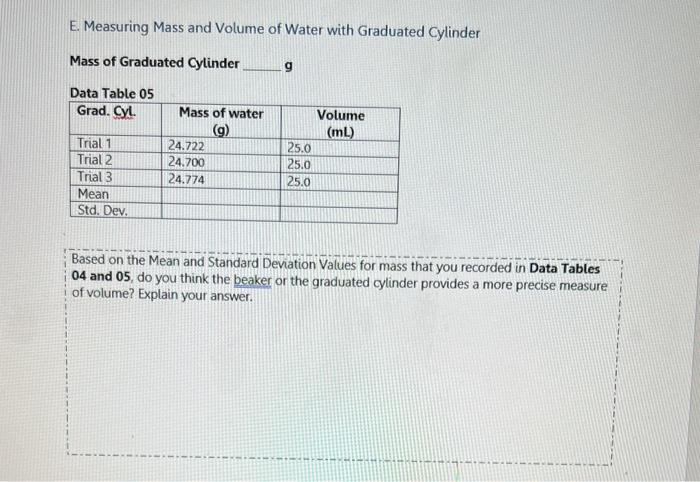
D. Measuring Mass and Volume of Water with Beaker Materials 50-mL beaker (n=1) Procedure (The data has been provided on Table 04) 1. Measure the mass of the beaker and record the mass in the space above Data Table 04. 2. Fill the beaker with 25mL of tap water. 3. Read the measurement for the volume of water as accurately as possible and record in Data Table 04. 4. Measure the total mass of the beaker with water. 5. Calculate the mass of water by subtracting the mass of the beaker from the total mass (beaker + water). 6. Record the mass of water in Data Table 04. 7. Empty the water from the beaker in the sink. 8. Repeat steps 27 for a total of three trials. 9. Using the data you recorded in Data Table 04, calculate using Excel the Mean and Standard Deviation Values (Refer to your Excel lab) for Mass for each of the 3 trials for the Beaker. Record those values in Data Table 04. Mass of Beaker Data Table 04 E. Measuring Mass and Volume of Water with Graduated Cylinder Materials 50-mL Graduated Cylinder (n=1) Procedure (The data has been provided on Table 05) 1. Measure the mass of a 50mL graduated cylinder and record the mass in the space above Data Table 05. 2. Fill the graduated cylinder with 25mL of tap water. 3. Read the measurement for the volume of water as accurately as possible and record in Data Table 05. 4. Measure the total mass of the graduated cylinder with water. 5. Calculate the mass of water by subtracting the mass of the graduated cylinder from the total mass (graduated cylinder + water). 6. Record the mass of water in Data Table 05. 7. Empty the water from the graduated cylinder in the sink. 8. Repeat steps 2-7 for a total of three trials. 9. Using the data you recorded in Data Table 05, calculate using Excel the Mean and Standard Deviation Values (Refer to your Excel lab) for Mass for each of the 3 trials for the graduated cylinder. Record those values in Data Table 05. E. Measuring Mass and Volume of Water with Graduated Cylinder Mass of Graduated Cylinder g Based on the Mean and Standard Deviation Values for mass that you recorded in Data Tables 04 and 05 , do you think the beaker or the graduated cylinder provides a more precise measure of volume? Explain your answer. D. Measuring Mass and Volume of Water with Beaker Materials 50-mL beaker (n=1) Procedure (The data has been provided on Table 04) 1. Measure the mass of the beaker and record the mass in the space above Data Table 04. 2. Fill the beaker with 25mL of tap water. 3. Read the measurement for the volume of water as accurately as possible and record in Data Table 04. 4. Measure the total mass of the beaker with water. 5. Calculate the mass of water by subtracting the mass of the beaker from the total mass (beaker + water). 6. Record the mass of water in Data Table 04. 7. Empty the water from the beaker in the sink. 8. Repeat steps 27 for a total of three trials. 9. Using the data you recorded in Data Table 04, calculate using Excel the Mean and Standard Deviation Values (Refer to your Excel lab) for Mass for each of the 3 trials for the Beaker. Record those values in Data Table 04. Mass of Beaker Data Table 04 E. Measuring Mass and Volume of Water with Graduated Cylinder Materials 50-mL Graduated Cylinder (n=1) Procedure (The data has been provided on Table 05) 1. Measure the mass of a 50mL graduated cylinder and record the mass in the space above Data Table 05. 2. Fill the graduated cylinder with 25mL of tap water. 3. Read the measurement for the volume of water as accurately as possible and record in Data Table 05. 4. Measure the total mass of the graduated cylinder with water. 5. Calculate the mass of water by subtracting the mass of the graduated cylinder from the total mass (graduated cylinder + water). 6. Record the mass of water in Data Table 05. 7. Empty the water from the graduated cylinder in the sink. 8. Repeat steps 2-7 for a total of three trials. 9. Using the data you recorded in Data Table 05, calculate using Excel the Mean and Standard Deviation Values (Refer to your Excel lab) for Mass for each of the 3 trials for the graduated cylinder. Record those values in Data Table 05. E. Measuring Mass and Volume of Water with Graduated Cylinder Mass of Graduated Cylinder g Based on the Mean and Standard Deviation Values for mass that you recorded in Data Tables 04 and 05 , do you think the beaker or the graduated cylinder provides a more precise measure of volume? Explain your
Step by Step Solution
There are 3 Steps involved in it

Get step-by-step solutions from verified subject matter experts
 Study Help