







Question: Data table (Click on the following icon [ in order to copy its contents into a spreadsheet.) Suppose that in April 2019 , Nike Inc.
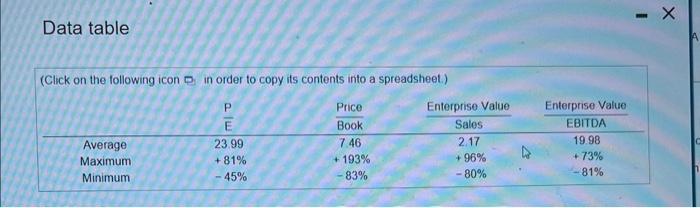
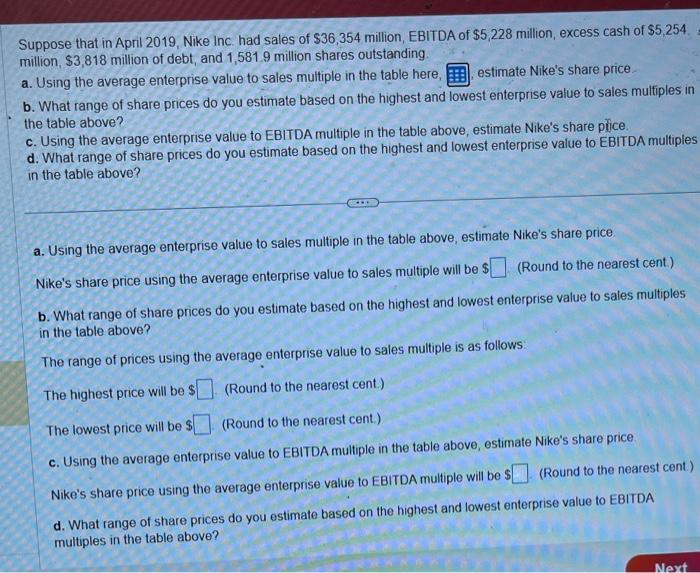
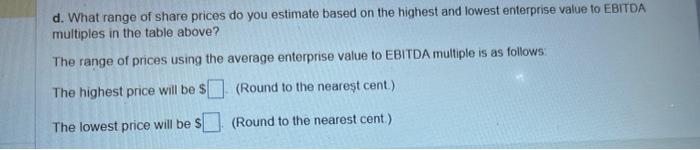
Data table (Click on the following icon [ in order to copy its contents into a spreadsheet.) Suppose that in April 2019 , Nike Inc. had sales of $36,354 million, EBITDA of $5,228 million, excess cash of $5,254 million, $3,818 million of debt, and 1,581,9 million shares outstanding. a. Using the average enterprise value to sales multiple in the table here, estimate Nike's share price. b. What range of share prices do you estimate based on the highest and lowest enterprise value to sales mulfiples in the table above? c. Using the average enterprise value to EBITDA multiple in the table above, estimate Nike's share plice. d. What range of share prices do you estimate based on the highest and lowest enterprise value to EBITDA multiples in the table above? a. Using the average enterprise value to sales multiple in the table above, estimate Nike's share price Nike's share price using the average enterprise value to sales multiple will be $ (Round to the nearest cent) b. What range of share prices do you estimate based on the highest and lowest enterprise value to sales multiples in the table above? The range of prices using the average enterprise value to sales multiple is as follows: The highest price will be $ (Round to the nearest cent) The lowest price will be $ (Round to the nearest cent) c. Using the average enterprise value to EBITDA multiple in the table above, estimate Nike's share price Nike's share price using the average enterprise value to EBITDA multiple will be $ (Round to the nearest cent) d. What range of share prices do you estimate based on the highest and lowest enterprise value to EBITDA multiples in the table above? d. What range of share prices do you estimate based on the highest and lowest enterprise value to EBITDA multiples in the table above? The range of prices using the average enterprise value to EBITDA multiple is as follows The highest price will be $ (Round to the nearet cent) The lowest price will be $ (Round to the nearest cent.)
Step by Step Solution
There are 3 Steps involved in it

Get step-by-step solutions from verified subject matter experts
 Study Help