







Question: Sm Bed Hospital is a small emergency-ted city located in a popular ski sat in North Michigan Mary Lart decides to regar Click the
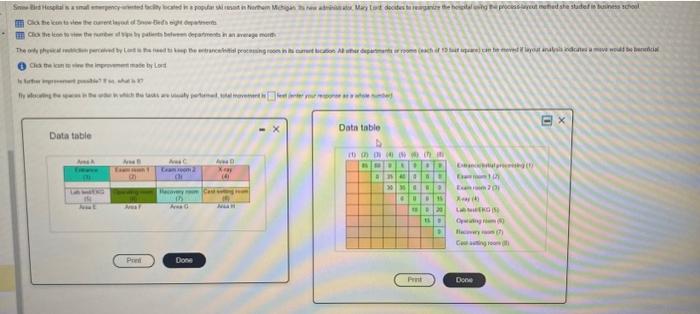
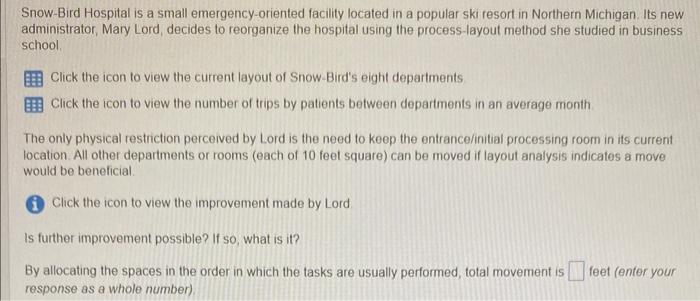
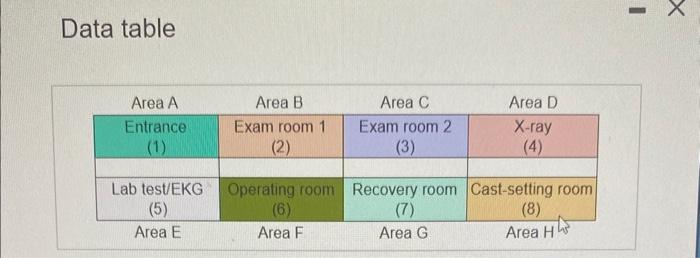
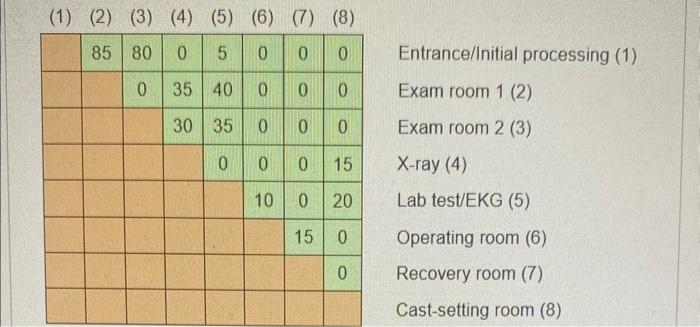
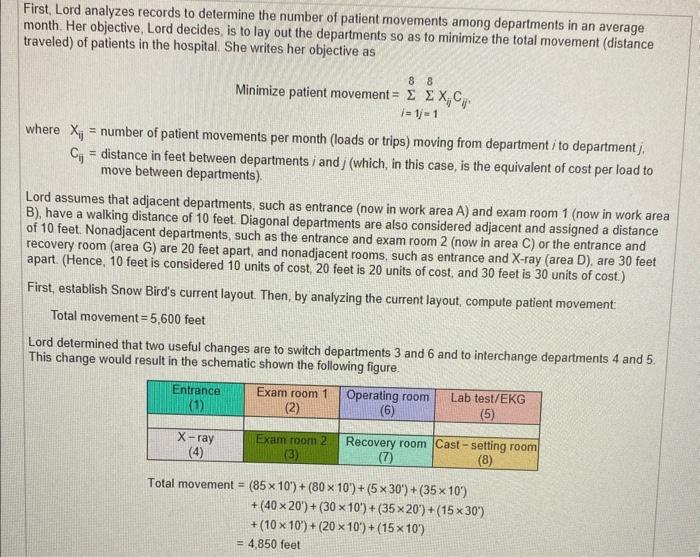
Sm Bed Hospital is a small emergency-ted city located in a popular ski sat in North Michigan Mary Lart decides to regar Click the icon to view the Dument layout of Snow Beds eight pers Click the leon to the number of pe by patients between departments in an average mod process-layout mehed she studief in business school The only physical i percaled by the need to keep the entrancelestial processing room in its cut tication Ab her departments or room (each of 10 at pane can be moved if layout analysis indicates a move would be budicial Ck the ican vine the improvement made by Lord Data table A AC A Xay Ch (4) Ara Cand Data table D 10 0 0 0 0 19 (7) 20 " ER- Opting Cing P Done Pr Done EX Snow-Bird Hospital is a small emergency-oriented facility located in a popular ski resort in Northern Michigan. Its new administrator, Mary Lord, decides to reorganize the hospital using the process-layout method she studied in business school. Click the icon to view the current layout of Snow-Bird's eight departments, BEB Click the icon to view the number of trips by patients between departments in an average month. The only physical restriction perceived by Lord is the need to keep the entrance/initial processing room in its current location. All other departments or rooms (each of 10 feet square) can be moved if layout analysis indicates a move would be beneficial. Click the icon to view the improvement made by Lord Is further improvement possible? If so, what is it? By allocating the spaces in the order in which the tasks are usually performed, total movement is response as a whole number) feet (enter your Data table Area A Entrance (1) Area B Exam room 1 (2) Area C Exam room 2 (3) Area D X-ray (4) Lab test/EKG (5) Area E Operating room (6) Recovery room (7) Cast-setting room (8) Area F Area G Area H (1) (2) (3) (4) (5) (6) (7) (8) 85 80 0 5 0 0 0 Entrance/Initial processing (1) 0 35 40 0 0 0 Exam room 1 (2) 30 35 000 Exam room 2 (3) 0 0 0 15 X-ray (4) 10 0 20 Lab test/EKG (5) 15 0 Operating room (6) 0 Recovery room (7) Cast-setting room (8) First, Lord analyzes records to determine the number of patient movements among departments in an average month. Her objective, Lord decides, is to lay out the departments so as to minimize the total movement (distance traveled) of patients in the hospital. She writes her objective as where Xij 8 8 Minimize patient movement = X,C. i=1j=1 = number of patient movements per month (loads or trips) moving from department i to department j. = C distance in feet between departments and j (which, in this case, is the equivalent of cost per load to move between departments). Lord assumes that adjacent departments, such as entrance (now in work area A) and exam room 1 (now in work area B), have a walking distance of 10 feet. Diagonal departments are also considered adjacent and assigned a distance of 10 feet. Nonadjacent departments, such as the entrance and exam room 2 (now in area C) or the entrance and recovery room (area G) are 20 feet apart, and nonadjacent rooms, such as entrance and X-ray (area D), are 30 feet apart. (Hence, 10 feet is considered 10 units of cost, 20 feet is 20 units of cost, and 30 feet is 30 units of cost.) First, establish Snow Bird's current layout. Then, by analyzing the current layout, compute patient movement: Total movement = 5,600 feet Lord determined that two useful changes are to switch departments 3 and 6 and to interchange departments 4 and 5. This change would result in the schematic shown the following figure. Entrance (1) Exam room 1 (2) X-ray (4) Exam room 2 (3) = Operating room Lab test/EKG (6) (5) Recovery room Cast-setting room (7) (8) Total movement (85 x 10') + (80 x 10)+(5x30')+(35 x 10') +(40x20')+(30x10')+(35x20)+(15x30') +(10x10)+(20 x 10') + (15 x 10')) = 4,850 feet
Step by Step Solution
There are 3 Steps involved in it
To determine if further improvement is possible lets examine the current movements and see if we can ... View full answer

Get step-by-step solutions from verified subject matter experts
 Study Help