







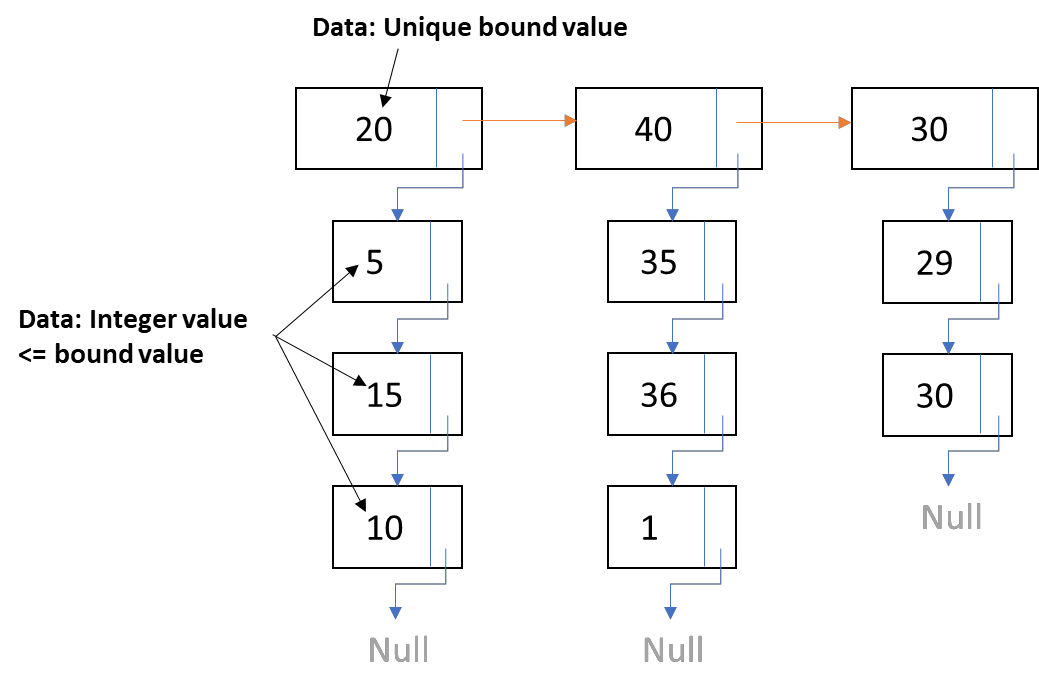
Question: Data: Unique bound value 1 . User can create unlimited bound - numbers lists. Each list must associate with a unique bound value ( i
Data: Unique bound value
User can create unlimited boundnumbers lists. Each list must associate with a unique bound
value ie two lists with same bound values are not allowed See
User can insert a new node in nested list. User inputs the bound value and then given two
options to insert the node in the front or in the middle of the nested list.
User can delete the front list from the nested list.
User can delete an item list from nested list specified by the user. User inputs the bound
value associated with the list to delete the item. If the list exists, then the user is prompted to
enter the index of the item to delete. If the list does not exist an appropriate message is shown.
User can merge two boundnumbers lists into a new list with maximum bound value from
both lists and without duplicate numbers. For example, if we have boundnumbers list
with and boundnumbers list with all integer numbers in both lists after
removing duplicates should be merged into a new boundnumbers list so that this merged list
will be bound value with
User must be able to display the bound values of stored lists.
User must be able to display the items numbers stored in a boundnumbers list specified by
the user.
The boundnumbers list has the following functional requirements:
Each node in the list stores an integer value that is entered by the user. The stored value is
the integer number that is less than or equal the bound value associated with the list.
There must be a way to insert an integer number in the list after specific node specified by the
user, provided that this number is less than or equal to the bound value associated with that
list. User inputs the bound value associated with the list to insert the number. If the list exists,
then the user is prompted to enter the integer number for that specific node in order to insert
the new number after it If the list does not exist an appropriate message is shown.
There must be a way to insert an integer number in the end of a list specified by the user,
provided that this number is less than or equal to the bound value associated with that list.
There must be a way to delete the last item in the list.
There must be a way to delete all items in the list except a particular item.
There must be a way to search the nested list for the list.
There must be a way to print the numbersin the listspecified by user in reverse order without
reversing it For example, if we have a boundnumbers list the output should be
displayed as follows without reversing the list: Note: if you are reversing the list
and then print it NO marks will be given.
Part : User Guide
You need to prepare a brief user guide that explain how to use the program and provide screenshots
of running code for each function.
Step by Step Solution
There are 3 Steps involved in it
1 Expert Approved Answer
Step: 1 Unlock

Question Has Been Solved by an Expert!
Get step-by-step solutions from verified subject matter experts
Step: 2 Unlock
Step: 3 Unlock
 Study Help