







Question: database (2) Design 6 queries on the relational schema that you obtained in step #(1). 2 of the queries should be answered by scanning a

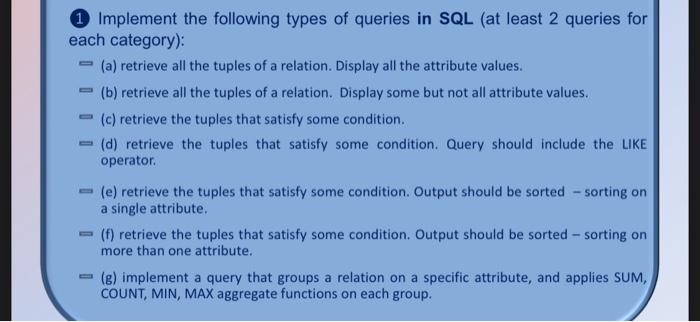
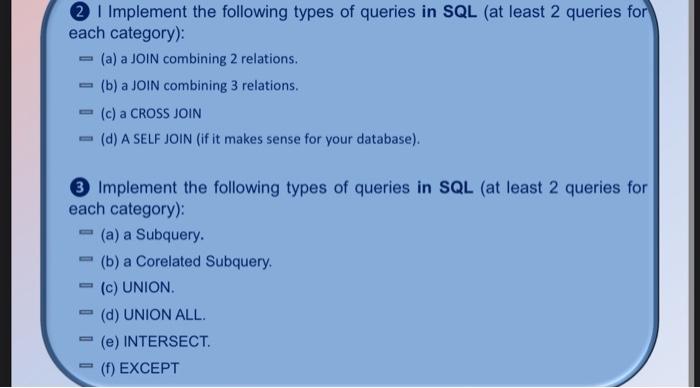
(2) Design 6 queries on the relational schema that you obtained in step \#(1). 2 of the queries should be answered by scanning a single Relation. 2 of the queries should involve two Relations. 2 of the queries should involve three Relations. (1) Implement the following types of queries in SQL (at least 2 queries for each category): (a) retrieve all the tuples of a relation. Display all the attribute values. (b) retrieve all the tuples of a relation. Display some but not all attribute values. (c) retrieve the tuples that satisfy some condition. (d) retrieve the tuples that satisfy some condition. Query should include the LIKE operator. (e) retrieve the tuples that satisfy some condition. Output should be sorted - sorting on a single attribute. (f) retrieve the tuples that satisfy some condition. Output should be sorted - sorting on more than one attribute. (g) implement a query that groups a relation on a specific attribute, and applies SUM, COUNT, MIN, MAX aggregate functions on each group. (2) I Implement the following types of queries in SQL (at least 2 queries for each category): - (a) a JOIN combining 2 relations. - (b) a JOIN combining 3 relations. (c) a CROSS JOIN (d) A SELF JOIN (if it makes sense for your database). (3) Implement the following types of queries in SQL (at least 2 queries for each category): (a) a Subquery. = (b) a Corelated Subquery. (c) UNION. - (d) UNION ALL. (e) INTERSECT. - (f) EXCEPT
Step by Step Solution
There are 3 Steps involved in it

Get step-by-step solutions from verified subject matter experts
 Study Help