Question: . Database Design 1: ProjectDB (20 points) A company has a number of employees. The attributes of EMPLOYEE include Employee_ID (identifier), Name, Address, and Birthdate.

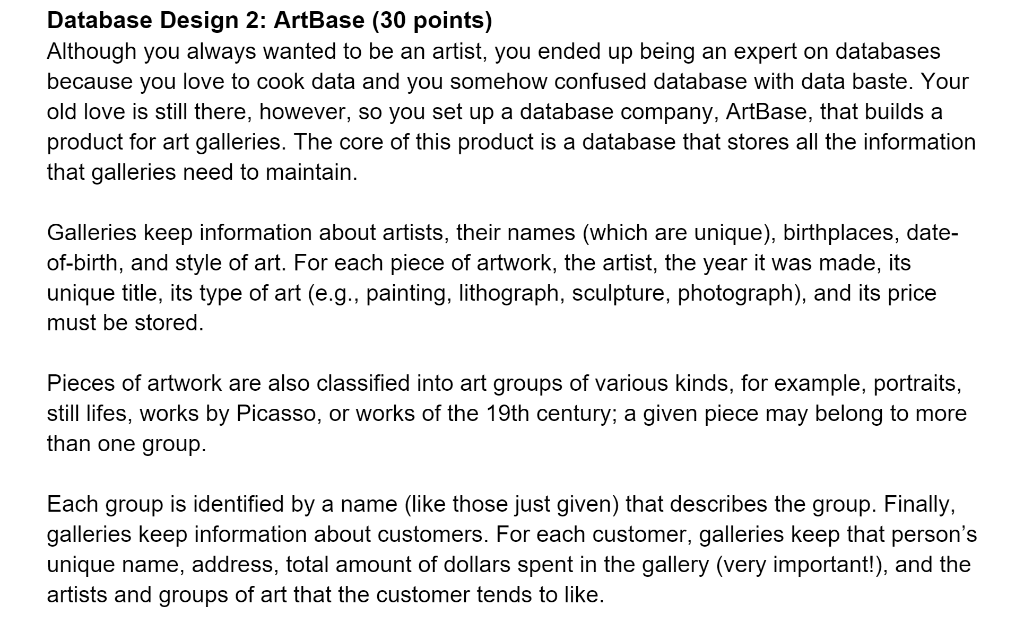
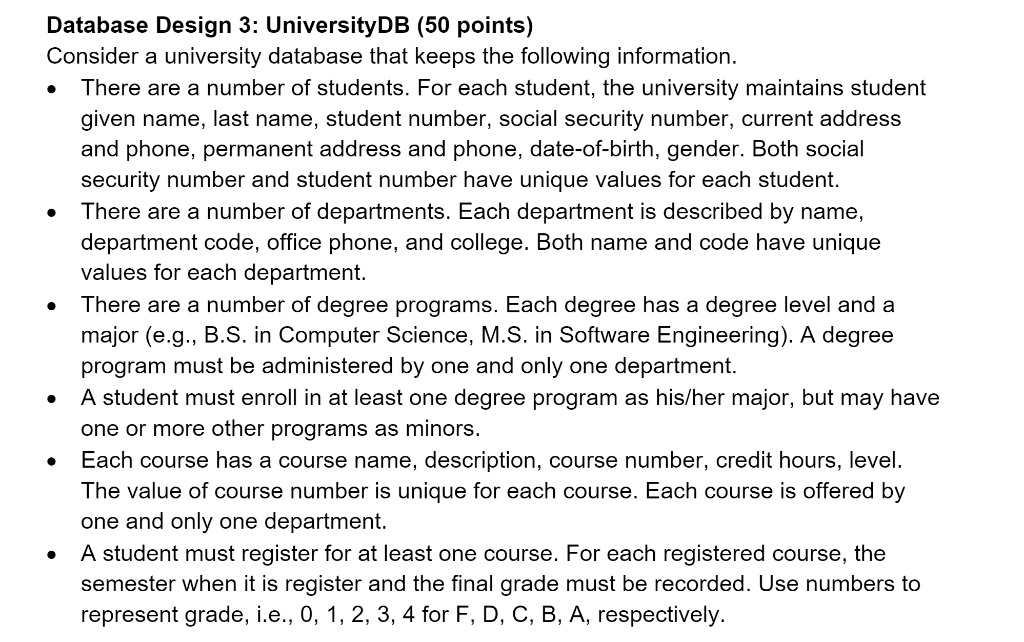
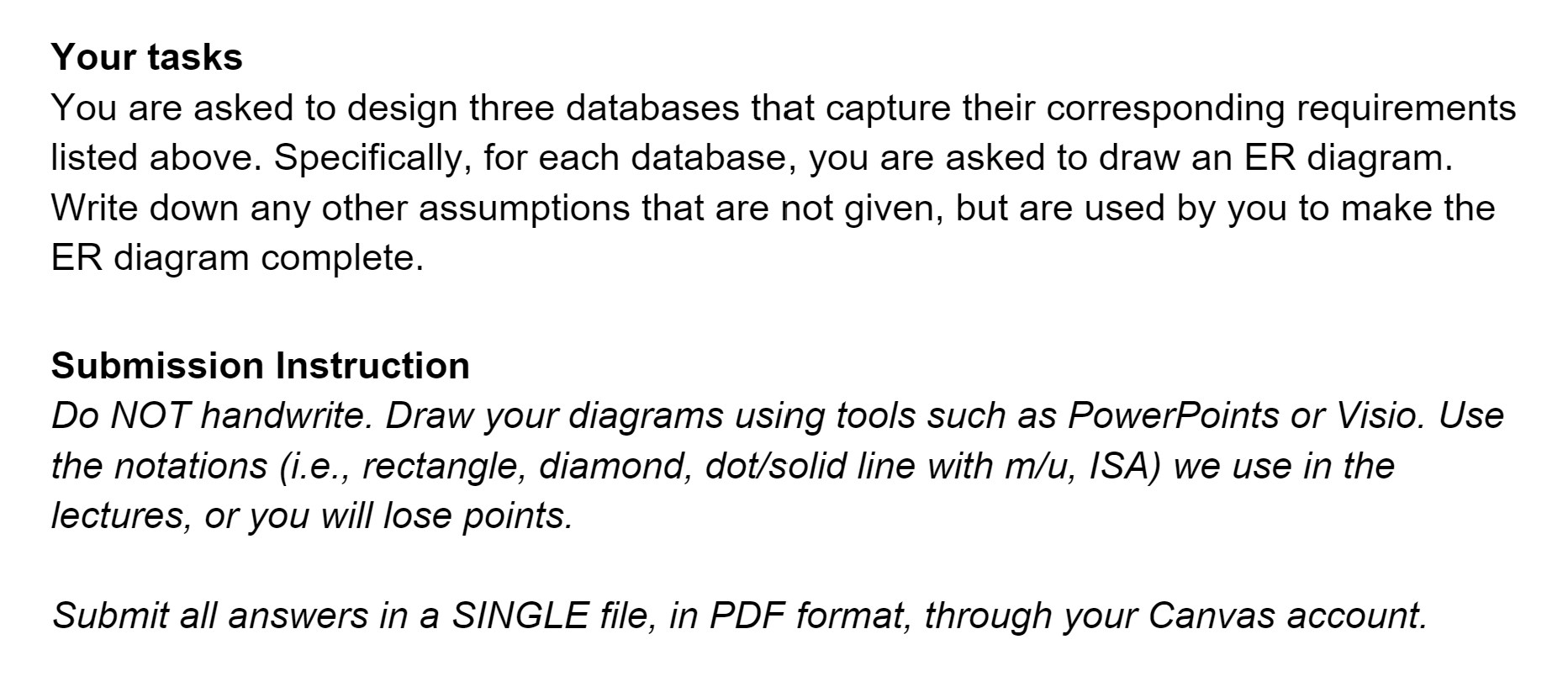
. Database Design 1: ProjectDB (20 points) A company has a number of employees. The attributes of EMPLOYEE include Employee_ID (identifier), Name, Address, and Birthdate. Some employees are maintenance staff, while the rest are technical staff. An employee can be either a maintenance staff or a technical staff, but not both. The company also has several projects. Attributes of PROJECT include Project_ID (identifier), Project_Name, and Start_Date. Each technical staff may be assigned to one or more projects, or may not be assigned to a project. A project must have at least one technical staff assigned, and may have any number of technical staffs assigned. A technical staff's billing rate may vary by project, and the company wishes to record the applicable billing rate (Billing_Rate) for each technical staff when assigned to a particular project. There are a number of building, each having a unique ID and address. An employee must work in at least one building. Each building must be managed by one and only one maintenance staff, and every maintenance staff must manage at least one building. Database Design 2: ArtBase (30 points) Although you always wanted to be an artist, you ended up being an expert on databases because you love to cook data and you somehow confused database with data baste. Your old love is still there, however, so you set up a database company, ArtBase, that builds a product for art galleries. The core of this product is a database that stores all the information that galleries need to maintain. Galleries keep information about artists, their names (which are unique), birthplaces, date- of-birth, and style of art. For each piece of artwork, the artist, the year it was made, its unique title, its type of art (e.g., painting, lithograph, sculpture, photograph), and its price must be stored. Pieces of artwork are also classified into art groups of various kinds, for example, portraits, still lifes, works by Picasso, or works of the 19th century; a given piece may belong to more than one group. Each group is identified by a name (like those just given) that describes the group. Finally, galleries keep information about customers. For each customer, galleries keep that person's unique name, address, total amount of dollars spent in the gallery (very important!), and the artists and groups of art that the customer tends to like. Database Design 3: UniversityDB (50 points) Consider a university database that keeps the following information. There are a number of students. For each student, the university maintains student given name, last name, student number, social security number, current address and phone, permanent address and phone, date-of-birth, gender. Both social security number and student number have unique values for each student. There are a number of departments. Each department is described by name, department code, office phone, and college. Both name and code have unique values for each department. There are a number of degree programs. Each degree has a degree level and a major (e.g., B.S. in Computer Science, M.S. in Software Engineering). A degree program must be administered by one and only one department. A student must enroll in at least one degree program as his/her major, but may have one or more other programs as minors. Each course has a course name, description, course number, credit hours, level. The value of course number is unique for each course. Each course is offered by one and only one department. A student must register for at least one course. For each registered course, the semester when it is register and the final grade must be recorded. Use numbers to represent grade, i.e., 0, 1, 2, 3, 4 for F, D, C, B, A, respectively. . Your tasks You are asked to design three databases that capture their corresponding requirements listed above. Specifically, for each database, you are asked to draw an ER diagram. Write down any other assumptions that are not given, but are used by you to make the ER diagram complete. Submission Instruction Do NOT handwrite. Draw your diagrams using tools such as PowerPoints or Visio. Use the notations (i.e., rectangle, diamond, dot/solid line with m/u, ISA) we use in the lectures, or you will lose points. Submit all answers in a SINGLE file, in PDF format, through your Canvas account. . Database Design 1: ProjectDB (20 points) A company has a number of employees. The attributes of EMPLOYEE include Employee_ID (identifier), Name, Address, and Birthdate. Some employees are maintenance staff, while the rest are technical staff. An employee can be either a maintenance staff or a technical staff, but not both. The company also has several projects. Attributes of PROJECT include Project_ID (identifier), Project_Name, and Start_Date. Each technical staff may be assigned to one or more projects, or may not be assigned to a project. A project must have at least one technical staff assigned, and may have any number of technical staffs assigned. A technical staff's billing rate may vary by project, and the company wishes to record the applicable billing rate (Billing_Rate) for each technical staff when assigned to a particular project. There are a number of building, each having a unique ID and address. An employee must work in at least one building. Each building must be managed by one and only one maintenance staff, and every maintenance staff must manage at least one building. Database Design 2: ArtBase (30 points) Although you always wanted to be an artist, you ended up being an expert on databases because you love to cook data and you somehow confused database with data baste. Your old love is still there, however, so you set up a database company, ArtBase, that builds a product for art galleries. The core of this product is a database that stores all the information that galleries need to maintain. Galleries keep information about artists, their names (which are unique), birthplaces, date- of-birth, and style of art. For each piece of artwork, the artist, the year it was made, its unique title, its type of art (e.g., painting, lithograph, sculpture, photograph), and its price must be stored. Pieces of artwork are also classified into art groups of various kinds, for example, portraits, still lifes, works by Picasso, or works of the 19th century; a given piece may belong to more than one group. Each group is identified by a name (like those just given) that describes the group. Finally, galleries keep information about customers. For each customer, galleries keep that person's unique name, address, total amount of dollars spent in the gallery (very important!), and the artists and groups of art that the customer tends to like. Database Design 3: UniversityDB (50 points) Consider a university database that keeps the following information. There are a number of students. For each student, the university maintains student given name, last name, student number, social security number, current address and phone, permanent address and phone, date-of-birth, gender. Both social security number and student number have unique values for each student. There are a number of departments. Each department is described by name, department code, office phone, and college. Both name and code have unique values for each department. There are a number of degree programs. Each degree has a degree level and a major (e.g., B.S. in Computer Science, M.S. in Software Engineering). A degree program must be administered by one and only one department. A student must enroll in at least one degree program as his/her major, but may have one or more other programs as minors. Each course has a course name, description, course number, credit hours, level. The value of course number is unique for each course. Each course is offered by one and only one department. A student must register for at least one course. For each registered course, the semester when it is register and the final grade must be recorded. Use numbers to represent grade, i.e., 0, 1, 2, 3, 4 for F, D, C, B, A, respectively. . Your tasks You are asked to design three databases that capture their corresponding requirements listed above. Specifically, for each database, you are asked to draw an ER diagram. Write down any other assumptions that are not given, but are used by you to make the ER diagram complete. Submission Instruction Do NOT handwrite. Draw your diagrams using tools such as PowerPoints or Visio. Use the notations (i.e., rectangle, diamond, dot/solid line with m/u, ISA) we use in the lectures, or you will lose points. Submit all answers in a SINGLE file, in PDF format, through your Canvas account









 Study Help