







Question: Database Normalization Practice Assignment Objective: To understand and apply the concepts of database normalization in SQL Server. This exercise involves designing a database, identifying anomalies,
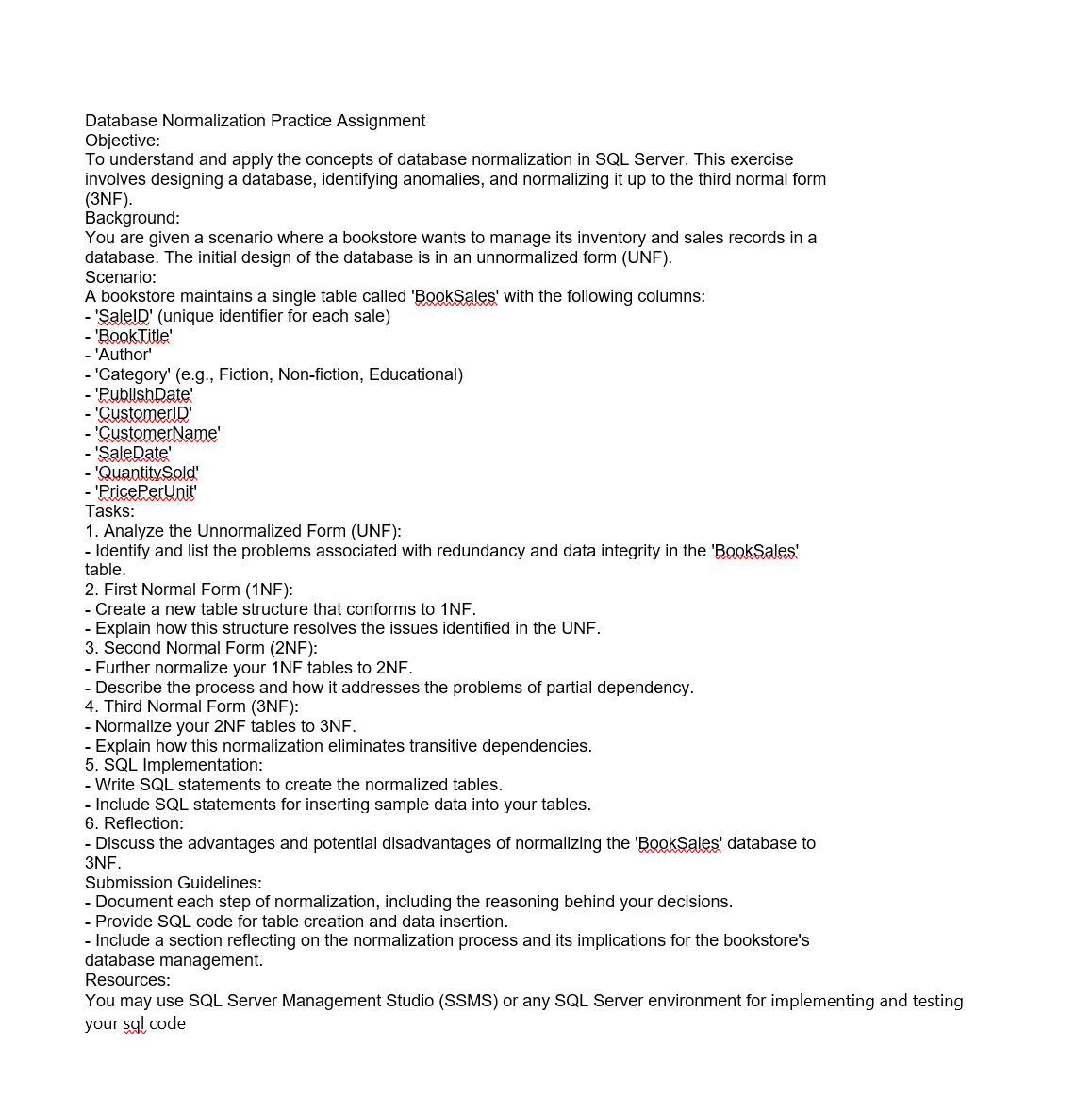
Database Normalization Practice Assignment
Objective:
To understand and apply the concepts of database normalization in SQL Server. This exercise
involves designing a database, identifying anomalies, and normalizing it up to the third normal form
NF
Background:
You are given a scenario where a bookstore wants to manage its inventory and sales records in a
database. The initial design of the database is in an unnormalized form UNF
Scenario:
A bookstore maintains a single table called 'BookSales' with the following columns:
'SalelD' unique identifier for each sale
'BookTitle'
'Author'
'Category' eg Fiction, Nonfiction, Educational
'PublishDate'
'CustomerlD'
'CustomerName'
'SaleDate'
'QuantitySold'
'PricePerUnit'
Tasks:
Analyze the Unnormalized Form UNF:
Identify and list the problems associated with redundancy and data integrity in the 'BookSales'
table.
First Normal Form NF:
Create a new table structure that conforms to
Explain how this structure resolves the issues identified in the UNF.
Second Normal Form NF:
Further normalize your tables to
Describe the process and how it addresses the problems of partial dependency.
Third Normal Form NF:
Normalize your NF tables to NF
Explain how this normalization eliminates transitive dependencies.
SQL Implementation:
Write SQL statements to create the normalized tables.
Include SQL statements for inserting sample data into your tables.
Reflection:
Discuss the advantages and potential disadvantages of normalizing the 'BookSales' database to
NF
Submission Guidelines:
Document each step of normalization, including the reasoning behind your decisions.
Provide SQL code for table creation and data insertion.
Include a section reflecting on the normalization process and its implications for the bookstore's
database management.
Resources:
You may use SQL Server Management Studio SSMS or any SQL Server environment for implementing and testing
your sql code
Step by Step Solution
There are 3 Steps involved in it
1 Expert Approved Answer
Step: 1 Unlock

Question Has Been Solved by an Expert!
Get step-by-step solutions from verified subject matter experts
Step: 2 Unlock
Step: 3 Unlock
 Study Help