







Question: DATABASE PRINCIPLE question: B. [Relational Modelingl Consider the relational database schema for a big company that has many divisions. The primary keys are underlined. Employee
DATABASE PRINCIPLE question:
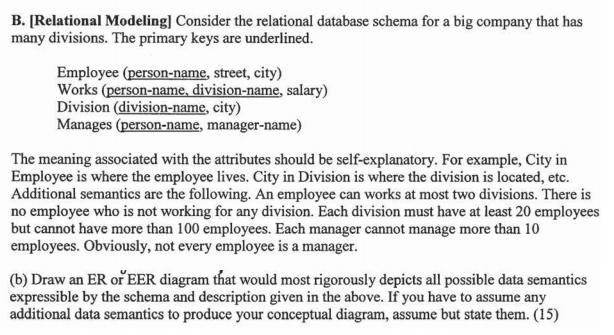
B. [Relational Modelingl Consider the relational database schema for a big company that has many divisions. The primary keys are underlined. Employee (person-name, street, city) Works (person-name, division-name, salary) Division (division-name, city) Manages (person-name, manager-name) The meaning associated with the attributes should be self-explanatory. For example, City in Employee is where the employee lives. City in Division is where the division is located, etc Additional semantics are the following. An employee can works at most two divisions. There is no employee who is not working for any division. Each division must have at least 20 employees but cannot have more than 100 employees. Each manager cannot manage more than 10 employees. Obviously, not every employee is a manager. (b) Draw an ER or EER diagram that would most rigorously depicts all possible data semantics expressible by the schema and description given in the above. If you have to assume any additional data semantics to produce your conceptual diagram, assume but state them. (15)
Step by Step Solution
There are 3 Steps involved in it

Get step-by-step solutions from verified subject matter experts
 Study Help