







Question: Database System: Exercise 18.2.1: Below are two transactions, described in terms of their effect on two database elements A and B, which we may assume
Database System:
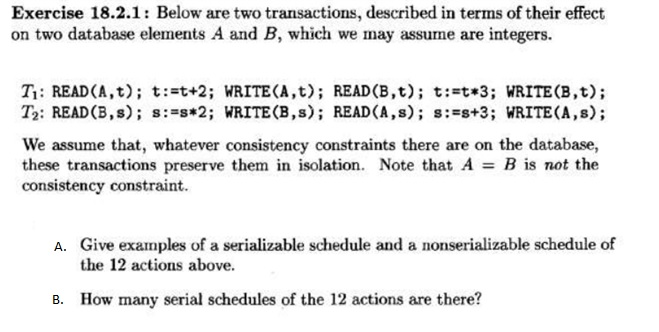
Exercise 18.2.1: Below are two transactions, described in terms of their effect on two database elements A and B, which we may assume are integers T,: READ(A,t); T2: READ(B,s); t:st+2 ; s:=s*2; WRITE(A,t); WRITE(B,s); READ(B,t); READ(A,s); t;st#3; s:=s+3 ; WRITE(B,t); WRITE(A,s); We assume that, whatever consistency constraints there are on the database, these transactions preserve them in isolation. Note that A- B is not the consistency constraint. Give examples of a serializable schedule and a nonserializable schedule of the 12 actions above. A. B. How many serial schedules of the 12 actions are there? Exercise 18.2.1: Below are two transactions, described in terms of their effect on two database elements A and B, which we may assume are integers T,: READ(A,t); T2: READ(B,s); t:st+2 ; s:=s*2; WRITE(A,t); WRITE(B,s); READ(B,t); READ(A,s); t;st#3; s:=s+3 ; WRITE(B,t); WRITE(A,s); We assume that, whatever consistency constraints there are on the database, these transactions preserve them in isolation. Note that A- B is not the consistency constraint. Give examples of a serializable schedule and a nonserializable schedule of the 12 actions above. A. B. How many serial schedules of the 12 actions are there
Step by Step Solution
There are 3 Steps involved in it

Get step-by-step solutions from verified subject matter experts
 Study Help