



Question: de1c can_balance{ items): Each element in items is considered to be a physical weight. and guaranteed to be a positive integer. Your task is to
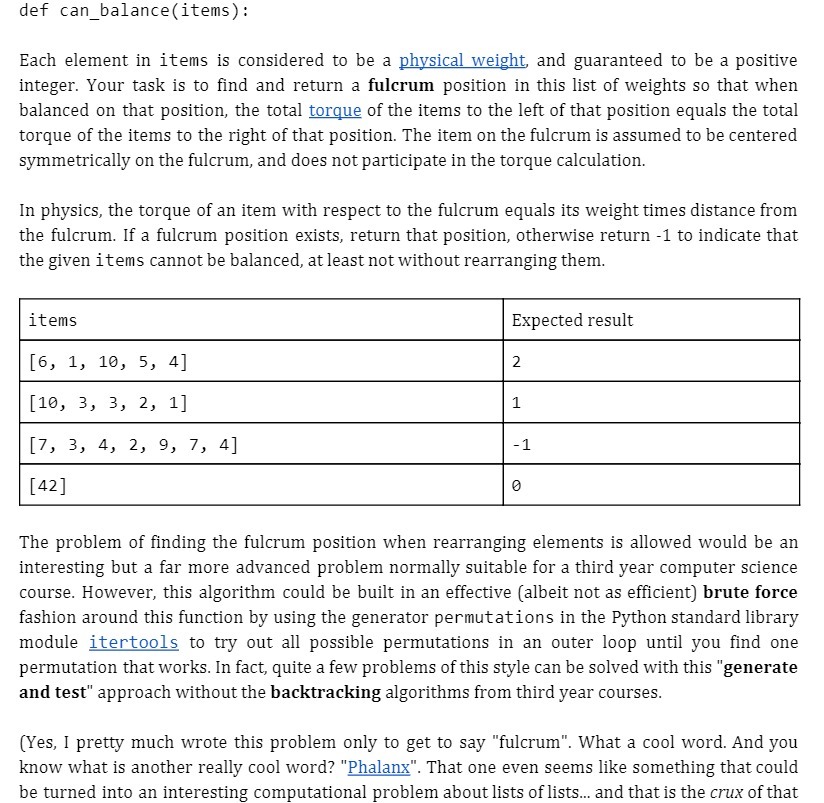
de1c can_balance{ items): Each element in items is considered to be a physical weight. and guaranteed to be a positive integer. Your task is to nd and return a fulcrum position in this list of weights so that when balanced on that position, the total torque of the items to the left of that position equals the total torque of the items to the right of that position. The item on the fulcrum is assumed to be centered symmetrically on the fulcrum, and does not participate in the torque calculation. In physics, the torque of an item with respect to the fulcrum equals its weight times distance from the fulcrum. If a fulcrum position exists, return that position, otherwise return -1 to indicate that the given items cannot be balanced, at least not without rearranging them. The problem of nding the fulcrum position when rearranging elements is allowed would be an interesting but a far more advanced problem normally suitable for a third year computer science course. However, this algorithm could be built in an effective {albeit not as efficient] brute force fashion around this function by using the generator permutations in the Python standard library module iter'tools to try out all possible permutations in an outer loop until you nd one permutation that works. In fact, quite a few problems of this style can be solved with this \"generate and test\" approach without the backtracking algorithms from third year courses. (Yes, I pretty much wrote this problem only to get to say "fulcrum". What a cool word. And you know what is another really cool word? "Phalanx". That one even seems like something that could be turned into an interesting computational problem about lists of lists... and that is the crux of that
Step by Step Solution
There are 3 Steps involved in it

Get step-by-step solutions from verified subject matter experts