







Question: Dear experts, please pick the correct option(s) based on the questions. Thank you Which of the following reasons or workings are correctly stated? Select all
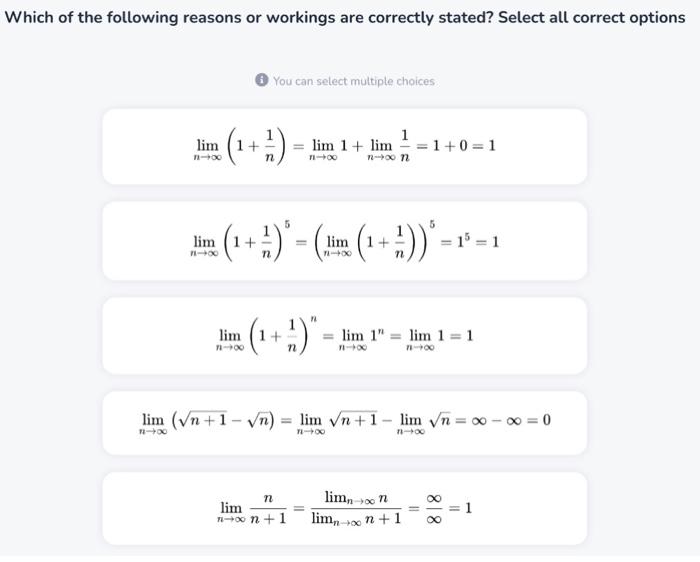
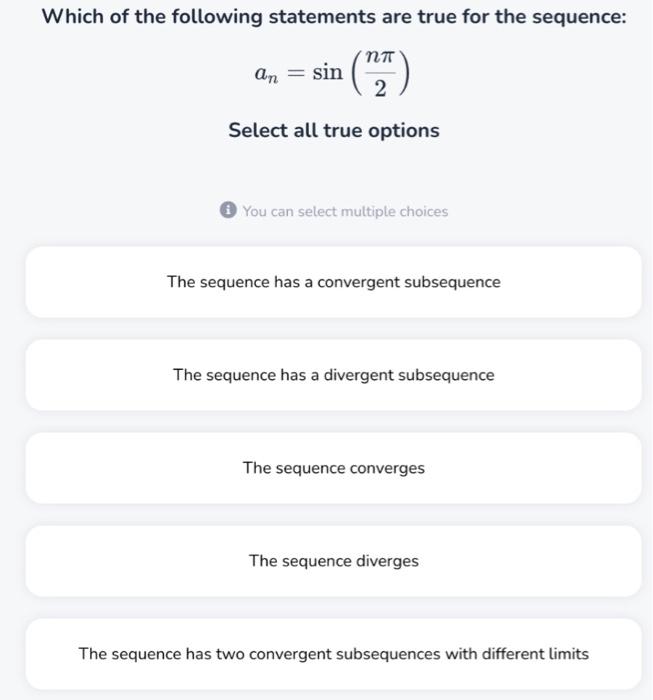
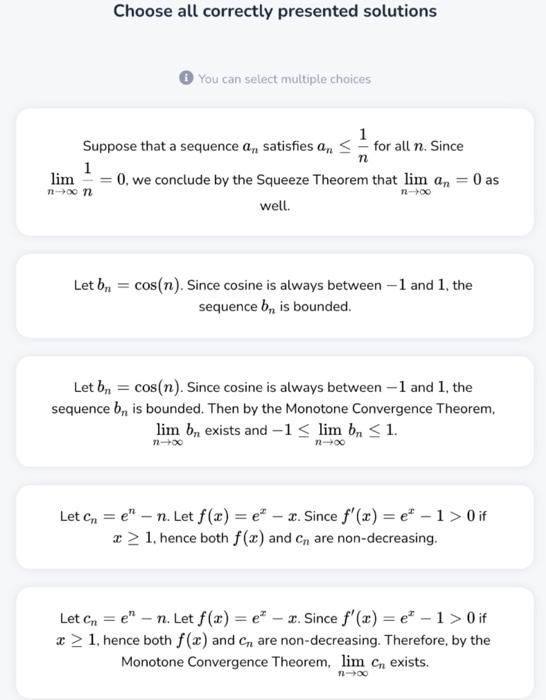
Which of the following reasons or workings are correctly stated? Select all correct options (i) You can select multiple choices. limn(1+n1)=limn1+limnn1=1+0=1 limn(1+n1)5=(limn(1+n1))5=15=1 limn(1+n1)n=limn1n=limn1=1 limn(n+1n)=limnn+1limnn==0 limnn+1n=limnn+1limnn==1 Which of the following statements are true for the sequence: an=sin(2n) Select all true options (i) You can select multiple choices The sequence has a convergent subsequence The sequence has a divergent subsequence The sequence converges The sequence diverges The sequence has two convergent subsequences with different limits Choose all correctly presented solutions (i) You can select multiple choices Suppose that a sequence an satisfies ann1 for all n. Since limnn1=0, we conclude by the Squeeze Theorem that limnan=0 as well. Let bn=cos(n). Since cosine is always between 1 and 1 , the sequence bn is bounded. Let bn=cos(n). Since cosine is always between 1 and 1 , the sequence bn is bounded. Then by the Monotone Convergence Theorem, limnbn exists and 1limnbn1. Let cn=enn. Let f(x)=exx. Since f(x)=ex1>0 if x1, hence both f(x) and cn are non-decreasing. Let cn=enn. Let f(x)=exx. Since f(x)=ex1>0 if x1, hence both f(x) and cn are non-decreasing. Therefore, by the Monotone Convergence Theorem, limncn exists
Step by Step Solution
There are 3 Steps involved in it

Get step-by-step solutions from verified subject matter experts
 Study Help