



Question: Dear Tutor, I am having trouble to get the correct outcome for the question below. Please explain how to solve this types of question step-by
Dear Tutor,
I am having trouble to get the correct outcome for the question below. Please explain how to solve this types of question step-by step. Thanks!
Ralph Wilson started his machine shop in Santa Ana, CA with a small business loan about 10 years ago. Since then, he has built a thriving business making products for companies such as Boeing, Walt Disney Corporation, and several others. This case describes the process by which Wilson Precision Products (WPP) converts a variety of materials into finished products. Although WPP sells its finished products to customers and purchases its materials from vendors, those processes are not part of this case.
Production
After WPP receives an order from a customer, Ralph or another supervisor signs one production order for each finished product that the customer ordered. This starts the production process. The inventory manager checks the bill of materials for that finished product and prepares one or more materials issue lists depending on when the materials are needed. For some products, materials are issued multiple times, since not everything is needed at once. The manager then removes the materials from their designated bins and gets them ready for use in production.
As soon as the materials are available, WPP manufacturing employees begin labor operations following the labor plan. Production usually involves cutting, treating, machining, assembly, testing, etc., but the specific steps depend on the particular finished product. Precision machining is characterized by the tight tolerances for hard-to-machine materials, so WPP only allows qualified employees to work on each step. Employees scan their ID cards to record when they start and end work on each production labor step. Each labor operation step is assigned a labor operation control #, and each operation corresponds to one labor plan step. When production finishes, the manager updates the production order to record that production is complete, and the inventory manager places the finished products on designated racks. Each rack holds one finished product so WPP can plan for packaging and delivery. Of course, there are often open racks which do not hold finished goods.
Inventories
WPP maintains a materials inventory required for manufacturing its finished products. The materials inventory includes both metallic and non-metallic materials. Materials typical of aerospace machining include lightweight aluminum, hard and temperature-resistant metals including titanium and carbon-fiber composites. For other customers such as theme parks, WPP works with both common and engineering thermoplastics as well as advanced, expensive thermoset laminates. Additionally, some government customers need products that require composite materials such as carbon fiber reinforced plastic (CFRP), Kevlar and quartz-epoxy composite. WPP tracks its materials inventory by material # and each material is placed in a separate bin for ease of access. However, some bins occasionally contain no material, and materials may not be in any bin.
WPP also maintains an inventory of finished products, but in most cases, it only produces those products after it receives a firm order from a customer. It tracks its finished products by product #. Over time, WPP works with its customers to develop precise specifications for each finished product. From those specifications, WPP creates a bill of materials that itemizes the materials necessary to create each finished product, although typically WPP establishes its finished products before it creates the bill of materials. The bill of materials specifies the quantity, quality, structural integrity, etc. of each material used for that finished product. Some materials are used in several finished products, and each finished products uses one or more materials.
Production planning
Over time, WPP has developed precise labor plans for constructing each finished product and controlling its labor costs. It implemented its labor plans as a series of control cards for each step in the production process. Each labor plan step is assigned a labor plan control #. The labor plan specifies the type of employee that will execute each step, the number of hours required, and the standard labor rate. Each labor plan step involves only one type of employee. Of course, WPP decides on finished products before it establishes labor plans for the products.
Miscellaneous
WPP keeps all employee records in one class. Employee information is recorded before employees they issue production orders, issue material, or work in production. It categorizes employees based on their qualifications to perform particular jobs in the production process. It records materials in its inventory records before they are first issued. It records each finished product in its inventory records before it is first produced. There are some employee types that are not yet specified in labor plans. There are also some employee types for which there are no qualified employees, yet.
Required:
Using the narrative above and the attributes list, answer the following questions.It is strongly recommended that you complete the UML class (REA) diagram, table listings, and BPMN diagram before attempting the questions.
UML Class Diagram
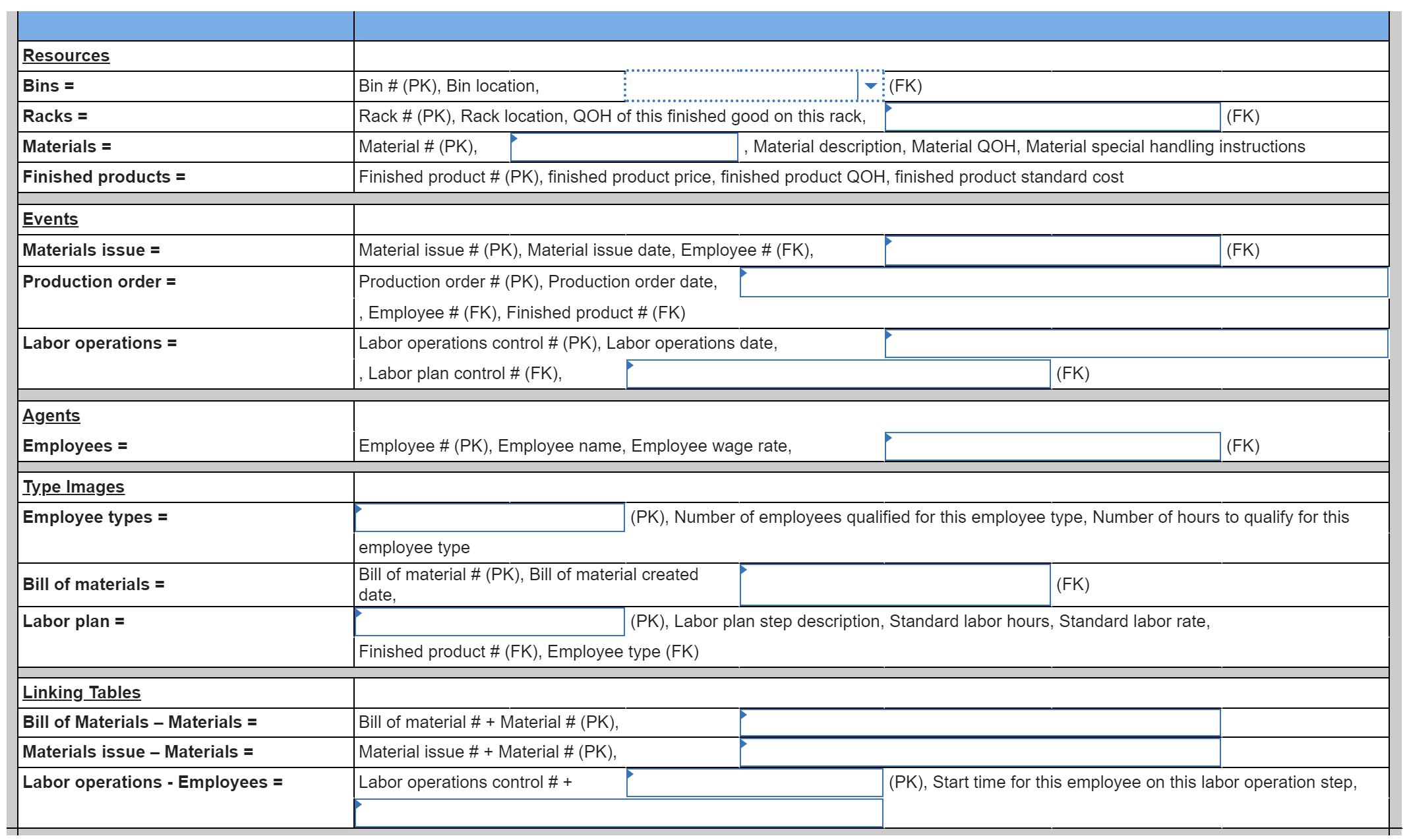
Refer to the following table listing. Answer the questions to replace the numbered blanks with the correct attribute numbers shown below.
Attributes
1.Bill of material #
2.Bill of material created date
3.Bin #
4.Bin location
5.Employee #
6.Employee name
7.Employee type
8.Employee wage rate
9.End time for this employee on this labor operation step
10.Finished product #
11.Finished product price
12.Finished product QOH
13.Finished product standard cost
14.Labor operations control #
15.Labor operations date
16.Labor plan control #
17.Labor plan step description
18.Material #
19.Material cost
20.Material description
21.Material issue #
22.Material issue date
23.Material QOH
24.Material special handling instructions
25.Number of employees qualified for this employee type
26.Number of hours to qualify for this employee type
27.Production order #
28.Production order date
29.QOH of this finished good on this rack
30.Quantity of this finished product ordered on this production order
31.Quantity of this material issued on this material issue
32.Quantity of this material planned for this bill of material
33.Rack #
34.Rack location
35.Standard labor hours
36.Standard labor rate
37.Start time for this employee on this labor operation step
38.Total labor hours for this labor operation step
Put the number of the attribute in the appropriate blank in the table list below.
\f
Step by Step Solution
There are 3 Steps involved in it

Get step-by-step solutions from verified subject matter experts