Question: Dear tutor Please help me to answer and understand the follow questions from the Case: American Home Products below: How would you characterize AHP's operating
Dear tutor
Please help me to answer and understand the follow questions from the Case: American Home Products below:
How would you characterize AHP's operating and financial strategy?
What are the implications for AHP's basic business risk? And for its financial strategy?
How much financial risk does it face at each of the proposed levels of debt shown in Exhibit 3?
How would you consider pros and cons (risks) of debt?
How would you convince the management to increase the firm's financial leverage?
What would be the impact of higher debt levels on the firm's main metrics? And on shareholders' wealth?
Upon the previous calculations you had to do, could you determine a target debt ratio for AHP?
What do you think would be the best way or strategy to reach a specific capital structure for this company?
What would be your final, summarized decision?
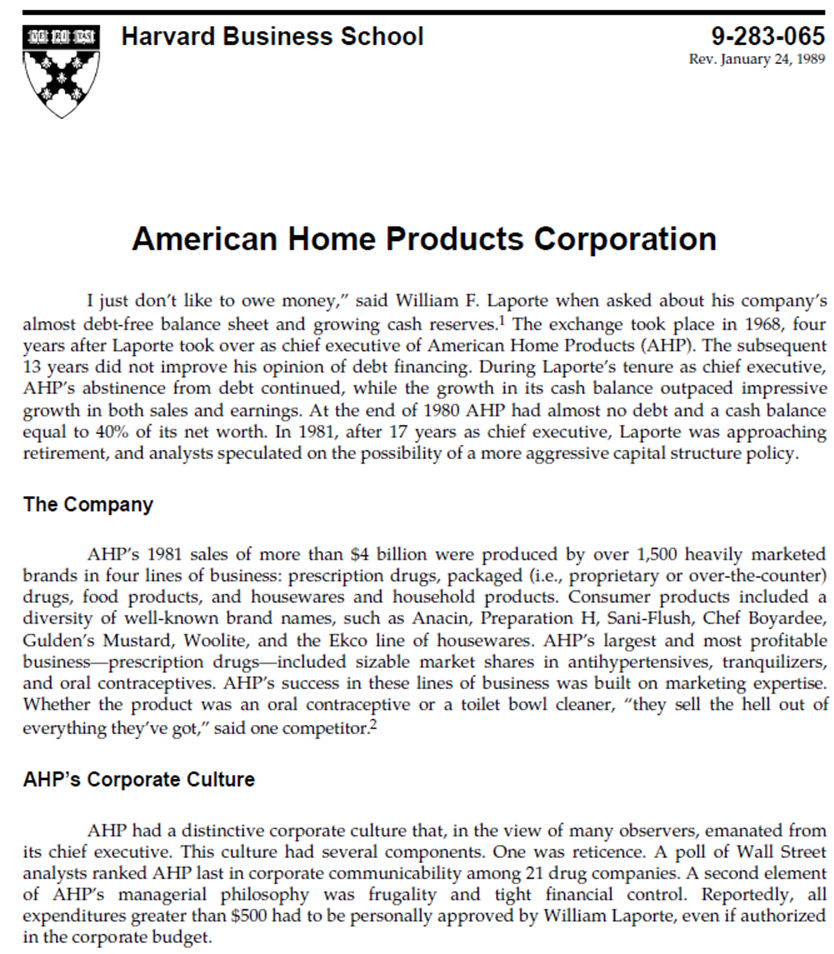
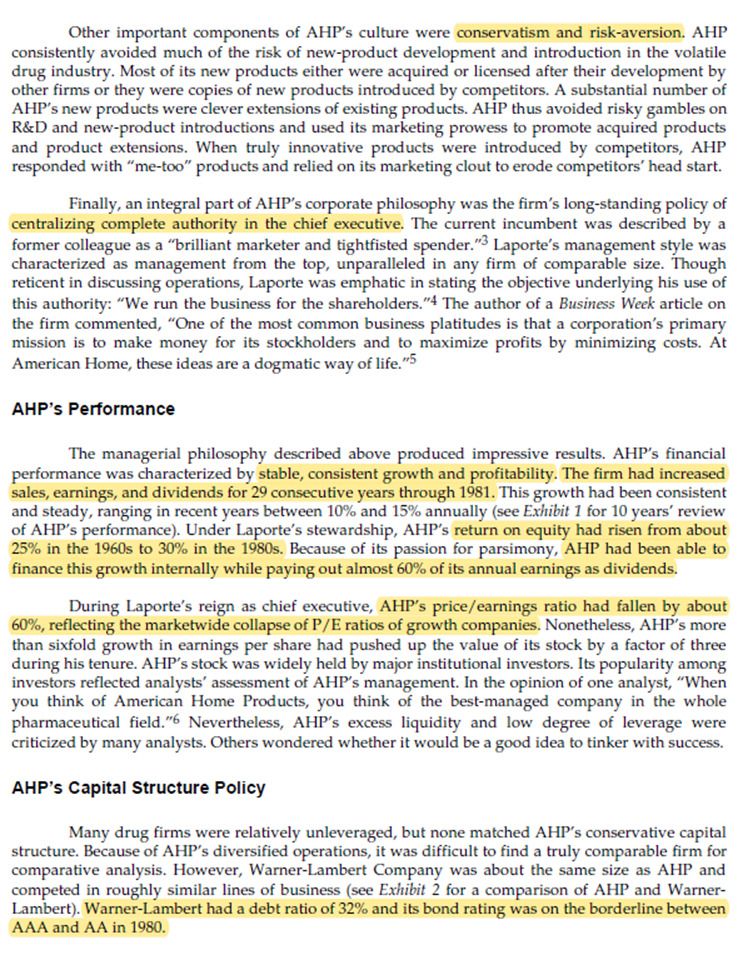
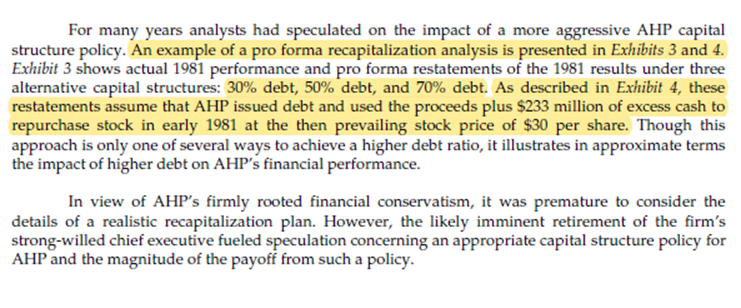
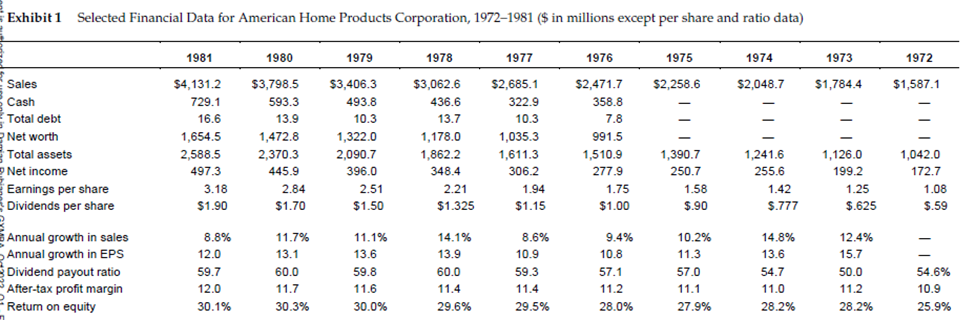
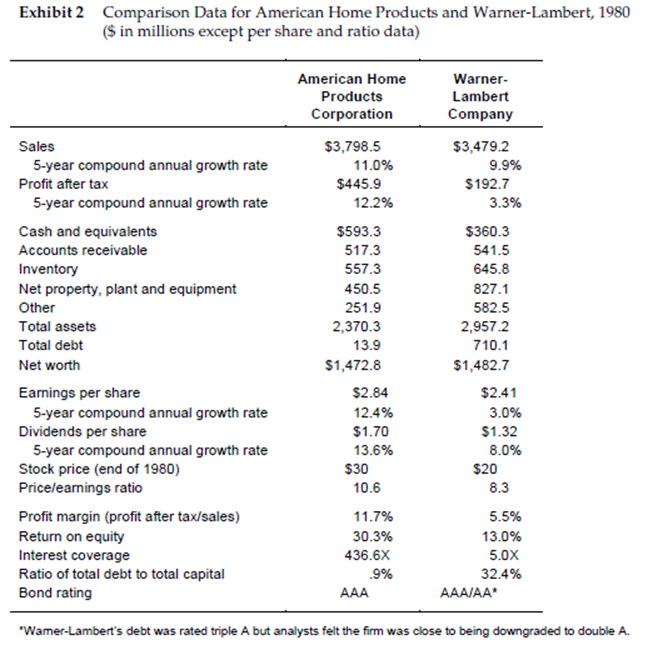
mars: Harvard Business School 9-283-065 Rev. January 24, 1089 American Home Products Corporation I just don't like to owe money," said William F. Laporte when asked about his company's almost debt-free balance sheet and growing cash reserves.l The exchange took place in 1968, four years after Laporte took over as chief executive of American Home Products {AHPL The subsequent 13 years did not improve his opinion of debt financing. During Laporte's tenure as chief executive, AHP's abstinence from debt continued, while the growth in its cash balance outpaced impressive growth in both sales and earnings. At the end of 1980 AB? had almost no debt and a cash balance equal to 409':- of its net worth. In 1981, after 1'7 years as chief executive, Laporte was approaching retirement, and analysts speculated on the possibility of a more aggressive capital structure policy. The Company AHP's 1981 sales of more than $4 billion were produced by over 1,500 heavily marketed brands in four lines of business: prescription drugs, packaged (i.e., proprietary or over-the-counter) drugs, food products, and housewares and household products. Consumer products included a diversity of wellknown brand names, such as Anacin, Preparation H, BaniFlush, Chef Boyardee, Gulden's Mustard, Woolite, and the Ekco line of housewares. AHP's largest and most profitable businessprescription drugsincluded sizable market shares in antihypertensives, tranquilizers, and oral contraceptives. AHP's success in these lines of business was built on marketing expertise. Whether the product was an oral contraceptive or a toilet bowl cleaner, \"they sell the hell out of everything they've got,\" said one competitor.2 AHP's Corporate Culture AHP had a distinctive corporate culture that, in the view of many observers, emanated from its chief executive. This culture had several components. One was reticence. A poll of Wall Street analysts ranked AHP last in corporate communicability among 21 drug companies. A second element of AHP's managerial philosophy was frugality and tight Financial control. Reportedly, all expenditures greater than $500 had to be personally approved by William Laporte, even if authorized in the corpomte budget. Other important components of AHP's culture were conservatism and risk-aversion. AHP consistently avoided much of the risk of new-product development and introduction in the volatile drug industry. Most of its new products either were acquired or licensed after their development by other firms or they were copies of nevi.r products introduced by competitors. A substantial number of AHP's new products were clever extensions of existing products. AHP thus avoided risky gambles on Rch and new-product introductions and used its marketing prowess to promote acquired products and product extensions. When truly innovative products were introduced by competitors, AHI' responded with "me-too" products and relied on its marketing clout to erode competitor-5' head start. Finally, an integral part of AHP's corporate philosophy was the rm's long-standing policy of centralizing complete authority in the chief executive. The current incumbent was described by a former colleague as a \"brilliant marketer and tightfisted spender."3 Laporte's management style was characterized as management from the top, unparalleled in any rm of comparable size. Though reticent in discussing operations, Laporte was emphatic in stating the objective underlying his use of this authority: "We run the business for the shareholders."'I The author of a Business Week article on the firm commented, \"One of the most common business platitudes is that a corporation's primary mission is to make money for its stockholders and to maximize prots by minimizing costs. At American Home, Husse ideas are a dogmatic way of life."5 AHP's Performance The managerial philosophy described above produced impressive results. AHP's financial performance was characterized by stable, consistent growth and protability. The rm had increased sales, earnings, and dividends for 29 consecutive years through 1931. This growth had been consistent and steady, ranging in recent years between 10% and 15% annually (see Exhibit 1 for ID years' review of AHP's performance). Under Laporte's stewardship, AHP's return on equity had risen from about 25% in the 19605 to 30% in the 19305. Because of its passion for parsimony, AHP had been able to nance this growth internally while paying out almost 60% of its annual earnings as dividends. During Laporte's reign as chief executive, AHP's price/comings ratio had fallen by about 60%, reecting the marketwide collapse of PIE ratios of growth companies. Nonetheless, AHP's more than sixfold growth in earnings per share had pushed up the value of its stock by a factor of three during his tenure. AHP's stock was widely held by major institutional investors Its popularity among investors reflected analysts' assessment of AHP's management. In the opinion of one analyst, \"When you think of American Home Products, you think of the best-managed company in the whole pharmaceutical field."6 Nevertheless, AHP's excess liquidity and low degree of leverage were criticized by many analysts. Others wondered whether it would be a good idea to tinker with success. AHP's Capital Structure Policy Many drug firms were relatively unleveraged, but none matched AHP's conservative capital structure. Because of AHP's diversified operations, it was difficult to find a truly comparable rm for comparative analysis. However, Warner-Lambert Company was about the same size as AH? and competed in roughly similar lines of business (see Exhibit 2 for a comparison of AHP and Warner- lambert). Wamenlambert had a debt ratio of 32% and its bond rating was on the borderline between AAA and AA in 1930. For many years analysts had speculated on the impact of a more aggressive AHP capital structure policy. An example of a pro forma recapitalization analysis is presented in Exhibits 3 and 4. Exhibit 3 shows actual 1981 performance and pro forma restatements of the 1931 results under three alternative capital structures: 30% debt, 50% debt, and 70% debt. As described in Exhibit 4, these renements assume that AH? issued debt and used the proceeds plus $233 million of excess cash to repurchase stock in early 1981 at the then prevailing stock price of $30 per share. Though this approach is only one of several ways to achieve a higher debt ratio, it illustrates in approximate term the impact of higher debt on AHP's nancial performance. In View of AHP's firmly rooted financial consewatism, it was premature to consider the details of a realistic recapitalization plan. However, the likely imminent retirement of the rm's strong-willed chief executive fueled speculation concerning an appropriate capital structure policy for AHP and the magnitude of the payoff from such a policy. \f\f
Step by Step Solution
There are 3 Steps involved in it
1 Expert Approved Answer
Step: 1 Unlock
Question Has Been Solved by an Expert!
Get step-by-step solutions from verified subject matter experts
Step: 2 Unlock
Step: 3 Unlock
Students Have Also Explored These Related Finance Questions!









 Study Help