Question: Debate Ethical Dilemma/Boom in Busts: Good or Bad? Based on your reading Boom in Busts: Good or Bad?(p.150-151 in Global 4 textbook,) research and debate
Debate Ethical Dilemma/Boom in Busts: Good or Bad?
Based on your reading "Boom in Busts: Good or Bad?"(p.150-151 in Global 4 textbook,) research and debate with your fellow peers your opinions of the subject. Discuss the pros and cons of what should be done with entrepreneurs that fail. pg. 151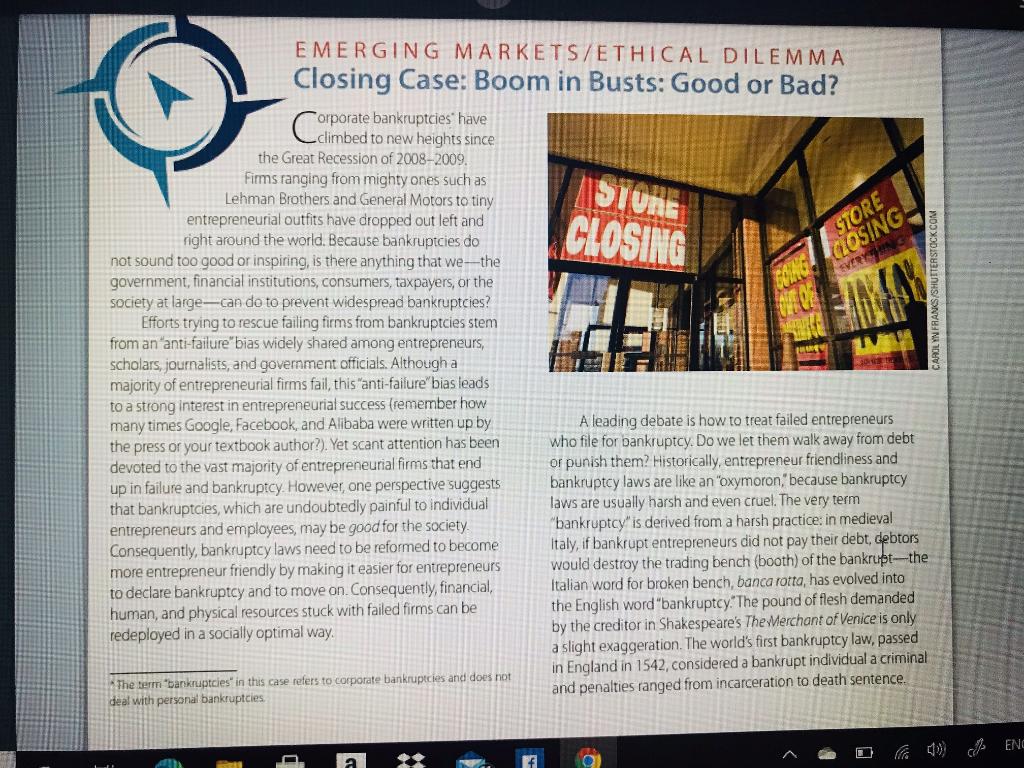
AUSTONE CLOSING STORE EVERYON Cons! CLOSING EMERGING MARKETS/ETHICAL DILEMMA Closing Case: Boom in Busts: Good or Bad? orporate bankruptcies have climbed to new heights since the Great Recession of 2008-2009. Firms ranging from mighty ones such as Lehman Brothers and General Motors to tiny entrepreneurial outfits have dropped out left and right around the world. Because bankruptcies do not sound too good or inspiring, is there anything that we--the government, financial institutions, consumers, taxpayers, or the society at large-can do to prevent widespread bankruptcies? Efforts trying to rescue failing firms from bankruptcies stem from an anti-failure" bias widely shared among entrepreneurs, scholars, journalists, and government officials. Although a majority of entrepreneurial firms fail, this "anti-failure"bias leads to a strong interest in entrepreneurial success (remember how many times Google, Facebook, and Alibaba were written up by A leading debate is how to treat failed entrepreneurs the press or your textbook author?). Yet scant attention has been who file for bankruptcy. Do we let them walk away from debt devoted to the vast majority of entrepreneurial firms that end or punish them? Historically, entrepreneur friendliness and up in failure and bankruptcy. However, one perspective suggests bankruptcy laws are like an "oxymoron, because bankruptcy that bankruptcies, which are undoubtedly painful to individual laws are usually harsh and even cruel. The very term entrepreneurs and employees, may be good for the society. "bankruptcy is derived from a harsh practice: in medieval Consequently, bankruptcy laws need to be reformed to become Italy, if bankrupt entrepreneurs did not pay their debt, debtors more entrepreneur friendly by making it easier for entrepreneurs would destroy the trading bench (booth) of the bankrut-the to declare bankruptcy and to move on. Consequently, financial, Italian word for broken bench, banca rotta, has evolved into human, and physical resources stuck with failed firms can be the English word "bankruptcy. The pound of flesh demanded redeployed in a socially optimal way. by the creditor in Shakespeare's The Merchant of Venice is only a slight exaggeration. The world's first bankruptcy law, passed in England in 1542, considered a bankrupt individual a criminal The term "bankruptcies in this case refers to corporate bankruptcies and does not deal with personal bankruptcies. and penalties ranged from incarceration to death sentence. ENC C 164 / 324 96% + However, recently, many governments have realized that entrepreneur-friendly bankruptcy laws can not only lower exit barriers, but also lower entry barriers for entrepreneurs. Although we are confident that many start-ups will end up in bankruptcy, up front it is impossible to predict which ones will go under. Therefore, from an institution-based standpoint, if entrepreneurship is to be encouraged, there is a need to ease the pain associated with bankruptcy by means such as allowing entrepreneurs to walk away from debt, a legal right that bankrupt US entrepreneurs appreciate. In contrast, until the recent bankruptcy law reforms, bankrupt German entrepreneurs might remain liable for unpaid debt for up to 30 years. Further, German and Japanese managers of bankrupt firms can also be liable for criminal penalties, and numerous bankrupt Japanese entrepreneurs have committed suicide. Not surprisingly, many failed entrepreneurs in Germany and Japan try to avoid business exit despite escalating losses, and societal and individual resources cannot be channeled to more productive uses. Therefore, as rules of the end game" harsh bankruptcy laws become grave exit barriers. They can also create significant entry barriers, as fewer would-be entrepreneurs may decide to launch their ventures At a societal level, if many would be entrepreneurs, in fear of failure, abandon their ideas, there will not be a thriving entrepreneurial sector. Given the risks and uncertainties, it is not surprising that many entrepreneurs do not make it the first time However, if they are given more chances, some of them will succeed For example, approximately 50% of US entrepreneurs who filed bankruptcy resumed a new venture in four years. This high level of entrepreneurialism is, in part, driven by the relatively entrepreneur- friendly bankruptcy laws (such as the provision of Chapter 11 bankruptcy reorganization instead of straight liquidation). On the other hand, a society that severely punishes failed entrepreneurs (such as forcing financially insolvent firms to liquidate instead of offering a US Chapter 11-style reorganization option) is not likely to foster widespread entrepreneurship. Failed entrepreneurs have nevertheless accumulated a great deal of experience and lessons on how to avoid their mistakes. If they drop out of the entrepreneurial game (or in the worst case, kill themselves), their wisdom will be permanently lost. Overall, worldwide evidence from 29 countries involving both developed and emerging economies from five continents-has identified a strong linkage between entrepreneur friendly bankruptcy laws and new firm entries. In summary one side of the debate asserts that at a societal level, entrepreneurial failures may be beneficial. This is because only through a large number of entrepreneurial experimentations- although many will fail-can winning solutions emerge and economies develop. Thus, the boom in busts is not necessarily bad. On the other hand, President Donald Trump's history of walking away from six corporate bankruptcies (although never personal bankruptcy) recently energized the other side of the debate. Trump praised himself during the 2016 presidential campaign for playing the bankruptcy laws. Critics argue that people with lots of money such as Trump can easily avoid the consequences of big losses by cashing out at the first sign of trouble, because bankruptcy laws protect them. But workers, who have no such protection, are stuck with the mess or are simply out of work. Is that fair? Case Discussion Questions What are the pros and cons for entrepreneur-friendly bankruptcy laws? Why can bankruptcy laws become exit barriers for an entrepreneurial firm? Entry barriers? 3. Having studied this case, how would you respond to a friend's comment: "Recent news about the boom in bankruptcies is so depressing"? Sources S.Lee, M W Peng, and I. Barney, pakruptcy law and entrepreneurship deve lopment Academy of Management Rennes 1212007257-272. Lee, Y Yamakawa, and MW Peng, "How does bankruptcy law atfect entrepreneurship development SBA Best Research Papers collection (Washington, DC US Small Business Administration, 2007) www.sba gov/advo/research/i5326tot pdf. S. Ise, Y. Yamakawa, M. W. Peng and Barney, 'How do bankruptcy lawsaffect entrepreneurship development around the word? Jumal of Business Venturing 26 2018,505-520; A. Reich "Donald Trump proves what's wrong with bankruptcy laws in America. Poco 28 September 2015: www politico.com Y Yamakawa, Mweng, and D. Deeds, "Rising from the ashes: Cognitive determinants of venture growth alter entrepreneurial falure Entrepreneurship Theory ond Padice 39(2015) 209 236 9:3 2/17 1 V 1) ENG




