



Question: debated whether to shape the portfolio by threading together a string of pearls from small acquisitions, or to make a major acquisition, like Cadbury Schweppes
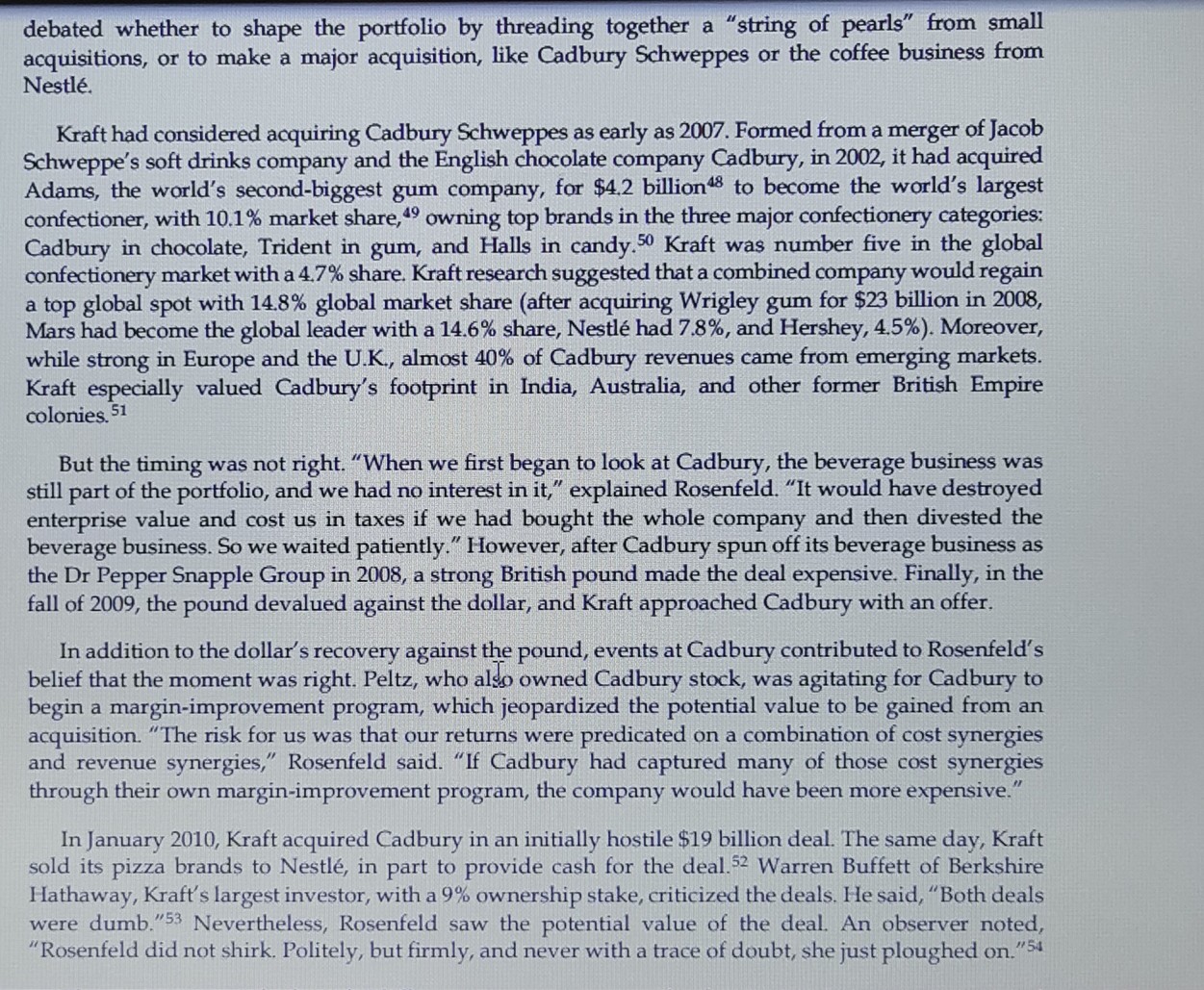
debated whether to shape the portfolio by threading together a "string of pearls" from small acquisitions, or to make a major acquisition, like Cadbury Schweppes or the coffee business from Nestl
Kraft had considered acquiring Cadbury Schweppes as early as Formed from a merger of Jacob Schweppe's soft drinks company and the English chocolate company Cadbury, in it had acquired Adams, the world's secondbiggest gum company, for $ billion to become the world's largest confectioner, with market share, owning top brands in the three major confectionery categories: Cadbury in chocolate, Trident in gum, and Halls in candy. Kraft was number five in the global confectionery market with a share. Kraft research suggested that a combined company would regain a top global spot with global market share after acquiring Wrigley gum for $ billion in Mars had become the global leader with a share, Nestl had and Hershey, Moreover, while strong in Europe and the UK almost of Cadbury revenues came from emerging markets. Kraft especially valued Cadbury's footprint in India, Australia, and other former British Empire colonies.
But the timing was not right. "When we first began to look at Cadbury, the beverage business was still part of the portfolio, and we had no interest in it explained Rosenfeld. It would have destroyed enterprise value and cost us in taxes if we had bought the whole company and then divested the beverage business. So we waited patiently." However, after Cadbury spun off its beverage business as the Dr Pepper Snapple Group in a strong British pound made the deal expensive. Finally, in the fall of the pound devalued against the dollar, and Kraft approached Cadbury with an offer.
In addition to the dollar's recovery against the pound, events at Cadbury contributed to Rosenfeld's belief that the moment was right. Peltz, who also owned Cadbury stock, was agitating for Cadbury to begin a marginimprovement program, which jeopardized the potential value to be gained from an acquisition. "The risk for us was that our returns were predicated on a combination of cost synergies and revenue synergies," Rosenfeld said. If Cadbury had captured many of those cost synergies through their own marginimprovement program, the company would have been more expensive."
In January Kraft acquired Cadbury in an initially hostile $ billion deal. The same day, Kraft sold its pizza brands to Nestl in part to provide cash for the deal. Warren Buffett of Berkshire Hathaway, Kraft's largest investor, with a ownership stake, criticized the deals. He said, "Both deals were dumb." Nevertheless, Rosenfeld saw the potential value of the deal. An observer noted, "Rosenfeld did not shirk. Politely, but firmly, and never with a trace of doubt, she just ploughed on
Step by Step Solution
There are 3 Steps involved in it
1 Expert Approved Answer
Step: 1 Unlock

Question Has Been Solved by an Expert!
Get step-by-step solutions from verified subject matter experts
Step: 2 Unlock
Step: 3 Unlock