







Question: Decide whether each statement is true, false, or uncertain, and explain why. Each question is worth 5 points - 1 for the correct true/false/uncertain
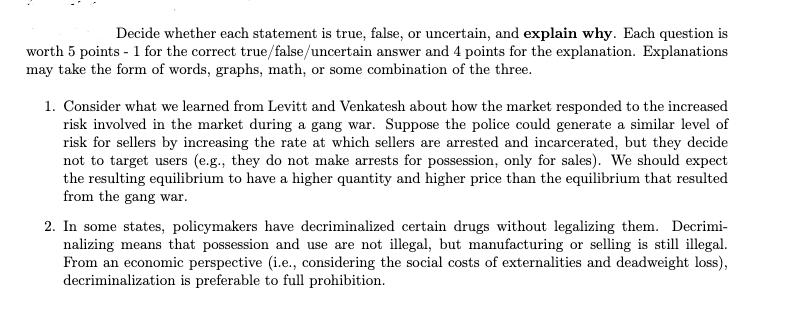
Decide whether each statement is true, false, or uncertain, and explain why. Each question is worth 5 points - 1 for the correct true/false/uncertain answer and 4 points for the explanation. Explanations may take the form of words, graphs, math, or some combination of the three. 1. Consider what we learned from Levitt and Venkatesh about how the market responded to the increased risk involved in the market during a gang war. Suppose the police could generate a similar level of risk for sellers by increasing the rate at which sellers are arrested and incarcerated, but they decide not to target users (e.g., they do not make arrests for possession, only for sales). We should expect the resulting equilibrium to have a higher quantity and higher price than the equilibrium that resulted from the gang war. 2. In some states, policymakers have decriminalized certain drugs without legalizing them. Decrimi- nalizing means that possession and use are not illegal, but manufacturing or selling is still illegal. From an economic perspective (i.e., considering the social costs of externalities and deadweight loss), decriminalization is preferable to full prohibition.
Step by Step Solution
There are 3 Steps involved in it
1 Uncertain Levitt and Venkateshs study provided insights into how the market responded to increased risk during a gang war However their findings may not directly apply to the scenario described invo... View full answer

Get step-by-step solutions from verified subject matter experts
 Study Help