







Question: Decision Makers' Perspective Apply your critical-thinking ability to the knowledge you've gained. These cases will provide you an opportunity to develop your research, analysis, judgment,
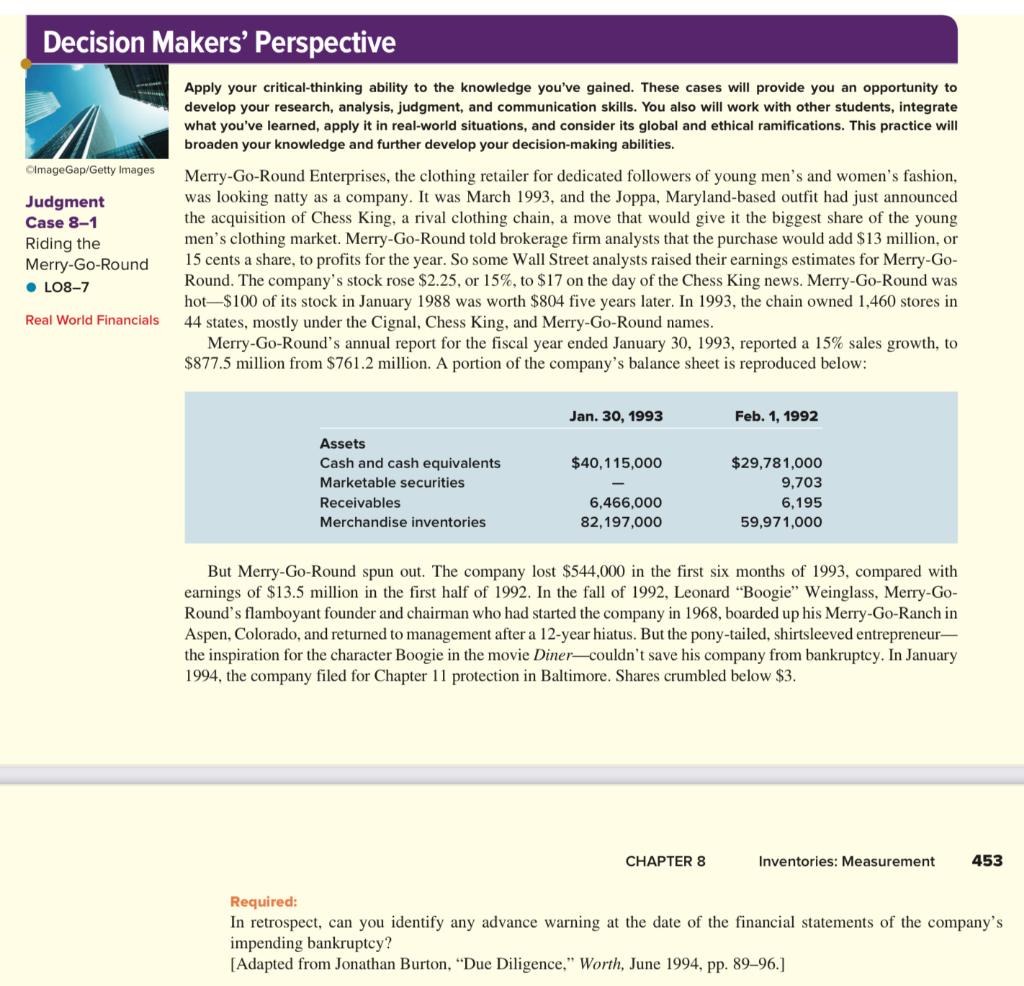
Decision Makers' Perspective Apply your critical-thinking ability to the knowledge you've gained. These cases will provide you an opportunity to develop your research, analysis, judgment, and communication skills. You also will work with other students, integrate what you've learned, apply it in real-world situations, and consider its global and ethical ramifications. This practice will broaden your knowledge and further develop your decision-making abilities. Merry-Go-Round Enterprises, the clothing retailer for dedicated followers of young men's and women's fashion, was looking natty as a company. It was March 1993, and the Joppa, Maryland-based outfit had just announced the acquisition of Chess King, a rival clothing chain, a move that would give it the biggest share of the young men's clothing market. Merry-Go-Round told brokerage firm analysts that the purchase would add $13 million, or - LO8-7 Round. The company's stock rose $2.25, or 15%, to $17 on the day of the Chess King news. Merry-Go-Round was hot-\$100 of its stock in January 1988 was worth $804 five years later. In 1993 , the chain owned 1,460 stores in Real World Financials 44 states, mostly under the Cignal, Chess King, and Merry-Go-Round names. Merry-Go-Round's annual report for the fiscal year ended January 30, 1993, reported a 15% sales growth, to $877.5 million from $761.2 million. A portion of the company's balance sheet is reproduced below: But Merry-Go-Round spun out. The company lost $544,000 in the first six months of 1993, compared with earnings of \$13.5 million in the first half of 1992. In the fall of 1992, Leonard "Boogie" Weinglass, Merry-GoRound's flamboyant founder and chairman who had started the company in 1968, boarded up his Merry-Go-Ranch in Aspen, Colorado, and returned to management after a 12 -year hiatus. But the pony-tailed, shirtsleeved entrepreneurthe inspiration for the character Boogie in the movie Diner-couldn't save his company from bankruptcy. In January 1994 , the company filed for Chapter 11 protection in Baltimore. Shares crumbled below \$3. CHAPTER 8 453 Required: In retrospect, can you identify any advance warning at the date of the financial statements of the company's impending bankruptcy? [Adapted from Jonathan Burton, "Due Diligence," Worth, June 1994, pp. 89-96.] Decision Makers' Perspective Apply your critical-thinking ability to the knowledge you've gained. These cases will provide you an opportunity to develop your research, analysis, judgment, and communication skills. You also will work with other students, integrate what you've learned, apply it in real-world situations, and consider its global and ethical ramifications. This practice will broaden your knowledge and further develop your decision-making abilities. Merry-Go-Round Enterprises, the clothing retailer for dedicated followers of young men's and women's fashion, was looking natty as a company. It was March 1993, and the Joppa, Maryland-based outfit had just announced the acquisition of Chess King, a rival clothing chain, a move that would give it the biggest share of the young men's clothing market. Merry-Go-Round told brokerage firm analysts that the purchase would add $13 million, or - LO8-7 Round. The company's stock rose $2.25, or 15%, to $17 on the day of the Chess King news. Merry-Go-Round was hot-\$100 of its stock in January 1988 was worth $804 five years later. In 1993 , the chain owned 1,460 stores in Real World Financials 44 states, mostly under the Cignal, Chess King, and Merry-Go-Round names. Merry-Go-Round's annual report for the fiscal year ended January 30, 1993, reported a 15% sales growth, to $877.5 million from $761.2 million. A portion of the company's balance sheet is reproduced below: But Merry-Go-Round spun out. The company lost $544,000 in the first six months of 1993, compared with earnings of \$13.5 million in the first half of 1992. In the fall of 1992, Leonard "Boogie" Weinglass, Merry-GoRound's flamboyant founder and chairman who had started the company in 1968, boarded up his Merry-Go-Ranch in Aspen, Colorado, and returned to management after a 12 -year hiatus. But the pony-tailed, shirtsleeved entrepreneurthe inspiration for the character Boogie in the movie Diner-couldn't save his company from bankruptcy. In January 1994 , the company filed for Chapter 11 protection in Baltimore. Shares crumbled below \$3. CHAPTER 8 453 Required: In retrospect, can you identify any advance warning at the date of the financial statements of the company's impending bankruptcy? [Adapted from Jonathan Burton, "Due Diligence," Worth, June 1994, pp. 89-96.]
Step by Step Solution
There are 3 Steps involved in it

Get step-by-step solutions from verified subject matter experts
 Study Help