





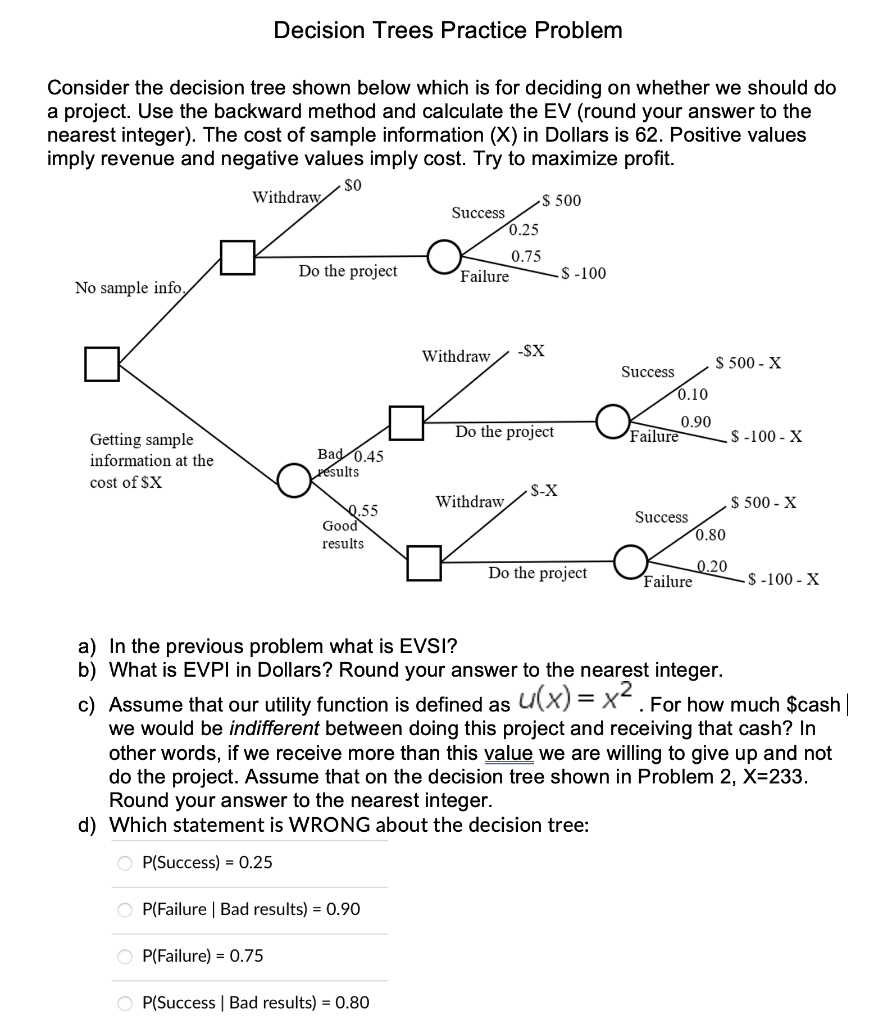
Question: Decision Trees Practice Problem Consider the decision tree shown below which is for deciding on whether we should do a project. Use the backward method
Decision Trees Practice Problem Consider the

Decision Trees Practice Problem Consider the decision tree shown below which is for deciding on whether we should do a project. Use the backward method and calculate the EV (round your answer to the nearest integer). The cost of sample information (X) in Dollars is 62 . Positive values imply revenue and negative values imply cost. Try to maximize profit. a) In the previous problem what is EVSI? b) What is EVPI in Dollars? Round your answer to the nearest integer. c) Assume that our utility function is defined as u(x)=x2. For how much $ cash we would be indifferent between doing this project and receiving that cash? In other words, if we receive more than this value we are willing to give up and not do the project. Assume that on the decision tree shown in Problem 2, X=233. Round your answer to the nearest integer. d) Which statement is WRONG about the decision tree: P( Success )=0.25 P( Failure Bad results )=0.90 P( Failure )=0.75 P( Success Bad results )=0.80 Decision Trees Practice Problem Consider the decision tree shown below which is for deciding on whether we should do a project. Use the backward method and calculate the EV (round your answer to the nearest integer). The cost of sample information (X) in Dollars is 62 . Positive values imply revenue and negative values imply cost. Try to maximize profit. a) In the previous problem what is EVSI? b) What is EVPI in Dollars? Round your answer to the nearest integer. c) Assume that our utility function is defined as u(x)=x2. For how much $ cash we would be indifferent between doing this project and receiving that cash? In other words, if we receive more than this value we are willing to give up and not do the project. Assume that on the decision tree shown in Problem 2, X=233. Round your answer to the nearest integer. d) Which statement is WRONG about the decision tree: P( Success )=0.25 P( Failure Bad results )=0.90 P( Failure )=0.75 P( Success Bad results )=0.80

Step by Step Solution

There are 3 Steps involved in it

1 Expert Approved Answer
Step: 1 Unlock blur-text-image

Question Has Been Solved by an Expert!

Get step-by-step solutions from verified subject matter experts

Step: 2 Unlock
Step: 3 Unlock

Students Have Also Explored These Related General Management Questions!