







Question: Decision-Making Steps Identify the alternatives. Evaluate the results. Select the best alternative. Evaluate the alternatives. Define the decision. Implement the chosen alternative. ffter you review
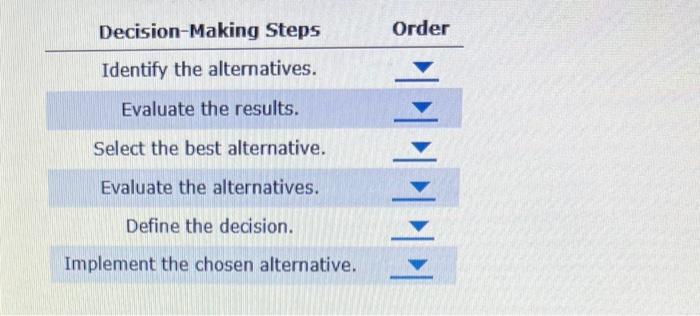
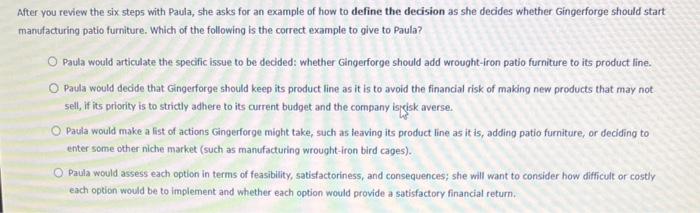
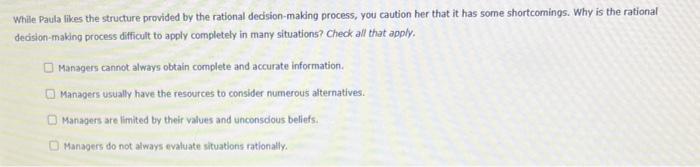
Decision-Making Steps Identify the alternatives. Evaluate the results. Select the best alternative. Evaluate the alternatives. Define the decision. Implement the chosen alternative. ffter you review the six steps with Paula, she asks for an example of how to define the decision as she dedides whether Gingerforge should start nanufacturing patio furniture. Which of the following is the correct example to give to Paula? Paula would articulate the specific issue to be dedided: whether Gingerforge should add wrought-iron patio furniture to its product line. Paula would dedide that Gingerforge should keep its product line as it is to avoid the finandal risk of making new products that may not sell, if its priority is to strictly adhere to its current budget and the company iskisk averse. Paula would make a fist of actions Gingerforge might take, such as leaving its product line as it is, adding patio furniture, or deciding to enter some other niche market (such as manufacturing wrought-iron bird cages). Paula would assess each option in terms of feasibility, satisfactoriness, and consequences; she will want to consider how difficult or costly each option would be to implement and whether each option would provide a satisfactory financial return. While Paula likes the structure provided by the rational dedision-making process, you caution her that it has some shortcomings. Why is the rational dedision-making process difficult to apply completely in many situations? Check all that apply. Managers cannot always obtain complete and accurate information. Managers usually have the resources to consider numerous alternatives. Managers are limited by their values and unconsoious beliefs. Managers do not always evaluate situations rationally
Step by Step Solution
There are 3 Steps involved in it

Get step-by-step solutions from verified subject matter experts
 Study Help