



Question: Decisions are made under differing conditions of certainty. Sometimes, managers have all the information they need to know exactly how a decision will turn out.
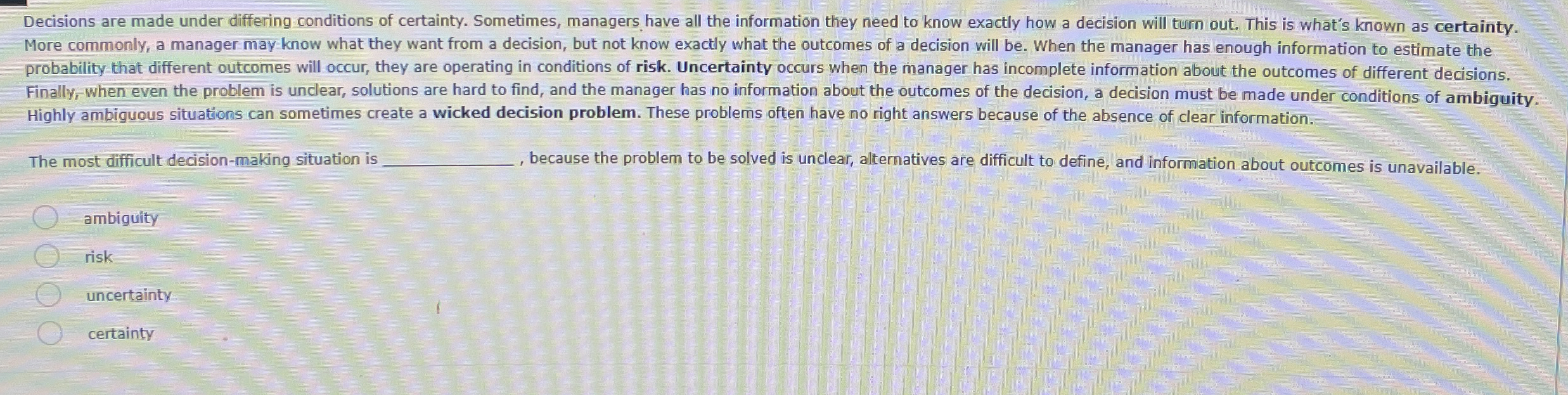
Decisions are made under differing conditions of certainty. Sometimes, managers have all the information they need to know exactly how a decision will turn out. This is what's known as certainty.
More commonly, a manager may know what they want from a decision, but not know exactly what the outcomes of a decision will be When the manager has enough information to estimate the
probability that different outcomes will occur, they are operating in conditions of risk. Uncertainty occurs when the manager has incomplete information about the outcomes of different decisions.
Finally, when even the problem is unclear, solutions are hard to find, and the manager has no information about the outcomes of the decision, a decision must be made under conditions of ambiguity.
Highly ambiguous situations can sometimes create a wicked decision problem. These problems often have no right answers because of the absence of clear information.
The most difficult decisionmaking situation is
because the problem to be solved is unclear, alternatives are difficult to define, and information about outcomes is unavailable.
ambiguity
risk
uncertainty
certainty
Step by Step Solution
There are 3 Steps involved in it
1 Expert Approved Answer
Step: 1 Unlock

Question Has Been Solved by an Expert!
Get step-by-step solutions from verified subject matter experts
Step: 2 Unlock
Step: 3 Unlock