







Question: Defence Electronics Inc December 3 1 , 2 0 2 1 . ( If information appears to be missing, change the row height to see
Defence Electronics Inc December
If information appears to be missing, change the row height to see it
Based in Winnipeg, Manitoba, Defence Electronics Inc. DEI was founded to provide security systems, facilities controls and related services. DEI established a solid reputation for quality and the business grew thanks to strong relationships with large, longterm customers in Canada and the United States.
The Research and Innovation Group RIG is the development side of the company. They are considering a new contract that will strain resources for not only RIG, but the entire company. With an upfront cost of $ million, managers understand that the cost of capital will be a key part of maintaining and improving Clearview's competitive edge. You have been asked to calculate the company's weighted average cost of capital WACC based on the following information.
Over the last five years the annual dividends on the firm's common stock have grown at percent per year and this growth is expected to continue indefinitely. A common share dividend of $ per share was recently paid. Common shares trade at $ per share. The company has authorized common shares, with common shares issued and outstanding.
The company has issued of the preferred shares authorized. The annual preferred share dividend is $ per share. The latest preferred share price is $ per share.
DEI has an outstanding bond issue, payable semiannually, that originally had a year maturity. The initial bond offering was sold years ago, at par and raised $ million dollars. To be specific bonds were sold at $ each. The yield to maturity, when they were issued, was percent. Currently, the nominal vield to maturity on bonds with a similar risk is at percent.
The company will use its current capital structure to set target weights for debt, preferred shares and common shares. Flotatio costs are percent for preferred shares, percent for common shares and percent for debt. The company's tax rat is percent. Aftertax earnings for the year will be $ million and the company has a payout ratio of percent.
Use this information to answer the questions on the following requirements
A Find market values of outstanding bonds, preferred shares and common shares:
Bonds:
a What is the market value of each bond? Enter your answer to two decimal places. eg $
b What is the total market value of bonds at DecRound your answer to whole numbers. For example, $ not $ million.
Preferred shares: What is the total market value of preferred shares at Dec Round your answer to whole numbers. For example, $ not $ million.
Common shares: What is the total market value of common shares at Dec Round your answer to whole numbers. For example, $ not $ million.
B What weights are assigned to debt, preferred shares and common equity on Dec Round all your answers to two decimal places. If you want to enter the number for example, enter not and do not enter the percent sign.
C Calculate the aftertax cost of the various components of WACC Round all your answers to two decimal places. If you want to enter the number for example, ent not and do not enter the percent sign.
Bonds
a What is the nominal yieldtomaturity?
b What is the effective yieldtomaturity?
c Calculate the aftertax cost of new debt using the effective yieldtomaturity
Preferred shares:
Common equity in the form of retained earnings:
not and do not enter the percent sign.
Bonds
a What is the nominal yieldtomaturity?
b What is the effective yieldtomaturity?
c Calculate the aftertax cost of new debt using the effective yieldtomaturity
Preferred shares:
Common equity in the form of retained earnings:
Common equity in the form of new shares:
D What is the Weighted Average Cost of Capital if:
The company uses new debt, new preferred shares and just retained earnings?
The company uses new debt, new preferred shares and new common shares?
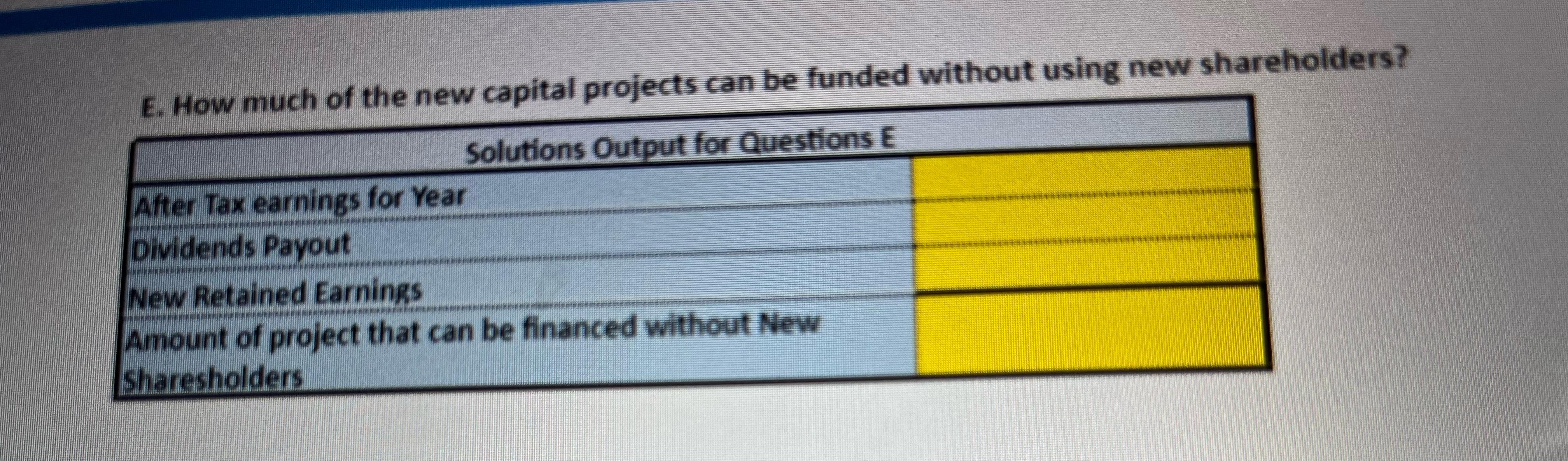
E How much of the new capital projects can be funded without using new shareholders?
Unless directed otherwise;
r Percentages should be rounded to two decimal places. If you want to enter the number for
Step by Step Solution
There are 3 Steps involved in it
1 Expert Approved Answer
Step: 1 Unlock

Question Has Been Solved by an Expert!
Get step-by-step solutions from verified subject matter experts
Step: 2 Unlock
Step: 3 Unlock
 Study Help