







Question: Define a predicate H(x, y) which has two natural numbers as arguments, G(x) which has one natural number as argument. Define set D = {1,
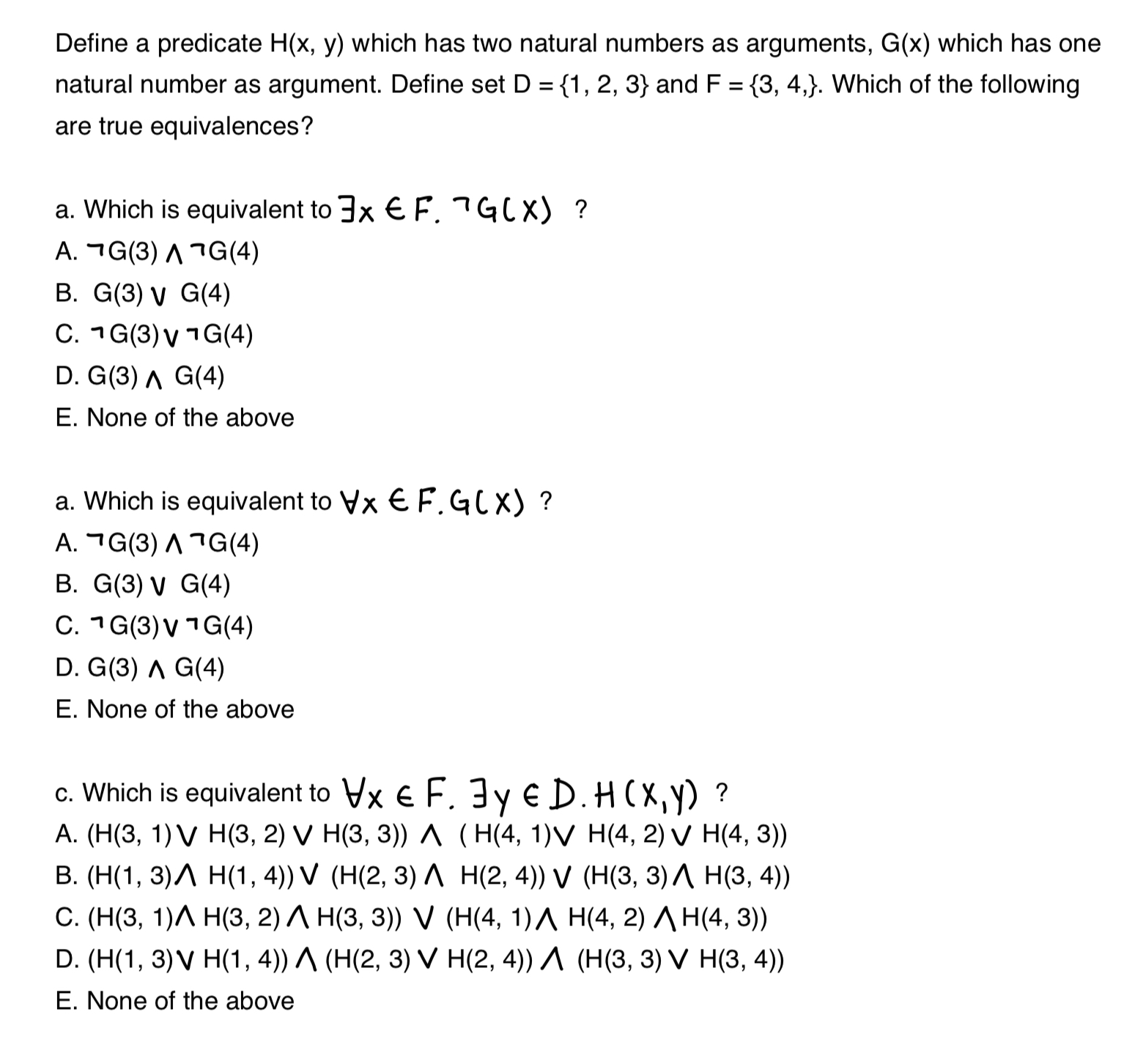
Define a predicate H(x, y) which has two natural numbers as arguments, G(x) which has one natural number as argument. Define set D = {1, 2, 3} and F = {3, 4,}. Which of the following are true equivalences? a. Which is equivalent to 3x E F. 7G(X) ? A. 7G(3) A 7G(4) B. G(3) V G(4) C. 7G(3) V 7G(4) D. G(3) A G(4) E. None of the above a. Which is equivalent to Vx E F. G(X) ? A. G(3) A 7G(4) B. G(3) V G(4) C. 7G(3) V 7G(4) D. G(3) A G(4) E. None of the above c. Which is equivalent to Vx E F. By E D. H (X,y) ? A. (H(3, 1) V H(3, 2) V H(3, 3)) A ( H(4, 1) V H(4, 2) V H(4, 3)) B. (H(1, 3)A H(1, 4)) V (H(2, 3) A H(2, 4)) V (H(3, 3) / H(3, 4) ) C. (H(3, 1)/ H(3, 2) / H(3, 3)) V (H(4, 1) / H(4, 2) A H(4, 3) ) D. (H(1, 3) V H(1, 4)) A (H(2, 3) V H(2, 4)) A (H(3, 3) V H(3, 4)) E. None of the above
Step by Step Solution
There are 3 Steps involved in it

Get step-by-step solutions from verified subject matter experts
 Study Help