







Question: define a simple voting protocol using the additive one-time-pad here. In the protocol we have a counting authority and t voters each of whom are
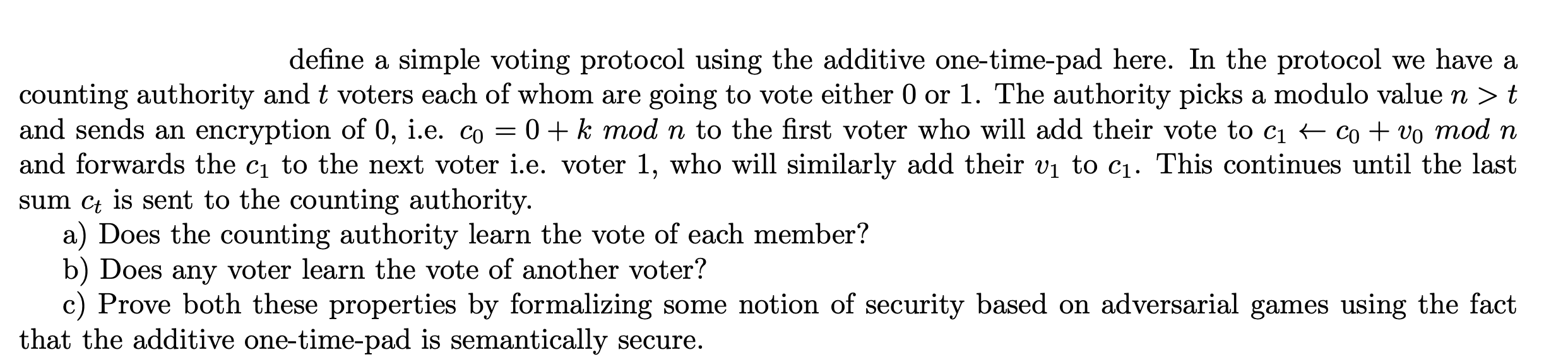
define a simple voting protocol using the additive one-time-pad here. In the protocol we have a counting authority and t voters each of whom are going to vote either 0 or 1. The authority picks a modulo value n >t and sends an encryption of 0, i.e. Co = 0 + k mod n to the first voter who will add their vote to cit co + vo mod n and forwards the ci to the next voter i.e. voter 1, who will similarly add their vi to C1. This continues until the last sum Ct is sent to the counting authority. a) Does the counting authority learn the vote of each member? b) Does any voter learn the vote of another voter? c) Prove both these properties by formalizing some notion of security based on adversarial games using the fact that the additive one-time-pad is semantically secure. define a simple voting protocol using the additive one-time-pad here. In the protocol we have a counting authority and t voters each of whom are going to vote either 0 or 1. The authority picks a modulo value n >t and sends an encryption of 0, i.e. Co = 0 + k mod n to the first voter who will add their vote to cit co + vo mod n and forwards the ci to the next voter i.e. voter 1, who will similarly add their vi to C1. This continues until the last sum Ct is sent to the counting authority. a) Does the counting authority learn the vote of each member? b) Does any voter learn the vote of another voter? c) Prove both these properties by formalizing some notion of security based on adversarial games using the fact that the additive one-time-pad is semantically secure
Step by Step Solution
There are 3 Steps involved in it

Get step-by-step solutions from verified subject matter experts
 Study Help