







Question: Define $cosh (x)=frac{e^{x}+e^{-x}}{2}$ and $sinh (x)=frac{e^{x}-e^{-x}}{2}$, and the function $$ f(x)=left{begin{array}{11} a+cosh (X), & text { if } x leq O, b x sinh left(frac{1}{x}
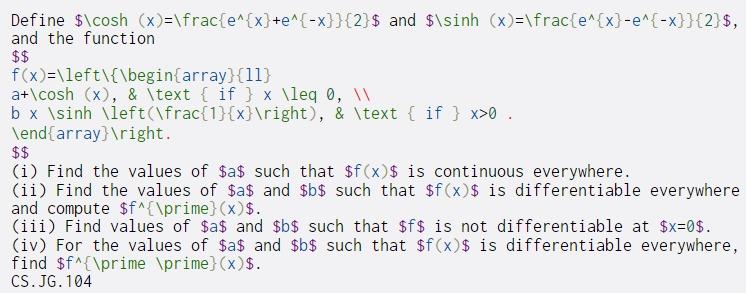
Define $\cosh (x)=\frac{e^{x}+e^{-x}}{2}$ and $\sinh (x)=\frac{e^{x}-e^{-x}}{2}$, and the function $$ f(x)=\left\{\begin{array}{11} a+\cosh (X), & \text { if } x \leq O, b x \sinh \left(\frac{1}{x} ight), & \text { if } x>0 . \end{array} ight. $$ (i) Find the values of $a$ such that $f(x)$ is continuous everywhere. (ii) Find the values of $a$ and $b$ such that $f(x)$ is differentiable everywhere and compute $f^{\prime} (x)$. (iii) Find values of $a$ and $b$ such that $f$ is not differentiable at $x=0$. (iv) For the values of $a$ and $b$ such that $f(x)$ is differentiable everywhere, find $f^{\prime \prime} (x)$. CS.JG. 104
Step by Step Solution
There are 3 Steps involved in it

Get step-by-step solutions from verified subject matter experts
 Study Help