







Question: Define customers. Why is this a difficult task for some industries? Name three industries that might have different groups of customers (i.e., end users vs.
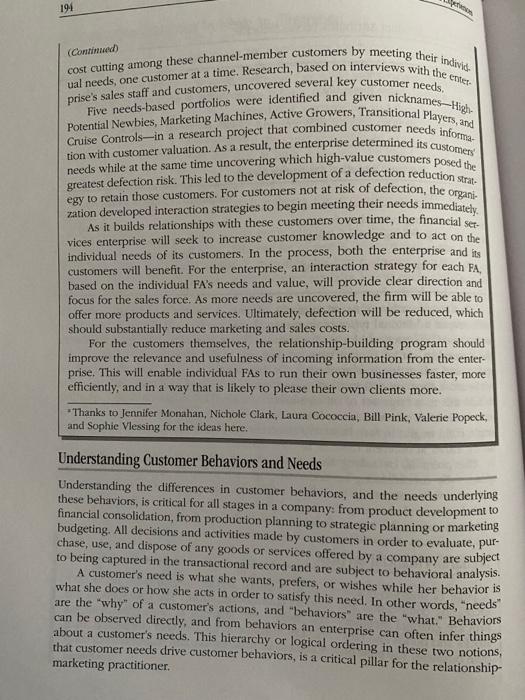
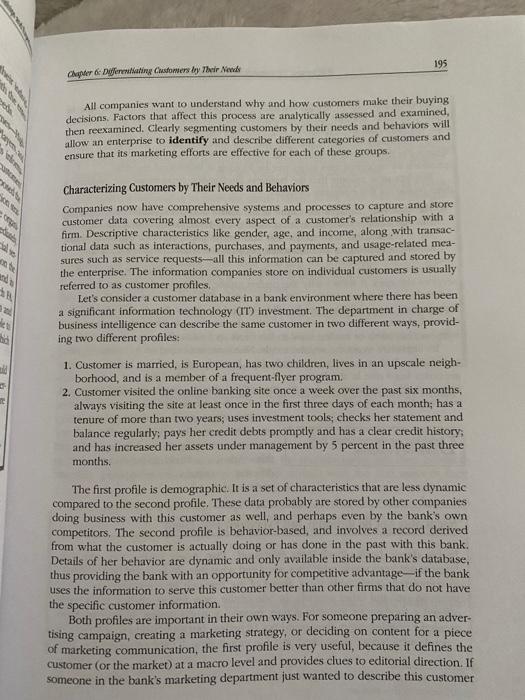
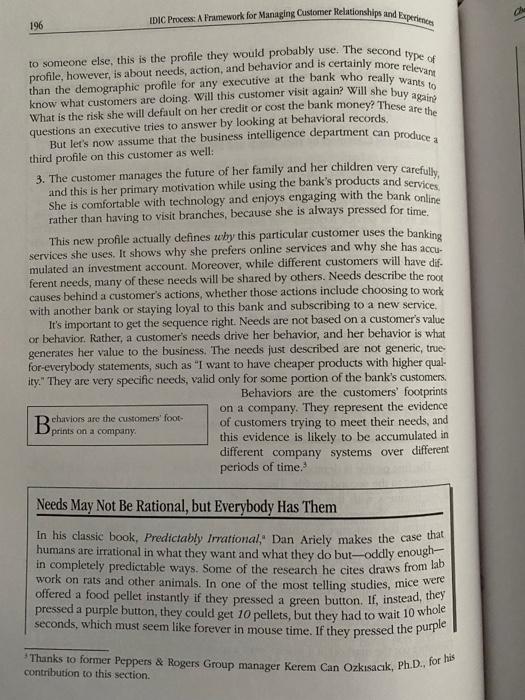
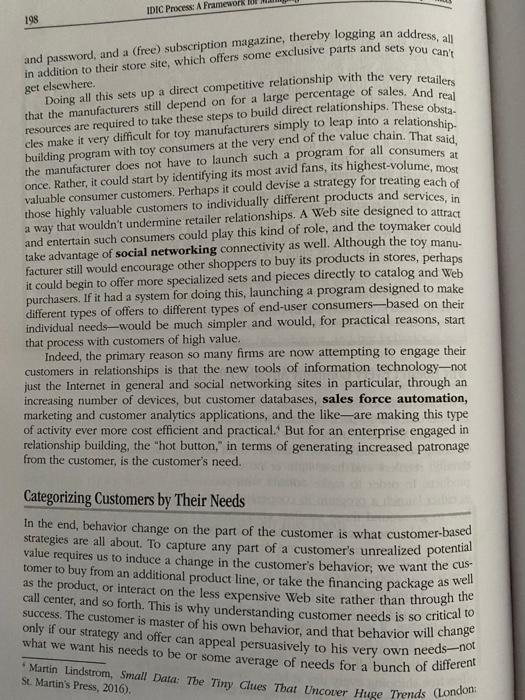
194 (Continued ual needs, one customer at a time. Research, based on interviews with the etter cost cutting among these channel-member customers by meeting their individ prise's sales staff and customers, uncovered several key customer needs. Five needs-based portfolios were identified and given nicknames-light- Potential Newbies, Marketing Machines, Active Growers, Transitional players, and Cruise Controls-in a research project that combined customer needs informa- tion with customer valuation. As a result, the enterprise determined its customers needs while at the same time uncovering which high-value customers posed the greatest defection risk. This led to the development of a defection reduction strat egy to retain those customers. For customers not at risk of defection, the organ zation developed interaction strategies to begin meeting their needs immediately As it builds relationships with these customers over time, the financial ser vices enterprise will seek to increase customer knowledge and to act on the individual needs of its customers. In the process, both the enterprise and its customers will benefit. For the enterprise, an interaction strategy for each FA based on the individual FA's needs and value, will provide clear direction and focus for the sales force. As more needs are uncovered, the firm will be able to offer more products and services. Ultimately, defection will be reduced, which should substantially reduce marketing and sales costs. For the customers themselves, the relationship-building program should improve the relevance and usefulness of incoming information from the enter- prise. This will enable individual FAs to run their own businesses faster, more efficiently, and in a way that is likely to please their own clients more. * Thanks to Jennifer Monahan, Nichole Clark, Laura Cococcia, Bill Pink, Valerie Popeck, and Sophie Vlessing for the ideas here. Understanding Customer Behaviors and Needs Understanding the differences in customer behaviors, and the needs underlying these behaviors, is critical for all stages in a company: from product development to financial consolidation, from production planning to strategic planning or marketing budgeting. All decisions and activities made by customers in order to evaluate, pur- chase, use, and dispose of any goods or services offered by a company are subject to being captured in the transactional record and are subject to behavioral analysis. A customer's need is what she wants, prefers, or wishes while her behavior is what she does or how she acts in order to satisfy this need. In other words, "needs are the "why" of a customer's actions, and "behaviors are the "what." Behaviors can be observed directly, and from behaviors an enterprise can often infer things about a customer's needs. This hierarchy or logical ordering in these two notions, that customer needs drive customer behaviors, is a critical pillar for the relationship marketing practitioner. 195 Cypher & Diereilaling Customers by Their New All companies want to understand why and how customers make their buying decisions. Factors that affect this process are analytically assessed and examined, then reexamined. Clearly segmenting customers by their needs and behaviors will allow an enterprise to identify and describe different categories of customers and ensure that its marketing efforts are effective for each of these groups. Characterizing Customers by Their Needs and Behaviors Companies now have comprehensive systems and processes to capture and store customer data covering almost every aspect of a customer's relationship with a firm. Descriptive characteristics like gender, age, and income, along with transac- tional data such as interactions, purchases, and payments, and usage-related mea- sures such as service requests all this information can be captured and stored by the enterprise. The information companies store on individual customers is usually referred to as customer profiles, Let's consider a customer database in a bank environment where there has been a significant information technology (IT) investment. The department in charge of business intelligence can describe the same customer in two different ways, provid- ing two different profiles: 1. Customer is married, is European, has two children, lives in an upscale neigh- borhood, and is a member of a frequent-flyer program. 2. Customer visited the online banking site once a week over the past six months, always visiting the site at least once in the first three days of each month; has a tenure of more than two years; uses investment tools, checks her statement and balance regularly, pays her credit debts promptly and has a clear credit history, and has increased her assets under management by 5 percent in the past three months. The first profile is demographic. It is a set of characteristics that are less dynamic compared to the second profile. These data probably are stored by other companies doing business with this customer as well, and perhaps even by the bank's own competitors. The second profile is behavior-based, and involves a record derived from what the customer is actually doing or has done in the past with this bank. Details of her behavior are dynamic and only available inside the bank's database, thus providing the bank with an opportunity for competitive advantage--if the bank uses the information to serve this customer better than other firms that do not have the specific customer information Both profiles are important in their own ways. For someone preparing an adver- tising campaign, creating a marketing strategy, or deciding on content for a piece of marketing communication, the first profile is very useful, because it defines the customer (or the market) at a macro level and provides clues to editorial direction. If someone in the bank's marketing department just wanted to describe this customer IDIC Process: A Framework for Managing Customer Relationships and Papers 196 to someone else, this is the profile they would probably use. The second type of than the demographic profile for any executive at the bank who really wants to profile, however, is about needs, action, and behavior and is certainly more relevant know what customers are doing. Will this customer visit again? Will she buy again What is the risk she will default on her credit or cost the bank money? These are the questions an executive tries to answer by looking at behavioral records. But let's now assume that the business intelligence department can produce a third profile on this customer as well: 3. The customer manages the future of her family and her children very carefully, and this is her primary motivation while using the bank's products and services She is comfortable with technology and enjoys engaging with the bank online rather than having to visit branches, because she is always pressed for time. This new profile actually defines uby this particular customer uses the banking services she uses. It shows why she prefers online services and why she has accu mulated an investment account. Moreover, while different customers will have dif- ferent needs, many of these needs will be shared by others. Needs describe the root causes behind a customer's actions, whether those actions include choosing to work with another bank or staying loyal to this bank and subscribing to a new service, It's important to get the sequence right. Needs are not based on a customer's value or behavior. Rather, a customer's needs drive her behavior, and her behavior is what generates her value to the business. The needs just described are not generic, true for-everybody statements, such as "I want to have cheaper products with higher qual- ity." They are very specific needs, valid only for some portion of the bank's customers. Behaviors are the customers' footprints chaviors are the customers' foot- on a company. They represent the evidence B of customers trying to meet their needs, and prints on a company this evidence is likely to be accumulated in different company systems over different periods of time. Needs May Not Be Rational, but Everybody Has Them In his classic book, Predictably Irrational Dan Ariely makes the case that humans are irrational in what they want and what they do but-oddly enough in completely predictable ways. Some of the research he cites draws from lab work on rats and other animals. In one of the most telling studies, mice were offered a food pellet instantly if they pressed a green button. If, instead, they pressed a purple button, they could get 10 pellets, but they had to wait 10 whole contribution to this section. * Thanks to former Peppers & Rogers Group manager Kerem Can Ozksack, Ph.D., for his 197 Chapter & Dieren dating Customers by hele Nords button, and-while they were waiting for the big reward-- had a chance to press the green button, they could not stop themselves and just had to press the green button-even after they figured out that pressing the green button stopped the delivery of the 10 pellets from the purple button. They learned that if they could not (and therefore did not press the green button, but they had already pressed the purple button, they did in fact get their 10 pellets after a delay. What did they do about this situation? Enter the red button, which, as it turns out, makes it impossible to press the green button. So the mice learned to press the purple button, then immediately press the red button, then press the green button all they wanted, but since pressing the red button had turned off the green button, the mice still got to collect the big win of 10 pellets. And this is just lab mice, managing to balance their own short- and long- term goals. Can companies do as well? And can we understand that the same customer wrestles with multiple kinds of needs at the same time? This customer needs thing: It's complicated. Dan Ariely, Predictably irrational: The Hidden Forces That Shape Our Decisions (New York: HarperCollins, 2008). Paraphrased from a story told by Dan Ariely in a keynote address to the Duke University Fuqua School of Business Marketing Club annual conference, January 27, 2010. di tebe piele merter Why Doesn't Every Company Already Differentiate Its Customers by Needs? It is reasonable to ask, if the logic outlined is so compelling, why toy manufactur- ers and other firms aren't already attempting to differentiate customers by needs. Many firms that have traditionally sold through retailers still believe that the hurdles to doing so are sizable. For example, most toy manufacturers sell their products through retailers and have little or no direct contact with the end users of their products. In order to make contact with consumers, a manufacturer would have to either launch a program in cooperation with its retailing partners or figure out how to go around those retailers altogether a course of action likely to arouse considerable resentment among the retailers themselves. So the majority of a manu- facturer's end-user consumers are destined to remain unknown to the enterprise, Moreover, even if it had its customers' identities, the manufacturer still would have to find some means of interacting with the customers individually and of process- ing their feedback, in order to learn their genuine needs. Then it would have to be able to translate those needs into different actions, requiring a mechanism for actu- ally offering and delivering different products and services to different consumers. Nevertheless, some companies, such as Lego, still sell through storefront and online retailers, but also sell directly to consumers through a Web site. Lego, for instance, offers free shipping every day at http://shop.lego.com/en-US/. Its Web site is highly interactive, keeping track of what a particular kid likes to do there by use of logic IDIC Process: A Framework for 198 address, all and password, and a (free) subscription magazine, thereby logging an in addition to their store site, which offers some exclusive parts and sets you can't get elsewhere. Doing all this sets up a direct competitive relationship with the very retailers that the manufacturers still depend on for a large percentage of sales. And rea resources are required to take these steps to build direct relationships. These obsta cles make it very difficult for toy manufacturers simply to leap into a relationship building program with toy consumers at the very end of the value chain. That said, the manufacturer does not have to launch such a program for all consumers at once. Rather , it could start by identifying its most avid fans, its highest-volume, most valuable consumer customers. Perhaps it could devise a strategy for treating each of those highly valuable customers to individually different products and services, in a way that wouldn't undermine retailer relationships. A Web site designed to attract and entertain such consumers could play this kind of role, and the toymaker could take advantage of social networking connectivity as well. Although the toy manu- facturer still would encourage other shoppers to buy its products in stores, perhaps it could begin to offer more specialized sets and pieces directly to catalog and Web purchasers. If it had a system for doing this, launching a program designed to make different types of offers to different types of end-user consumers--based on their individual needs-would be much simpler and would, for practical reasons, start that process with customers of high value. Indeed, the primary reason so many firms are now attempting to engage their customers in relationships is that the new tools of information technology-not just the Internet in general and social networking sites in particular, through an increasing number of devices, but customer databases, sales force automation, marketing and customer analytics applications, and the like-are making this type of activity ever more cost efficient and practical. But for an enterprise engaged in relationship building, the "hot button, in terms of generating increased patronage from the customer, is the customer's need Categorizing Customers by Their Needs In the end, behavior change on the part of the customer is what customer-based strategies are all about. To capture any part of a customer's unrealized potential value requires us to induce a change in the customer's behavior, we want the cus tomer to buy from an additional product line, or take the financing package as well call center, and so forth. This is why understanding customer needs is so critical be as the product , or interact on the less expensive Web site rather than through the success. The customer is master of his own behavior, and that behavior will change what we want his needs to be or some average of needs for a bunch of different only if our strategy and offer can appeal persuasively to his very own needsnor St. Martin's Press, 2016). Martin Lindstrom, Small Data: The Tiny Clues That Uncover Huge Trends (London: 199 cor & Dating Customers by Their Arad customers. Being able to see the situation from the customer's point of view is key to any successful customer-based strategy, But in order to take action, at some point, different customers must be catego- rized into different groups, based on their needs. Clearly, it would be too costly for most firms to treat every single customer with a custom-designed set of product features or services. Instead, using information technology, the customer-focused enterprise categorizes customers into finer and finer groups, based on what is known about each customer, and then matches each group with an appropriately mass customized product-and-service offering. (More about mass customization and the actual mechanics of the process in Chapter 10) One big problem is the complexity of describing and categorizing customers by their needs. There are as many dimensions and nuances to customer needs as there are analysts to imagine them. For consumers, there are deeply held beliefs, psychological predispositions, life stages, moods, ambitions, and the like. For busi- ness customers, there are business strategy differences, financial reporting horizons, collegial or hierarchical decision-making styles, and other corporate differences not to mention the individual motivations of the players within the customer orga- nizations, including decision makers, approvers, specifiers, reviewers, and others involved in shaping the company's behavior. Marketing has always relied on appealing to different customers in different ways. Market segmentation is a highly developed, sophisticated discipline, but it is based primarily on products and the appeal of product benefits rather than on cus- tomers and their broader set of needs considered in a holistic fashion for each indi- vidual customer. To address customers as different types of customers, rather than as recipients of a product's different benefits, the customer-based enterprise must think beyond market segmentation per se. Rather than grouping customers into segments based on the product's appeal, the customer-based enterprise places customers into portfolios based primarily on type of need. A market segment is made up of customers with a similar attribute. A cus- tomer portfolio is made up of customers with similar needs. The market segmen- tation approach is based on appealing to the segment's attribute, while the customer portfolio approach is based on meeting each customer's broader need, based on the customer's own worldview. If segments and portfolios were made up then red fire trucks might be in a segment of toys that included red checkers sets, red dolly makeup lipsticks, and red blocks. But red fire trucks would be in a port- folio of toys that included ambulances, fireboats, police cars, and maybe medical helicopters, along with fire hats and axes, stuffed Dalmatians, and ladders. A market segment might be composed of women, over age 45, with household incomes in excess of $50,000. A portfolio of customers might be made up of women who value friendships and like to entertain. In Chapter 13, we will discuss customer management, including the grouping of customers into portfolios. There is a continuing role for traditional market segmentation, even in a highly evolved customer-strategy enterprise, because understanding how a product's benefits match up with the attributes of different customers continues to be form of toys
Step by Step Solution
There are 3 Steps involved in it

Get step-by-step solutions from verified subject matter experts
 Study Help