







Question: Define the following Prolog predicates without using library functions (except where noted): a) increasing(List) which is true if List is a monotonically increasing list of
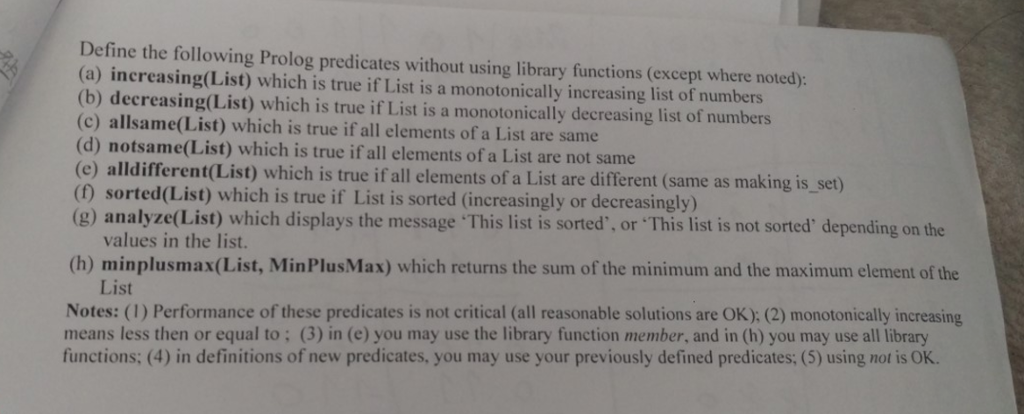
Define the following Prolog predicates without using library functions (except where noted): a) increasing(List) which is true if List is a monotonically increasing list of numbers (b) decreasing(List) which is true if List is a monotonically decreasing list of numbers (c) allsame(List) which is true if all elements of a List are same (d) notsame(List) which is true if all elements of a List are not same (e) all different(List) which is true if all elements of a List are different (same as making is_set) (f) sorted(List) which is true if List is sorted (increasingly or decreasingly) (g) analyze(List) which displays the message "This list is sorted", or 'This list is not sorted' depending on the values in the list. (h) minplusmax(List, MinPlusMax) which returns the sum of the minimum and the maximum element of the List Define the following Prolog predicates without using library functions (except where noted): a) increasing(List) which is true if List is a monotonically increasing list of numbers (b) decreasing(List) which is true if List is a monotonically decreasing list of numbers (c) allsame(List) which is true if all elements of a List are same (d) notsame(List) which is true if all elements of a List are not same (e) all different(List) which is true if all elements of a List are different (same as making is_set) (f) sorted(List) which is true if List is sorted (increasingly or decreasingly) (g) analyze(List) which displays the message "This list is sorted", or 'This list is not sorted' depending on the values in the list. (h) minplusmax(List, MinPlusMax) which returns the sum of the minimum and the maximum element of the List
Step by Step Solution
There are 3 Steps involved in it

Get step-by-step solutions from verified subject matter experts
 Study Help