







Question: Define UNIQUE and NON-UNIQUE indexes for relations 5.1.3 Relational Model Notation We will use the following notation in our presentation: A relation schema R of
Define UNIQUE and NON-UNIQUE indexes for relations
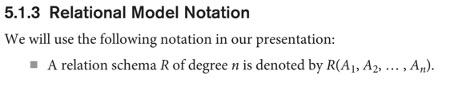
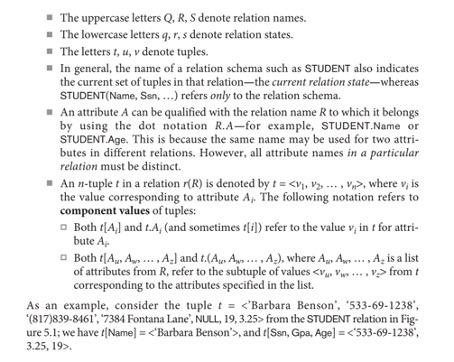
5.1.3 Relational Model Notation We will use the following notation in our presentation: A relation schema R of degree n is denoted by R(A1, A2, ..., An). The uppercase letters Q, R, S denote relation names. The lowercase letters q, r, s denote relation states. The letters t, u, v denote tuples. . In general, the name of a relation schema such as STUDENT also indicates the current set of tuples in that relation-the current relation state-whereas STUDENT(Name, Son,...) refers only to the relation schema. An attribute A can be qualified with the relation name R to which it belongs by using the dot notation R.A-for example, STUDENT.Name or STUDENT.Age. This is because the same name may be used for two attri- butes in different relations. However, all attribute names in a particular relation must be distinct. An n-tuple t in a relation (R) is denoted by t =
Step by Step Solution
There are 3 Steps involved in it

Get step-by-step solutions from verified subject matter experts
 Study Help