







Question: A random sample of ten observations is taken from the distribution with density function 1 f (x; ) = (2 4)*) T defined for
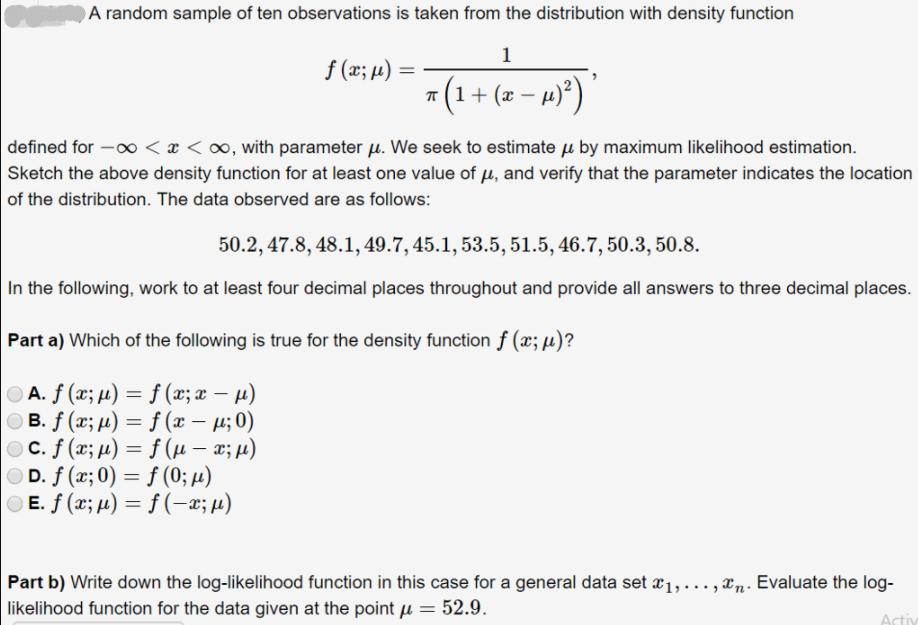
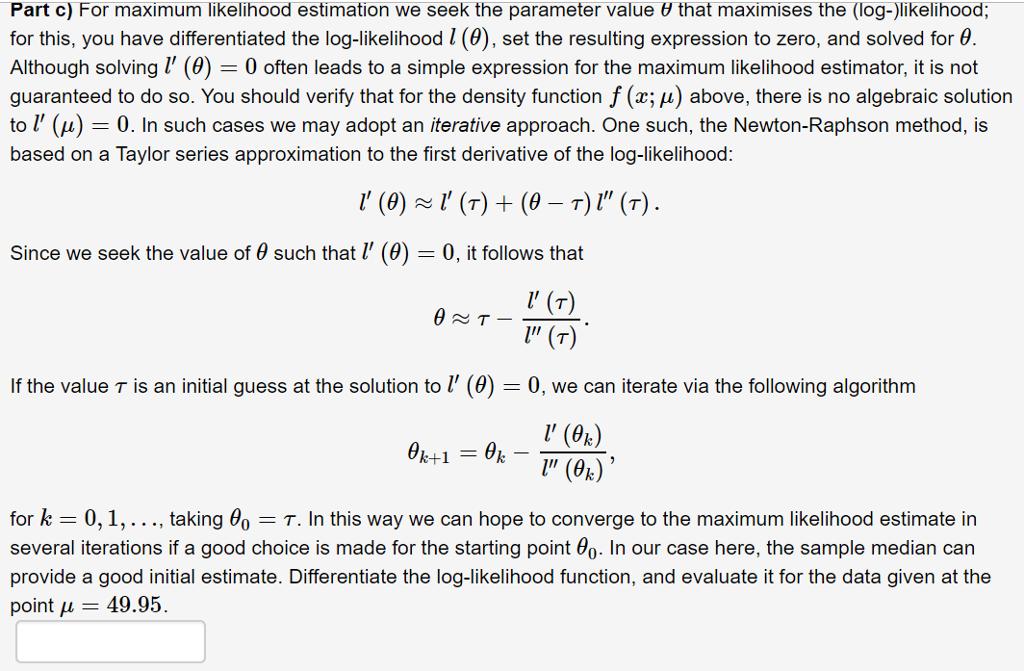
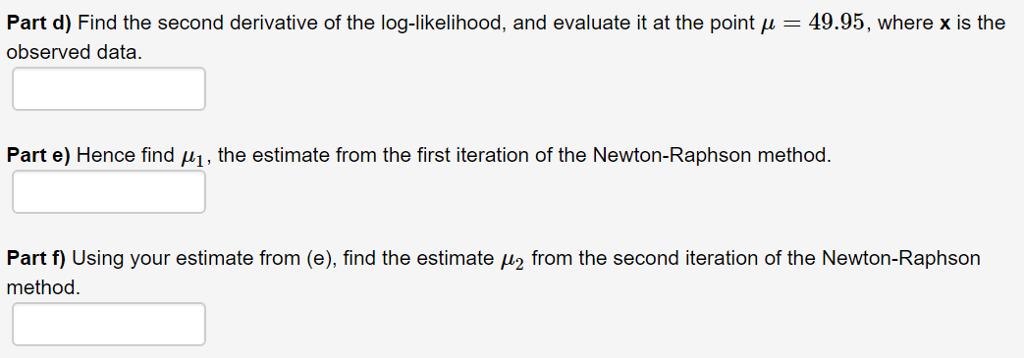
A random sample of ten observations is taken from the distribution with density function 1 f (x; ) = (2 4)*) T defined for -00 < a < o, with parameter u. We seek to estimate u by maximum likelihood estimation. Sketch the above density function for at least one value of u, and verify that the parameter indicates the location of the distribution. The data observed are as follows: 50.2, 47.8, 48.1, 49.7, 45.1, 53.5, 51.5, 46.7, 50.3, 50.8. In the following, work to at least four decimal places throughout and provide all answers to three decimal places. Part a) Which of the following is true for the density function f (x; )? O A. f (x; ) = f (x; x u) .f (r; ) -f (- 0) c. f (x; ) = f ( -; ) D. f (x; 0) = f (0; ) O E. f (x; 4) = f (-e; ) Part b) Write down the log-likelihood function in this case for a general data set a1,..., xn. Evaluate the log- likelihood function for the data given at the point u = 52.9. Artiv Part c) For maximum likelihood estimation we seek the parameter value 0 that maximises the (log-)likelihood; for this, you have differentiated the log-likelihood l (0), set the resulting expression to zero, and solved for 0. Although solving l' (0) guaranteed to do so. You should verify that for the density function f (x; u) above, there is no algebraic solution to l' (u) = 0. In such cases we may adopt an iterative approach. One such, the Newton-Raphson method, is = 0 often leads to a simple expression for the maximum likelihood estimator, it is not based on a Taylor series approximation to the first derivative of the log-likelihood: l (0) - l (T) + (0 - T) I" (7). Since we seek the value of 0 such that l' (0) = = 0, it follows that l' (T) O NT - " (7) If the value T is an initial guess at the solution to l' (0) = 0, we can iterate via the following algorithm %3D l' (Ok) T" (Ok) Ok+1 = Ok for k = 0,1,..., taking 0, = T. In this way we can hope to converge to the maximum likelihood estimate in several iterations if a good choice is made for the starting point O0. In our case here, the sample median can provide a good initial estimate. Differentiate the log-likelihood function, and evaluate it for the data given at the point u = 49.95. Part d) Find the second derivative of the log-likelihood, and evaluate it at the point u = 49.95, where x is the observed data. Part e) Hence find u1, the estimate from the first iteration of the Newton-Raphson method. Part f) Using your estimate from (e), find the estimate u, from the second iteration of the Newton-Raphson method. A random sample of ten observations is taken from the distribution with density function 1 f (x; ) = (2 4)*) T defined for -00 < a < o, with parameter u. We seek to estimate u by maximum likelihood estimation. Sketch the above density function for at least one value of u, and verify that the parameter indicates the location of the distribution. The data observed are as follows: 50.2, 47.8, 48.1, 49.7, 45.1, 53.5, 51.5, 46.7, 50.3, 50.8. In the following, work to at least four decimal places throughout and provide all answers to three decimal places. Part a) Which of the following is true for the density function f (x; )? O A. f (x; ) = f (x; x u) .f (r; ) -f (- 0) c. f (x; ) = f ( -; ) D. f (x; 0) = f (0; ) O E. f (x; 4) = f (-e; ) Part b) Write down the log-likelihood function in this case for a general data set a1,..., xn. Evaluate the log- likelihood function for the data given at the point u = 52.9. Artiv Part c) For maximum likelihood estimation we seek the parameter value 0 that maximises the (log-)likelihood; for this, you have differentiated the log-likelihood l (0), set the resulting expression to zero, and solved for 0. Although solving l' (0) guaranteed to do so. You should verify that for the density function f (x; u) above, there is no algebraic solution to l' (u) = 0. In such cases we may adopt an iterative approach. One such, the Newton-Raphson method, is = 0 often leads to a simple expression for the maximum likelihood estimator, it is not based on a Taylor series approximation to the first derivative of the log-likelihood: l (0) - l (T) + (0 - T) I" (7). Since we seek the value of 0 such that l' (0) = = 0, it follows that l' (T) O NT - " (7) If the value T is an initial guess at the solution to l' (0) = 0, we can iterate via the following algorithm %3D l' (Ok) T" (Ok) Ok+1 = Ok for k = 0,1,..., taking 0, = T. In this way we can hope to converge to the maximum likelihood estimate in several iterations if a good choice is made for the starting point O0. In our case here, the sample median can provide a good initial estimate. Differentiate the log-likelihood function, and evaluate it for the data given at the point u = 49.95. Part d) Find the second derivative of the log-likelihood, and evaluate it at the point u = 49.95, where x is the observed data. Part e) Hence find u1, the estimate from the first iteration of the Newton-Raphson method. Part f) Using your estimate from (e), find the estimate u, from the second iteration of the Newton-Raphson method. A random sample of ten observations is taken from the distribution with density function 1 f (x; ) = (2 4)*) T defined for -00 < a < o, with parameter u. We seek to estimate u by maximum likelihood estimation. Sketch the above density function for at least one value of u, and verify that the parameter indicates the location of the distribution. The data observed are as follows: 50.2, 47.8, 48.1, 49.7, 45.1, 53.5, 51.5, 46.7, 50.3, 50.8. In the following, work to at least four decimal places throughout and provide all answers to three decimal places. Part a) Which of the following is true for the density function f (x; )? O A. f (x; ) = f (x; x u) .f (r; ) -f (- 0) c. f (x; ) = f ( -; ) D. f (x; 0) = f (0; ) O E. f (x; 4) = f (-e; ) Part b) Write down the log-likelihood function in this case for a general data set a1,..., xn. Evaluate the log- likelihood function for the data given at the point u = 52.9. Artiv Part c) For maximum likelihood estimation we seek the parameter value 0 that maximises the (log-)likelihood; for this, you have differentiated the log-likelihood l (0), set the resulting expression to zero, and solved for 0. Although solving l' (0) guaranteed to do so. You should verify that for the density function f (x; u) above, there is no algebraic solution to l' (u) = 0. In such cases we may adopt an iterative approach. One such, the Newton-Raphson method, is = 0 often leads to a simple expression for the maximum likelihood estimator, it is not based on a Taylor series approximation to the first derivative of the log-likelihood: l (0) - l (T) + (0 - T) I" (7). Since we seek the value of 0 such that l' (0) = = 0, it follows that l' (T) O NT - " (7) If the value T is an initial guess at the solution to l' (0) = 0, we can iterate via the following algorithm %3D l' (Ok) T" (Ok) Ok+1 = Ok for k = 0,1,..., taking 0, = T. In this way we can hope to converge to the maximum likelihood estimate in several iterations if a good choice is made for the starting point O0. In our case here, the sample median can provide a good initial estimate. Differentiate the log-likelihood function, and evaluate it for the data given at the point u = 49.95. Part d) Find the second derivative of the log-likelihood, and evaluate it at the point u = 49.95, where x is the observed data. Part e) Hence find u1, the estimate from the first iteration of the Newton-Raphson method. Part f) Using your estimate from (e), find the estimate u, from the second iteration of the Newton-Raphson method.
Step by Step Solution
3.37 Rating (153 Votes )
There are 3 Steps involved in it
Hore we haue Xi to No t ue a cleanly a4 f x10 cored OA ONB as f Q4 haue u i... View full answer

Get step-by-step solutions from verified subject matter experts
 Study Help