


Question: DEFINITION 3.4: Let V, W be F-vector spaces, and assume B = (b1, . . . , bm) is a basis of V, and C
DEFINITION 3.4: Let V, W be F-vector spaces, andDEFINITION 3.4: Let V, W be F-vector spaces, and
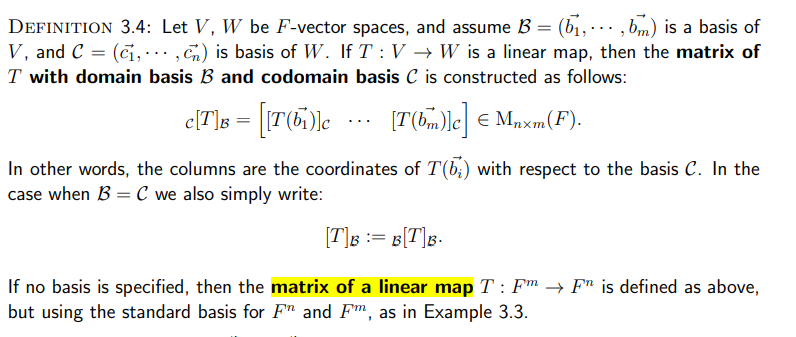
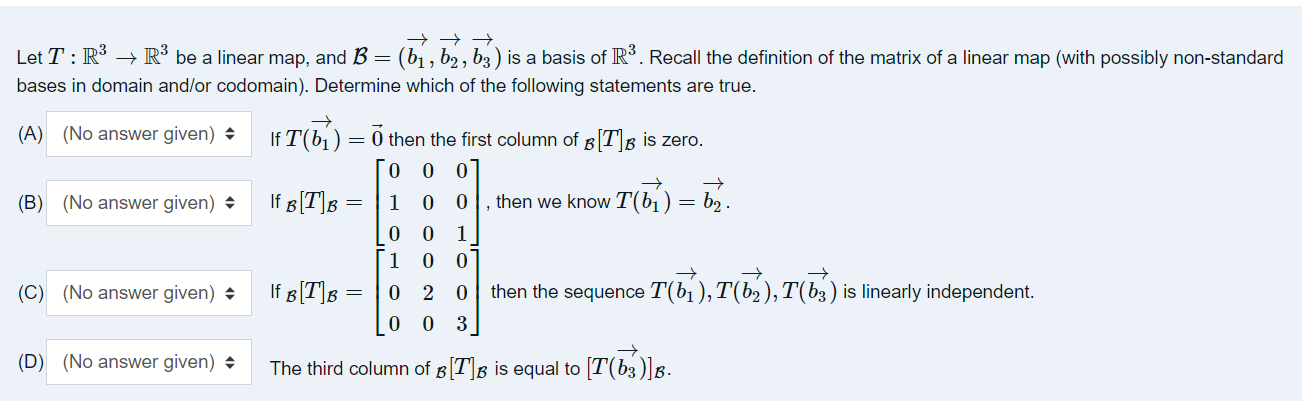
DEFINITION 3.4: Let V, W be F-vector spaces, and assume B = (b1, . . . , bm) is a basis of V, and C = (Ci, . . . , () is basis of W. If T : V - W is a linear map, then the matrix of T with domain basis B and codomain basis C is constructed as follows: c[T]B = [T(bi)lc ... IT(bm)]c E Mnxm(F). In other words, the columns are the coordinates of T(b;) with respect to the basis C. In the case when B = C we also simply write: ]B := BIT]B. If no basis is specified, then the matrix of a linear map T : Fm -> F" is defined as above, but using the standard basis for F" and Fm, as in Example 3.3.Let T : 3 - R' be a linear map, and B = (b1, b2, b3 ) is a basis of IRS . Recall the definition of the matrix of a linear map (with possibly non-standard bases in domain and/or codomain). Determine which of the following statements are true. (A) (No answer given) + If T(b1 ) = 0 then the first column of BIT] is zero. 0 0 0 (B) (No answer given) + If B T B = 1 0 0 , then we know T(bi ) = b2 . 0 01 10 0 (C) (No answer given) + If B [T]B = 0 2 0 then the sequence T(bi ), T(b2 ), T(b3 ) is linearly independent. O 0 3 (D) (No answer given) + The third column of B [T] is equal to [T(b3 ) ]B

Step by Step Solution

There are 3 Steps involved in it

1 Expert Approved Answer
Step: 1 Unlock blur-text-image

Question Has Been Solved by an Expert!

Get step-by-step solutions from verified subject matter experts

Step: 2 Unlock
Step: 3 Unlock

Students Have Also Explored These Related Mathematics Questions!