







Question: Definition of Terms: Fixed Input - is aresource which cannot be altered in the short run. Variable Input - is aresourcewhichcan vary in the short
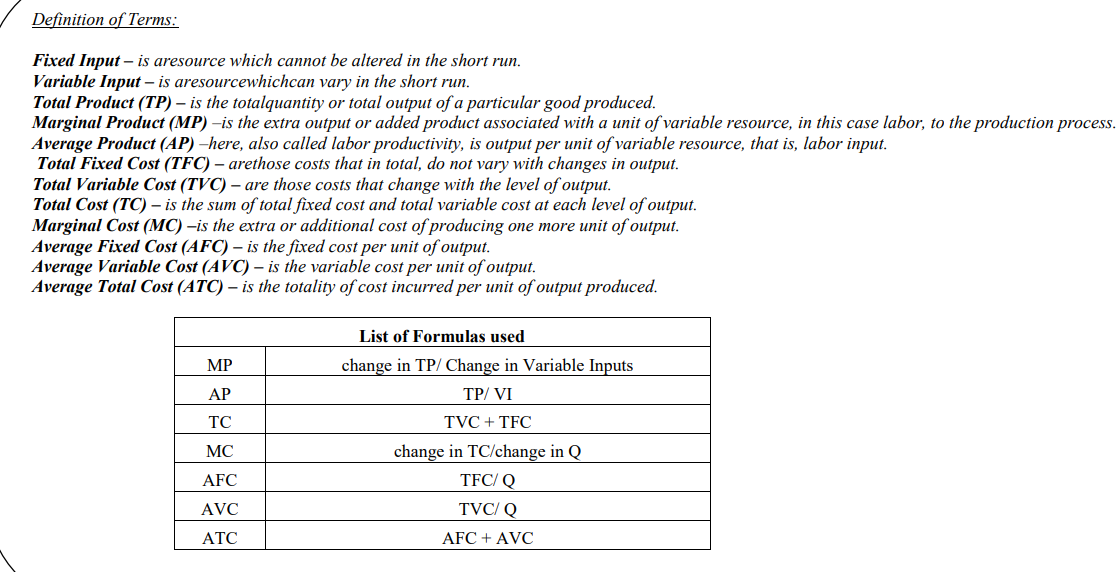
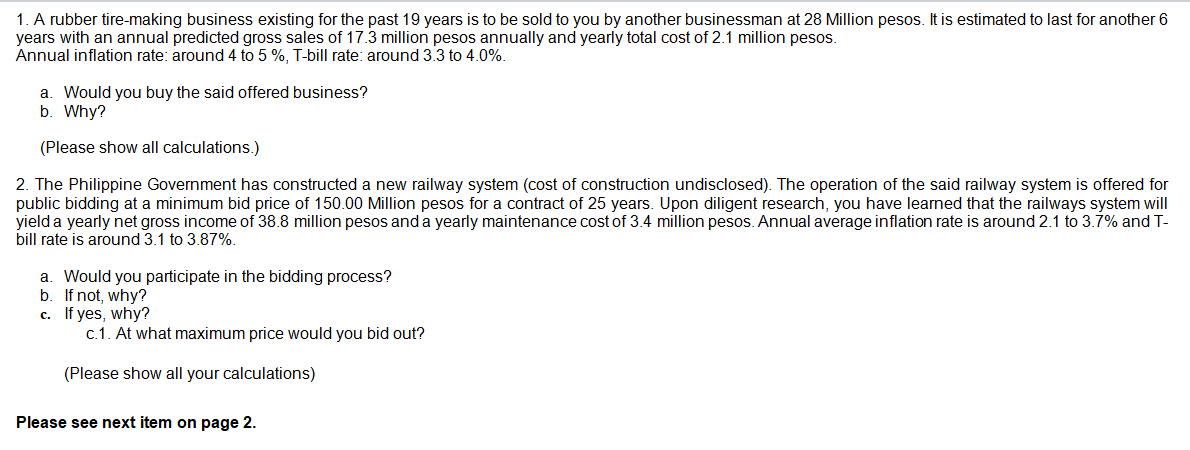
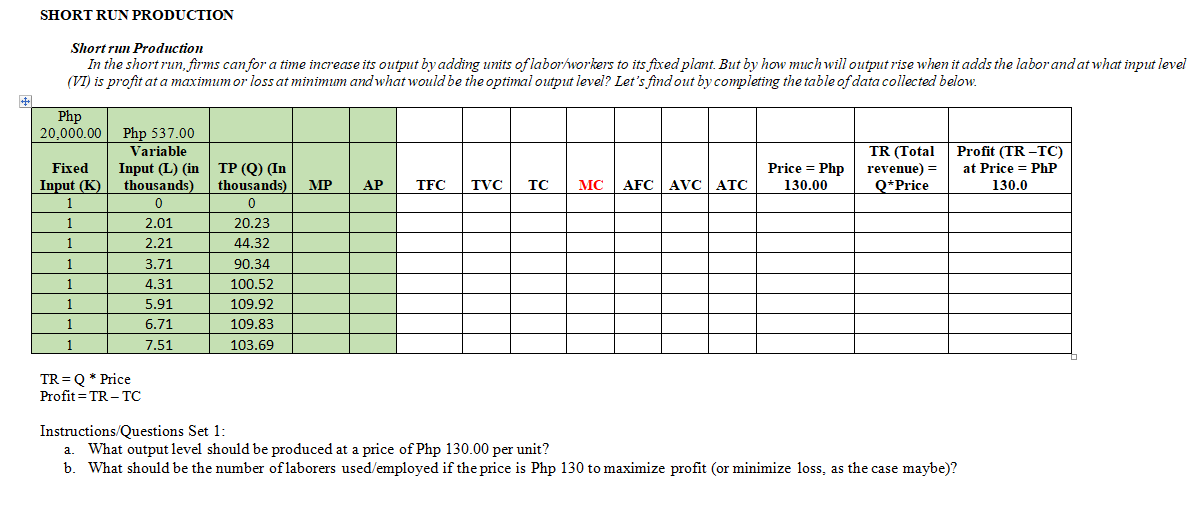
Definition of Terms: Fixed Input - is aresource which cannot be altered in the short run. Variable Input - is aresourcewhichcan vary in the short run. Total Product (TP) - is the totalquantity or total output of a particular good produced. Marginal Product (MP) -is the extra output or added product associated with a unit of variable resource, in this case labor, to the production process. Average Product (AP) -here, also called labor productivity, is output per unit of variable resource, that is, labor input. Total Fixed Cost (TFC) - arethose costs that in total, do not vary with changes in output. Total Variable Cost (TVC) - are those costs that change with the level of output. Total Cost (TC) - is the sum of total fixed cost and total variable cost at each level of output. Marginal Cost (MC) -is the extra or additional cost of producing one more unit of output. Average Fixed Cost (AFC) - is the fixed cost per unit of output. Average Variable Cost (AVC) - is the variable cost per unit of output. Average Total Cost (ATC) - is the totality of cost incurred per unit of output produced. List of Formulas used MP change in TP/ Change in Variable Inputs AP TP/ VI TC TVC + TFC MC change in TC/change in Q AFC TFC/ Q AVC TVC/ Q ATC AFC + AVC1. A anber tiremaking business existing forthe past 19 years is to be sold to you by another businessman at 23 Million pesos. It is estimated to last for another years with an annual predicted gross sales of 1?.3 million pesos annually and yearly total cost o12.1 million pesos. Annual inflation rate: around 4 to 5 %, Tbill rate: around 3.3 to 4.0%. a. Would you buy the said offered business? b. Why? (Please show all calculations.) 2. The Philippine Government has consthcted a new railway system (cost of consthction undisclosed). The operation of the said railway system is offered for public bidding at a minimum bid mice of 150.00 Million pesos for a contract o125 years. Upon diligent research, you have learned that the railways system will yield a yearly net gross income of33.3 million pesos and a yearly maintenance cost of 3.4 million pesos. Annual average ination rate is around 2.1 to 3.7% and T bill rate is around 3.1 to 3.37%. a. Would you participate in the bidding process? b. If not, why? c. If yes, why? c.1. At what maximum price would you bid out? (Please show all your calculations) Please see next item on page 2. SHORT RUN PRODUCTION Short run Production In the short run, firms can for a time increase its output by adding units of labor/workers to its fixed plant. But by how much will output rise when it adds the labor and at what input level (VI) is profit at a maximum or loss at minimum and what would be the optimal output level? Let's find out by completing the table of data collected below. Php 20,000.00 Php 537.00 Variable TR (Total Profit (TR-TC) Fixed Input (L) (in TP (Q) (In Price = Php revenue) = at Price = PhP Input (K) thousands) thousands) MP AP TFC TVC TC MC AFC AVC ATC 130.00 Q)*Price 130.0 1 0 0 2.01 20.23 2.21 44.32 3.71 90.34 4.31 100.52 5.91 109.92 6.71 109.83 7.51 103.69 TR = Q * Price Profit = TR - TC Instructions/Questions Set 1: a. What output level should be produced at a price of Php 130.00 per unit? b. What should be the number of laborers used/employed if the price is Php 130 to maximize profit (or minimize loss, as the case maybe)
Step by Step Solution
There are 3 Steps involved in it

Get step-by-step solutions from verified subject matter experts
 Study Help