







Question: deli Question Three (25 points) 5 Define and explain the main features and the differencus between accounting profit and economic profit. Also, provide the meaning
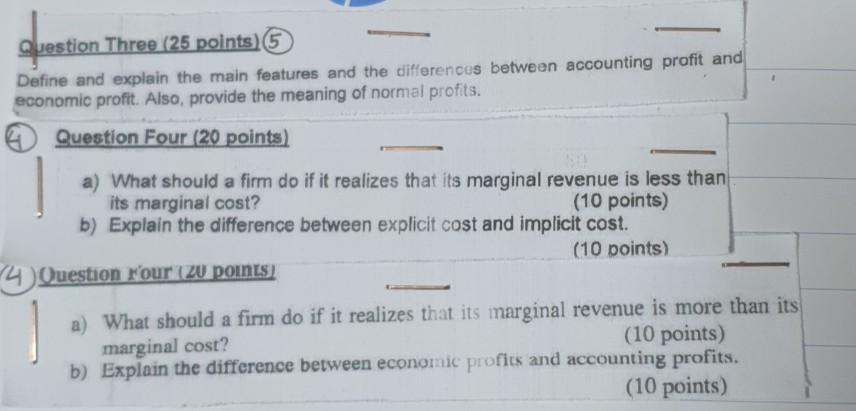
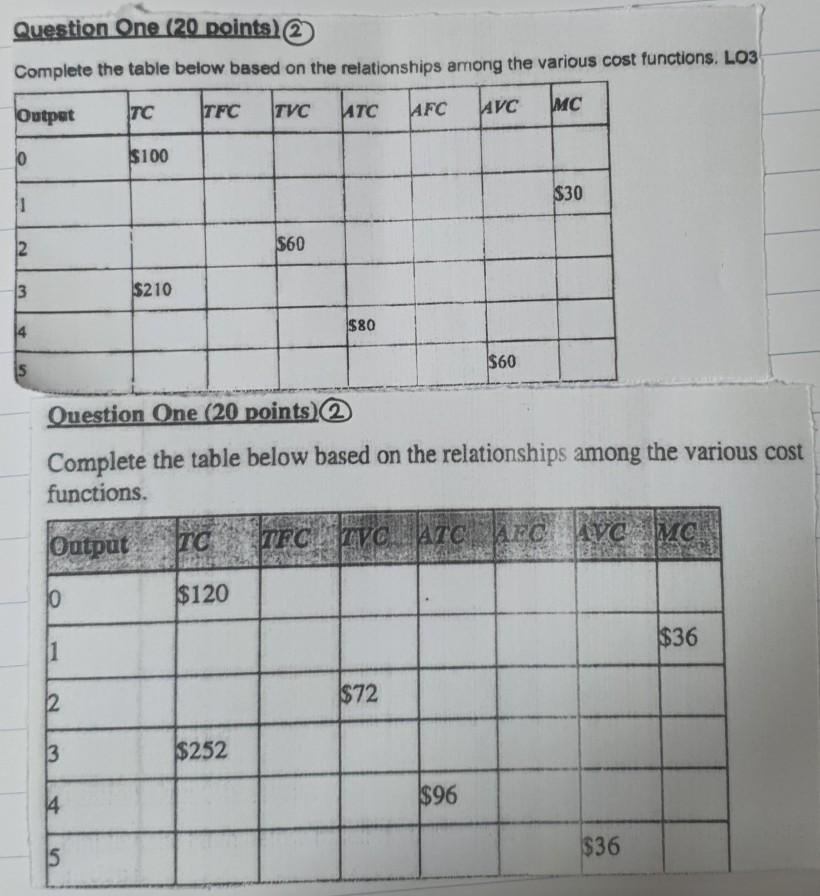
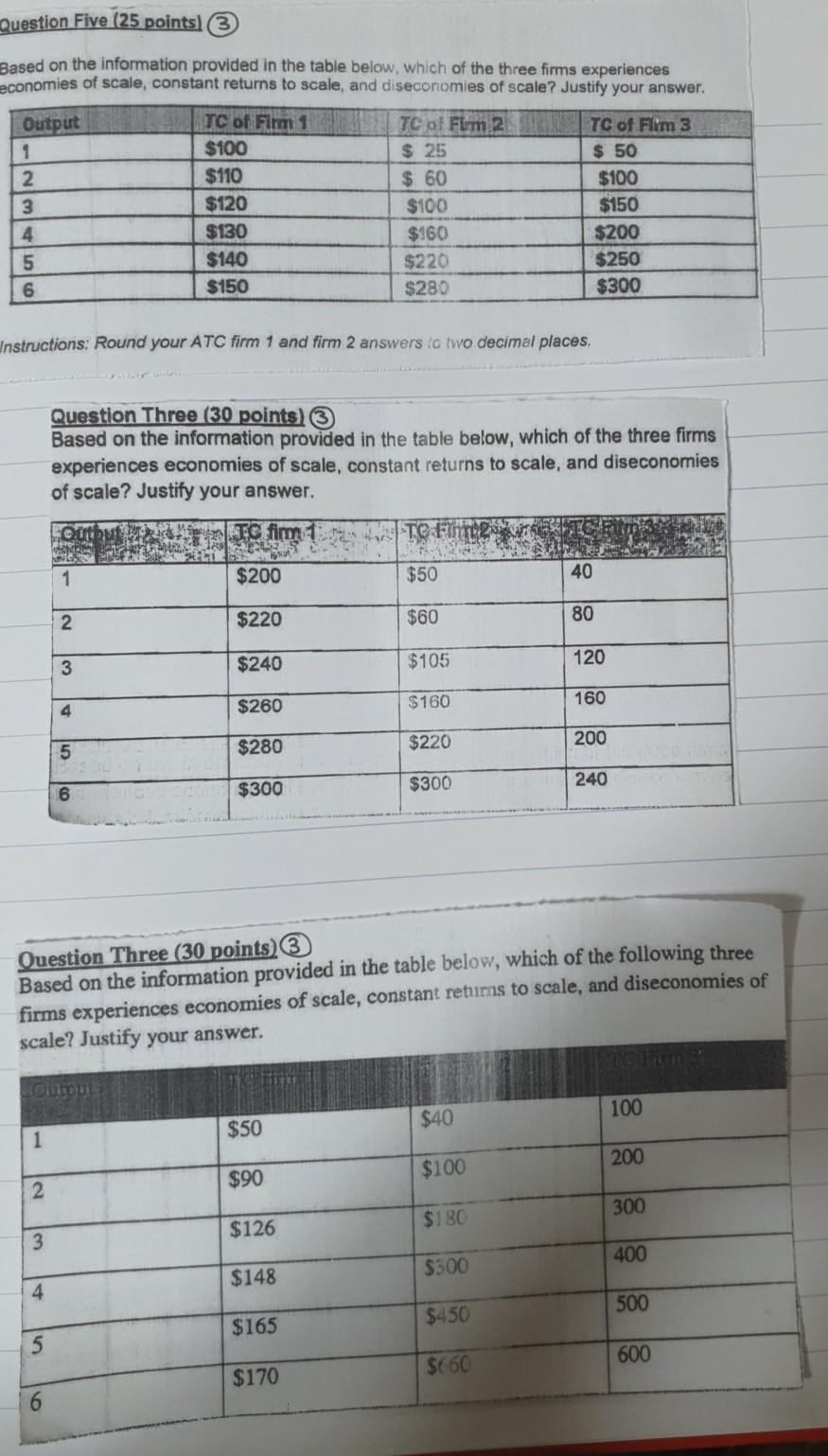
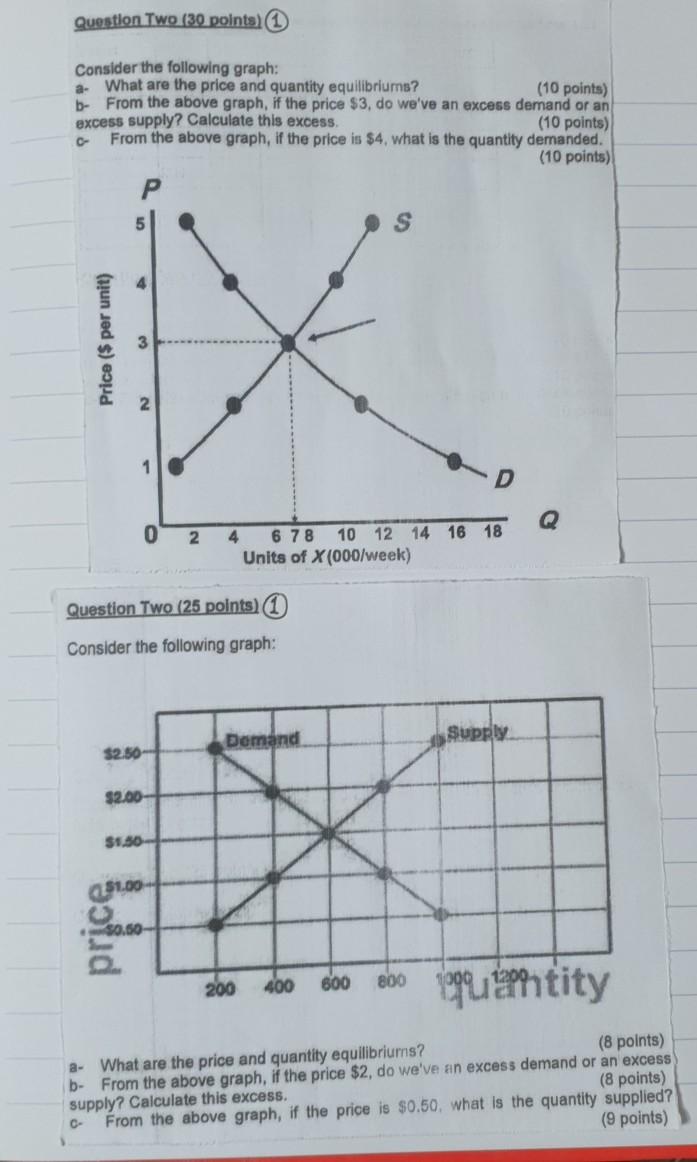
deli Question Three (25 points) 5 Define and explain the main features and the differencus between accounting profit and economic profit. Also, provide the meaning of normal profits. Question Four (20 points) a) What should a firm do if it realizes that its marginal revenue is less than its marginal cost? (10 points) b) Explain the difference between explicit cost and implicit cost. (10 points) 4 Question rour (20 points) a) What should a firm do if it realizes that its marginal revenue is more than its marginal cost? (10 points) b) Explain the difference between economic profits and accounting profits. (10 points) Question One (20 points) Complete the table below based on the relationships among the various cost functions. LO3 Outpat TC TFC TVC harc AFC Tave me 0 $100 $30 1 12 $60 3 $210 $80 14 $60 5 Question One (20 points) Complete the table below based on the relationships among the various cost functions. Output TC TEC TVC ATC AFC AVC MC 10 $120 $36 1 2 $72 3 $252 4 $96 $36 5 Question Five (25 points) (3) Based on the information provided in the table below, which of the three firms experiences economies of scale, constant returns to scale, and diseconomies of scale? Justify your answer. Output TC of Firm 1 TC of Form 2 TC of Film 3 1 $100 $ 25 $ 50 2 $110 $ 60 $100 3 $120 $100 $150 4 $130 $160 $200 5 $220 $250 6 $150 $280 $300 $140 Instructions: Round your ATC firm 1 and firm 2 answers to two decimal places, Question Three (30 points) 3 Based on the information provided in the table below, which of the three firms experiences economies of scale, constant returns to scale, and diseconomies of scale? Justify your answer. To fim 1TC FT $200 $50 40 NING 1 2 $220 $60 80 3 $240 $105 120 $160 160 4 $260 $220 200 5 $280 $300 240 6 $300 Question Three (30 points) Based on the information provided in the table below, which of the following three firms experiences economies of scale, constant returns to scale, and diseconomies of scale? Justify your answer. Lola $40 100 $50 1 200 $90 $100 2 300 $126 $180 3 400 $300 $148 4 500 $450 $165 5 600 $660 $170 6 Question Two (30 points) 1 Consider the following graph: a. What are the price and quantity equilibriums? (10 points) b- From the above graph, if the price $3, do we've an excess demand or an excess supply? Calculate this excess. (10 points) From the above graph, if the price is $4, what is the quantity demanded. (10 points) P 5 S Price ($ per unit) 2 1 D 0 24 6 78 10 12 14 16 18 Units of X (000/week) Question Two (25 points) Consider the following graph: Demand Supply $250- $2.00 - $1.50 $1.00- 50.60- 200 400 800 800 Yoquantity a- What are the price and quantity equilibriums? (8 points) b- From the above graph, if the price $2, do we've an excess demand or an excess supply? Calculate this excess. (8 points) From the above graph, if the price is $0.50, what is the quantity supplied? (9 points) C
Step by Step Solution
There are 3 Steps involved in it

Get step-by-step solutions from verified subject matter experts
 Study Help