







Question: Demonstrate how to calculate each single contract, show each step of how ypu find the answer and the formula you used clearly! Part 1(60 Points)
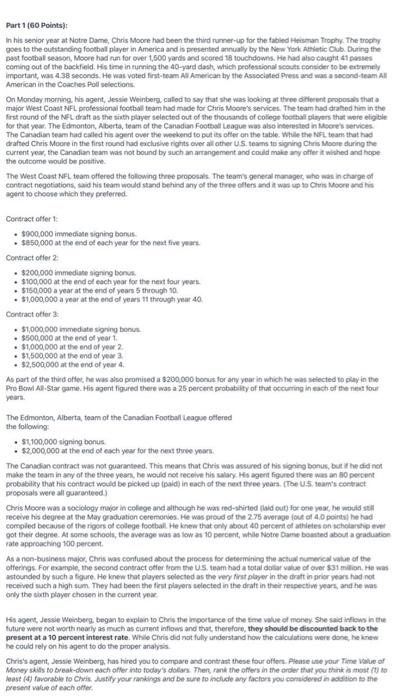
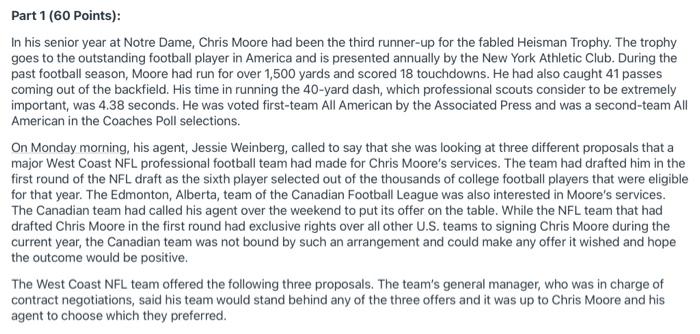
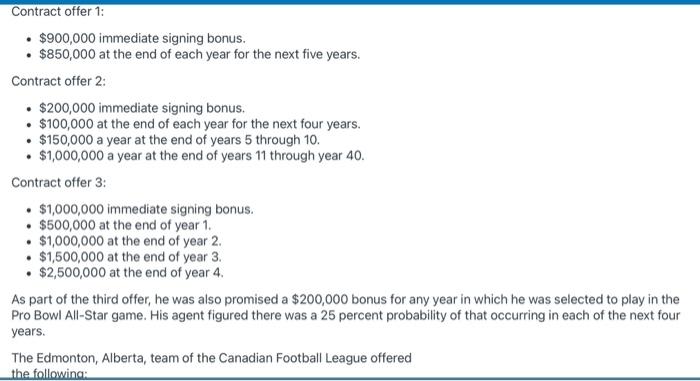
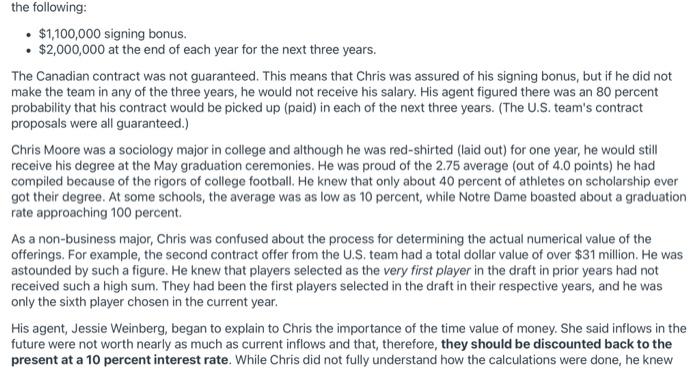
Part 1(60 Points) In his senior year at Notre Dame, Chris Moore had been the third runner-up for the fabled Heisman Trophy. The trophy goes to the outstanding football player in America and is presented annually by the New York tic Club During the past football season, Moore had run for over 500 yards and scored 18 touchdowns. He had also caught 41 postes coming out of the backfield. His time in running the 40-yard desh, which professional scouts consider to be extremely important, was 4.38 seconds. He was voted first-team An American by the Associated Press and was a second-team Al American in the Coaches Poll selections On Monday morning, his agent, Jessie Weinberg, called to say that she was looking at the different proposals that a major West Coast NFL professional football team had made for Chris Moore's services. The team had drafted him in the first round of the NFL draft as the sixth player selected out of the thousands of college football players that were eligible for that year. The Edmonton, Alberta, team of the Canadian Football League was also interested in Moore's services The Canadian team had called his agent over the weekend to put it offer on the table. While the NFL teams that had drafted Chris Moore in the first round had exclusive rights over all other US teams to signing Chris Moore during the Current you, the Canadian team was not bound by such an arrangement and could make any offers wished and hope the outcome would be positive The West Coast NFL team offered the following the proposals. The teams general manager, who was in charge of contract negotiations, said his team would stand behind any of the three offers and it was up to Chris Moore and his agent to choose which they preferred. Contract offer 1 $900.000 immediate signing bonus . $850,000 at the end of each year for the five years Contract offer 2 . $200.000 immediate signing bonus $100,000 at the end of each year for the next four years $150.000 a year at the end of years through 10 . $1,000,000 a year at the end of years 11 through year 40 Contract offer $1,000,000 immediate signing bonus . $500,000 at the end of yeart . $1,000,000 at the end of yow 2 . 31,500,000 at the end of year 3 . $2,500.000 at the end of year 4 As part of the third ofter, he was also promised a $200,000 bonus for any year in which he was selected to play in the Pro Bowl Al-Star Game. His agent figured there was a 25 percent probability of that occurring in each of the next four The Edmonton, Alberta, team of the Canadian Football League offered the following: . $1100,000 signing bonus $2,000,000 at the end of each year for the next three years The Canadian contract was not guaranteed. This means that Chris was assured of his signing bonus, but he did not make the team in any of the three yean, he would not receive his salary. His agerit figured there was an 80 percent probability that his contract would be picked up (id) in each of the next three years. (The U.S. sean's contract proposals were all guaranteed) Chris Moore wm a sociology major in college and although he was red-shirted (laid out for one year he would still receive his degree at the May graduation ceremonies. He was proud of the 2.75 average fout of 40 points he had compled because of the rigors of college football. He knew that only about 40 percent of athletes on scholarship ever got their degree. At some schools, the average was as low as 10 percent, while Notre Dame bosted about a graduation rate approaching 100 percent As a non-business major, Chris was confused about the process for determining the actual numerical value of the offerings. For example, the second contract offer from the US, team had a total doar value of over 531 million. He was astounded by such a figure. He knew that players selected as the very first player in the draftin prior years had not received such a high sum. They had been the first players selected in the dratt in their respective years and he was only the sixth player chose in the current you His agent, Jessie Weinberg, began to explain to Chris the importance of the time value of money. She said inflows in the future were not worth nearly as much as current inflows and that therefore, they should be discounted back to the present at a 10 percent interest rate. While Chris did not fully understand how the calculations were done he knew he could rely on his agent to do the proper analysis Chris's agent, Jessie Weinberg, has hired you to compare and contrast these four offers. Please use your Time of Money skills to break down each offer into today's dollars. The rank the offers in the order that you think is most o to least (6) favorable to Chris Justify your rankings and be sure to include any factors you considered in addition to the present value of each offer Part 1 (60 Points): In his senior year at Notre Dame, Chris Moore had been the third runner-up for the fabled Heisman Trophy. The trophy goes to the outstanding football player in America and is presented annually by the New York Athletic Club. During the past football season, Moore had run for over 1,500 yards and scored 18 touchdowns. He had also caught 41 passes coming out of the backfield. His time in running the 40-yard dash, which professional scouts consider to be extremely important, was 4.38 seconds. He was voted first-team All American by the Associated Press and was a second-team All American in the Coaches Poll selections. On Monday morning, his agent, Jessie Weinberg, called to say that she was looking at three different proposals that a major West Coast NFL professional football team had made for Chris Moore's services. The team had drafted him in the first round of the NFL draft as the sixth player selected out of the thousands of college football players that were eligible for that year. The Edmonton, Alberta, team of the Canadian Football League was also interested in Moore's services. The Canadian team had called his agent over the weekend to put its offer on the table. While the NFL team that had drafted Chris Moore in the first round had exclusive rights over all other U.S. teams to signing Chris Moore during the current year, the Canadian team was not bound by such an arrangement and could make any offer it wished and hope the outcome would be positive. The West Coast NFL team offered the following three proposals. The team's general manager, who was in charge of contract negotiations, said his team would stand behind any of the three offers and it was up to Chris Moore and his agent to choose which they preferred. Contract offer 1: $900,000 immediate signing bonus. $850,000 at the end of each year for the next five years. Contract offer 2: $200,000 immediate signing bonus. $100,000 at the end of each year for the next four years. $150,000 a year at the end of years 5 through 10. $1,000,000 a year at the end of years 11 through year 40. Contract offer 3: $1,000,000 immediate signing bonus. $500,000 at the end of year 1. $1,000,000 at the end of year 2. $1,500,000 at the end of year 3. $2,500,000 at the end of year 4. As part of the third offer, he was also promised a $200,000 bonus for any year in which he was selected to play in the Pro Bowl All-Star game. His agent figured there was a 25 percent probability of that occurring in each of the next four years. The Edmonton, Alberta, team of the Canadian Football League offered the following: the following: $1,100,000 signing bonus. $2,000,000 at the end of each year for the next three years. The Canadian contract was not guaranteed. This means that Chris was assured of his signing bonus, but if he did not make the team in any of the three years, he would not receive his salary. His agent figured there was an 80 percent probability that his contract would be picked up (paid) in each of the next three years. (The U.S. team's contract proposals were all guaranteed.) Chris Moore was a sociology major in college and although he was red-shirted (laid out) for one year, he would still receive his degree at the May graduation ceremonies. He was proud of the 2.75 average (out of 4.0 points) he had compiled because of the rigors of college football. He knew that only about 40 percent of athletes on scholarship ever got their degree. At some schools, the average was as low as 10 percent, while Notre Dame boasted about a graduation rate approaching 100 percent. As a non-business major, Chris was confused about the process for determining the actual numerical value of the offerings. For example, the second contract offer from the U.S. team had a total dollar value of over $31 million. He was astounded by such a figure. He knew that players selected as the very first player in the draft in prior years had not received such a high sum. They had been the first players selected in the draft in their respective years, and he was only the sixth player chosen in the current year. His agent, Jessie Weinberg, began to explain to Chris the importance of the time value of money. She said inflows in the future were not worth nearly as much as current inflows and that, therefore, they should be discounted back to the present at a 10 percent interest rate. While Chris did not fully understand how the calculations were done, he knew His agent, Jessie Weinberg, began to explain to Chris the importance of the time value of money, She said inflows in the future were not worth nearly as much as current inflows and that, therefore, they should be discounted back to the present at a 10 percent interest rate. While Chris did not fully understand how the calculations were done, he knew he could rely on his agent to do the proper analysis. Chris's agent, Jessie Weinberg, has hired you to compare and contrast these four offers. Please use your Time Value of Money skills to break-down each offer into today's dollars. Then, rank the offers in the order that you think is most (1) to least (4) favorable to Chris, Justify your rankings and be sure to include any factors you considered in addition to the present value of each offer. Part 1(60 Points) In his senior year at Notre Dame, Chris Moore had been the third runner-up for the fabled Heisman Trophy. The trophy goes to the outstanding football player in America and is presented annually by the New York tic Club During the past football season, Moore had run for over 500 yards and scored 18 touchdowns. He had also caught 41 postes coming out of the backfield. His time in running the 40-yard desh, which professional scouts consider to be extremely important, was 4.38 seconds. He was voted first-team An American by the Associated Press and was a second-team Al American in the Coaches Poll selections On Monday morning, his agent, Jessie Weinberg, called to say that she was looking at the different proposals that a major West Coast NFL professional football team had made for Chris Moore's services. The team had drafted him in the first round of the NFL draft as the sixth player selected out of the thousands of college football players that were eligible for that year. The Edmonton, Alberta, team of the Canadian Football League was also interested in Moore's services The Canadian team had called his agent over the weekend to put it offer on the table. While the NFL teams that had drafted Chris Moore in the first round had exclusive rights over all other US teams to signing Chris Moore during the Current you, the Canadian team was not bound by such an arrangement and could make any offers wished and hope the outcome would be positive The West Coast NFL team offered the following the proposals. The teams general manager, who was in charge of contract negotiations, said his team would stand behind any of the three offers and it was up to Chris Moore and his agent to choose which they preferred. Contract offer 1 $900.000 immediate signing bonus . $850,000 at the end of each year for the five years Contract offer 2 . $200.000 immediate signing bonus $100,000 at the end of each year for the next four years $150.000 a year at the end of years through 10 . $1,000,000 a year at the end of years 11 through year 40 Contract offer $1,000,000 immediate signing bonus . $500,000 at the end of yeart . $1,000,000 at the end of yow 2 . 31,500,000 at the end of year 3 . $2,500.000 at the end of year 4 As part of the third ofter, he was also promised a $200,000 bonus for any year in which he was selected to play in the Pro Bowl Al-Star Game. His agent figured there was a 25 percent probability of that occurring in each of the next four The Edmonton, Alberta, team of the Canadian Football League offered the following: . $1100,000 signing bonus $2,000,000 at the end of each year for the next three years The Canadian contract was not guaranteed. This means that Chris was assured of his signing bonus, but he did not make the team in any of the three yean, he would not receive his salary. His agerit figured there was an 80 percent probability that his contract would be picked up (id) in each of the next three years. (The U.S. sean's contract proposals were all guaranteed) Chris Moore wm a sociology major in college and although he was red-shirted (laid out for one year he would still receive his degree at the May graduation ceremonies. He was proud of the 2.75 average fout of 40 points he had compled because of the rigors of college football. He knew that only about 40 percent of athletes on scholarship ever got their degree. At some schools, the average was as low as 10 percent, while Notre Dame bosted about a graduation rate approaching 100 percent As a non-business major, Chris was confused about the process for determining the actual numerical value of the offerings. For example, the second contract offer from the US, team had a total doar value of over 531 million. He was astounded by such a figure. He knew that players selected as the very first player in the draftin prior years had not received such a high sum. They had been the first players selected in the dratt in their respective years and he was only the sixth player chose in the current you His agent, Jessie Weinberg, began to explain to Chris the importance of the time value of money. She said inflows in the future were not worth nearly as much as current inflows and that therefore, they should be discounted back to the present at a 10 percent interest rate. While Chris did not fully understand how the calculations were done he knew he could rely on his agent to do the proper analysis Chris's agent, Jessie Weinberg, has hired you to compare and contrast these four offers. Please use your Time of Money skills to break down each offer into today's dollars. The rank the offers in the order that you think is most o to least (6) favorable to Chris Justify your rankings and be sure to include any factors you considered in addition to the present value of each offer Part 1 (60 Points): In his senior year at Notre Dame, Chris Moore had been the third runner-up for the fabled Heisman Trophy. The trophy goes to the outstanding football player in America and is presented annually by the New York Athletic Club. During the past football season, Moore had run for over 1,500 yards and scored 18 touchdowns. He had also caught 41 passes coming out of the backfield. His time in running the 40-yard dash, which professional scouts consider to be extremely important, was 4.38 seconds. He was voted first-team All American by the Associated Press and was a second-team All American in the Coaches Poll selections. On Monday morning, his agent, Jessie Weinberg, called to say that she was looking at three different proposals that a major West Coast NFL professional football team had made for Chris Moore's services. The team had drafted him in the first round of the NFL draft as the sixth player selected out of the thousands of college football players that were eligible for that year. The Edmonton, Alberta, team of the Canadian Football League was also interested in Moore's services. The Canadian team had called his agent over the weekend to put its offer on the table. While the NFL team that had drafted Chris Moore in the first round had exclusive rights over all other U.S. teams to signing Chris Moore during the current year, the Canadian team was not bound by such an arrangement and could make any offer it wished and hope the outcome would be positive. The West Coast NFL team offered the following three proposals. The team's general manager, who was in charge of contract negotiations, said his team would stand behind any of the three offers and it was up to Chris Moore and his agent to choose which they preferred. Contract offer 1: $900,000 immediate signing bonus. $850,000 at the end of each year for the next five years. Contract offer 2: $200,000 immediate signing bonus. $100,000 at the end of each year for the next four years. $150,000 a year at the end of years 5 through 10. $1,000,000 a year at the end of years 11 through year 40. Contract offer 3: $1,000,000 immediate signing bonus. $500,000 at the end of year 1. $1,000,000 at the end of year 2. $1,500,000 at the end of year 3. $2,500,000 at the end of year 4. As part of the third offer, he was also promised a $200,000 bonus for any year in which he was selected to play in the Pro Bowl All-Star game. His agent figured there was a 25 percent probability of that occurring in each of the next four years. The Edmonton, Alberta, team of the Canadian Football League offered the following: the following: $1,100,000 signing bonus. $2,000,000 at the end of each year for the next three years. The Canadian contract was not guaranteed. This means that Chris was assured of his signing bonus, but if he did not make the team in any of the three years, he would not receive his salary. His agent figured there was an 80 percent probability that his contract would be picked up (paid) in each of the next three years. (The U.S. team's contract proposals were all guaranteed.) Chris Moore was a sociology major in college and although he was red-shirted (laid out) for one year, he would still receive his degree at the May graduation ceremonies. He was proud of the 2.75 average (out of 4.0 points) he had compiled because of the rigors of college football. He knew that only about 40 percent of athletes on scholarship ever got their degree. At some schools, the average was as low as 10 percent, while Notre Dame boasted about a graduation rate approaching 100 percent. As a non-business major, Chris was confused about the process for determining the actual numerical value of the offerings. For example, the second contract offer from the U.S. team had a total dollar value of over $31 million. He was astounded by such a figure. He knew that players selected as the very first player in the draft in prior years had not received such a high sum. They had been the first players selected in the draft in their respective years, and he was only the sixth player chosen in the current year. His agent, Jessie Weinberg, began to explain to Chris the importance of the time value of money. She said inflows in the future were not worth nearly as much as current inflows and that, therefore, they should be discounted back to the present at a 10 percent interest rate. While Chris did not fully understand how the calculations were done, he knew His agent, Jessie Weinberg, began to explain to Chris the importance of the time value of money, She said inflows in the future were not worth nearly as much as current inflows and that, therefore, they should be discounted back to the present at a 10 percent interest rate. While Chris did not fully understand how the calculations were done, he knew he could rely on his agent to do the proper analysis. Chris's agent, Jessie Weinberg, has hired you to compare and contrast these four offers. Please use your Time Value of Money skills to break-down each offer into today's dollars. Then, rank the offers in the order that you think is most (1) to least (4) favorable to Chris, Justify your rankings and be sure to include any factors you considered in addition to the present value of each offer
Step by Step Solution
There are 3 Steps involved in it

Get step-by-step solutions from verified subject matter experts
 Study Help