







Question: Demonstrate the basic techniques of concurrency control and their application. Suppose the table Course in Q3 includes an additional column capacity. A student may enrol
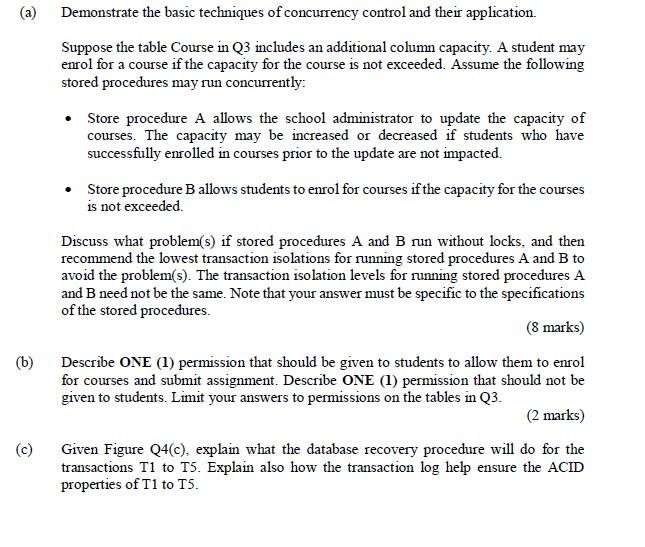
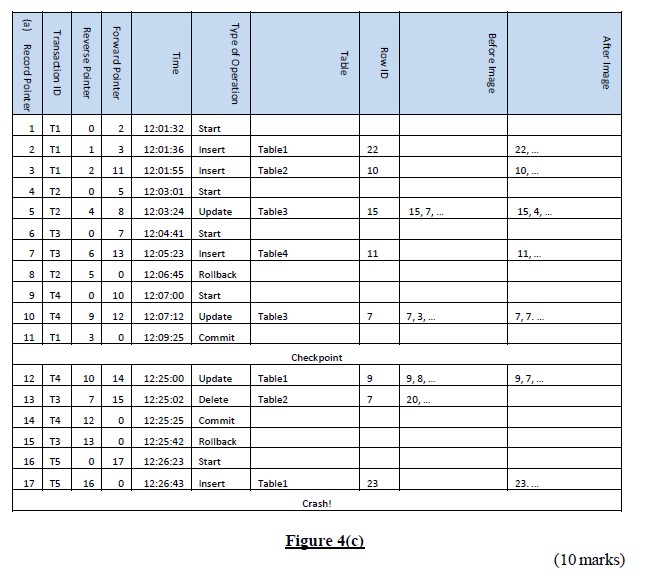
Demonstrate the basic techniques of concurrency control and their application. Suppose the table Course in Q3 includes an additional column capacity. A student may enrol for a course if the capacity for the course is not exceeded. Assume the following stored procedures may run concurrently: - Store procedure A allows the school administrator to update the capacity of courses. The capacity may be increased or decreased if students who have successfully enrolled in courses prior to the update are not impacted. - Store procedure B allows students to enrol for courses if the capacity for the courses is not exceeded. Discuss what problem(s) if stored procedures A and B run without locks, and then recommend the lowest transaction isolations for running stored procedures A and B to avoid the problem(s). The transaction isolation levels for running stored procedures A and B need not be the same. Note that your answer must be specific to the specifications of the stored procedures. (8 marks) Describe ONE (1) permission that should be given to students to allow them to enrol for courses and submit assignment. Describe ONE (1) permission that should not be given to students. Limit your answers to permissions on the tables in Q3. ( 2 marks) Given Figure Q4(c), explain what the database recovery procedure will do for the transactions T1 to T5. Explain also how the transaction log help ensure the ACID properties of T1 to T5. =
Step by Step Solution
There are 3 Steps involved in it

Get step-by-step solutions from verified subject matter experts
 Study Help